COMING SOON! VENUS-JUPITER CONJUNCTION: For the past few weeks, Jupiter has been hiding behind the sun. In November, the giant planet will emerge from the glare and race into the pre-dawn sky for a spectacular conjunction with Venus. At closest approach on Nov. 13th, the two bright worlds will be a breathtaking 0.3 degrees apart--so close that you can hide them together behind an outstretched pinky finger. Mark your calendar. Sky maps: Nov. 12, 13, 14.


MOON HALO ALERT: The Moon is waxing full, and there's an autumnal chill in the air. That means it's time to be alert for icy Moon halos. Paul Martini photographed this specimen from Bluff, Utah, on Oct. 30th:

Bluff is the gateway to Utah's Bears Ears National Monument and the Valley of the Gods, where wind- and rain-sculpted sandstone formations jut beautifully out of the ground, framed in Martini's photo by the pale halo.
Moon halos are created by ice crystals in high clouds, which catch rays of moonlight and bend them into a 22o ring. Bright full Moons are great at making these halos--and the next full Moon is only days away. After sunset on Nov. 3rd, the Beaver Moon will rise in the east, making halos and other atmospheric figures in the night sky. Submit your photos here.
Realtime Space Weather Photo Gallery
HERE COMES THE SOLAR WIND: A hole has opened in the sun's atmosphere, and it is spewing a stream of solar wind toward Earth. Estimated time of arrival: Nov. 2nd. This image, based on data from NASA's Solar Dynamics Observatory, shows the structure facing Earth on Oct. 30th:

This is a "coronal hole," a region where the sun's magnetic field opens up and allows solar wind to escape. Gaseous material is emerging faster than 600 km/s. The southern orientation of the crack could cause the solar wind stream to hit Earth off-center, mitigating its effect; although this is not yet certain.
NOAA forecasters say that the leading edge of the solar wind stream may contain a shockwave-like structure called a CIR (co-rotating interaction region). CIRs are transition zones between slow- and fast-moving solar wind. They contain density gradients and enhanced magnetic fields that often do a good job sparking auroras. As a result, Arctic sky watchers might see Northern Lights mixed with nearly-full moonlight on Nov. 2-3. Free: Aurora Alerts.
ROSE QUARTZ CRYSTAL ECLIPSE PENDANTS: On Aug. 21st during the Great American Solar Eclipse, the students of Earth to Sky Calculus launched 11 space weather balloons from the path of totality. They aimed to photograph the Moon's shadow from the stratosphere--and they succeeded. As a fundraiser, some of the balloons carried jewelry, such as this rose quartz crystal pendant, shown entering the Moon's shadow more than 90,000 feet above eastern Oregon:
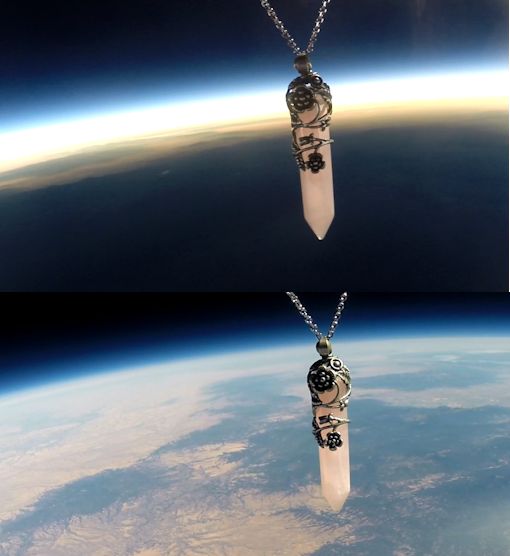
During the 2.5 hour flight, the pendants were wrapped in the Moon's shadow for more than two minutes, experiencing a spooky darkness colder than -50 C.
You can have one for $169.95. Each crystal pendant comes with a unique gift card showing the jewelry passing through the Moon's shadow and floating at the top of Earth's atmosphere. The interior of the card tells the story of the flight and confirms that this gift has been to the edge of space and back again.
Far Out Gifts: Earth to Sky Store
All proceeds support hands-on STEM education