SOLAR WIND TO GRAZE EARTH: A stream of solar wind flowing from a hole in the sun's atmosphere is expected to graze Earth's magnetic field on Nov. 2-3, passing mainly to the south of our planet. The glancing pressure of the gaseous stream could cause magnetic unrest around the poles. Arctic sky watchers should be alert for auroras mixed with bright moonlight. Free: Aurora Alerts.

SOLAR MINIMUM RETURNS: Today the sunspot number is zero as the sun resumes its transition to Solar Minimum. Images from NASA's Dynamics Observatory show no dark cores on the face of the sun:

This development continues a years-long trend of decreasing sunspot numbers -- with a notable interruption in September 2017, which brought a surprising outburst of large sunspots and intense solar flares. The disappearance of sunspots signals a weakening of the sun's magnetic field and a change in the character of space weather. During Solar Minimum, space weather is dominated by solar wind streams and cosmic rays, not sunspots and solar flares. Bonus: Solar Minimum auroras are gorgeous.
MOON HALO ALERT: The Moon is waxing full, and there's an autumnal chill in the air. That means it's time to be alert for icy Moon halos. Paul Martini photographed this specimen from Bluff, Utah, on Oct. 30th:

Bluff is the gateway to Utah's Bears Ears National Monument and the Valley of the Gods, where wind- and rain-sculpted sandstone formations jut beautifully out of the ground, framed in Martini's photo by the pale halo.
Moon halos are created by ice crystals in high clouds, which catch rays of moonlight and bend them into a 22o ring. Bright full Moons are great at making these halos--and the next full Moon is only days away. After sunset on Nov. 3rd, the Beaver Moon will rise in the east, making halos and other atmospheric figures in the night sky. Submit your photos here.
Realtime Space Weather Photo Gallery
THIS WATCH FLEW TO SPACE ... AND KEPT ON TICKING: On Aug. 21, 2017, during the Great American Solar Eclipse, the students of Earth to Sky Calculus launched 11 space weather balloons from the path of totality. They soared into the stratosphere, photographing the shadow of the Moon more than 100,000 feet above Earth's surface. As a fundraiser, one of the balloons carried this wristwatch:
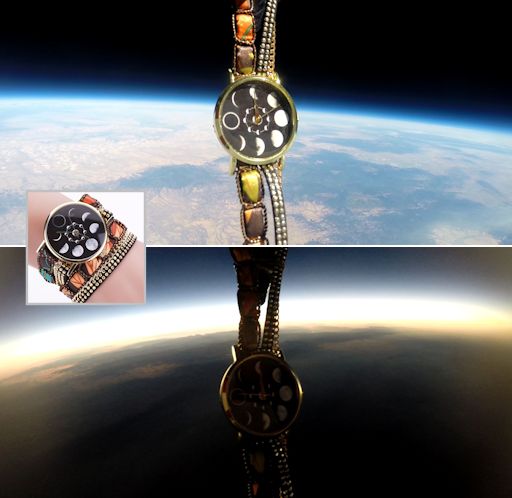
With the sun, Earth, and Moon perfectly aligned, the watch entered the space-cold shadow of the Moon … and kept on ticking! Watch the video. It survived temperatures lower than -49 C and cosmic ray dose rates more than 100 times sea level.
You can have one for $99.95. Each timepiece comes with a unique gift card showing the watch floating at the top of Earth's atmosphere and touching the shadow of the Moon. The interior of the card tells the story of the flight and confirms that this gift has been to the edge of space and back again.
Far Out Gifts: Earth to Sky Store
All proceeds support hands-on STEM education