SOLAR SECTOR BOUNDARY CROSSING: On Nov. 6th, Earth will cross a fold in the heliospheric current sheet--a vast wavy structure in interplanetary space separating regions of opposite magnetic polarity. This is called a "solar sector boundary crossing," and it could trigger geomagnetic activity around Earth's poles. Arctic sky watchers should be alert for auroras when the crossing occurs. Free: Aurora Alerts.
A METEOR MELTS AWAY: On the night of Oct. 26th, sky watchers in Japan witnessed a fireball tearing through the belt of Orion. "It was yellow and very bright," reports Yasushi Aoshima, who captured the dramatic disintegration in a series of rapid-fire photos. Click to watch the meteor melt away:

The swirling wisps in Aoshima's photos are the meteoroid's smokey remains, stretched and twisted by high altitude winds in the upper atmosphere. "I classify this as a 'melting-away type meteor,' says Aoshima.
Another group in Japan, the SonotaCo Meteor Network, used images from multiple cameras to calculate the meteoroid's orbit. They found that it came from beyond the orbit of Mars, a random piece of rocky space debris in the Asteroid Belt. Possibly nudged out of its orbit by the gravity of Jupiter or a collision with a neighboring meteoroid, it fell toward Earth and made a beautiful yellow fireball over Japan.
More fireballs are in the offing. Right now, Earth is passing through a broad, sparse stream of debris from Comet Encke, source of the annual Taurid meteor shower. Taurid meteor rates are typically low, only a handful per hour, but the shower compensates for that by being rich in fireballs. Encke's gravelly debris tends to produce beautifully bright meteors like the one Aoshima recorded on Oct. 26th. The northern branch of the Taurid meteor shower peaks on Nov. 10-11.
Realtime Space Weather Photo Gallery
AURORAS MIX WITH MOONLIGHT: Some photographers worry that bright moonlight will spoil their aurora photos. "Not last night," says Chad Blakley of Abisko, Sweden. "The full Moon illuminated our snowy landscape and made a beautiful moonbow beneath the aurora borealis." The Lights over Lapland automated webcam captured the scene:

"It was a spectacular sight as the the auroras and the moonbow mirrored each other's shape almost perfectly," he says. Moonbows (lunar rainbows) form when bright moonlight bounces in and out of falling raindrops. "It had been raining earlier in the evening, and there were still some water droplets in the air when the clouds parted to reveal the auroras," says Blakley. "It was a perfect mix!"
THIS WATCH FLEW TO SPACE ... AND KEPT ON TICKING: On Aug. 21, 2017, during the Great American Solar Eclipse, the students of Earth to Sky Calculus launched 11 space weather balloons from the path of totality. They soared into the stratosphere, photographing the shadow of the Moon more than 100,000 feet above Earth's surface. As a fundraiser, one of the balloons carried this wristwatch:
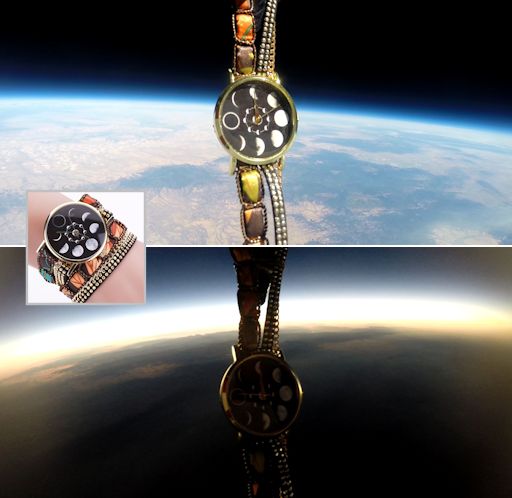
With the sun, Earth, and Moon perfectly aligned, the watch entered the space-cold shadow of the Moon … and kept on ticking! Watch the video. It survived temperatures lower than -49 C and cosmic ray dose rates more than 100 times sea level.
You can have one for $79.95. Each timepiece comes with a unique gift card showing the watch floating at the top of Earth's atmosphere and touching the shadow of the Moon. The interior of the card tells the story of the flight and confirms that this gift has been to the edge of space and back again.
Far Out Gifts: Earth to Sky Store
All proceeds support hands-on STEM education