GEOMAGNETIC STORM PREDICTED (G1-CLASS): NOAA forecasters say there is a 45% chance of polar geomagnetic storms on Nov. 7th, increasing to 60% on Nov. 8th as Earth enters a stream of fast-moving solar wind. The gaseous material is flowing from a hole in the sun's atmosphere. Isolated periods of G1-class storming will likely spark bright naked-eye auroras around the Arctic circle and photographic auroras in northern-tier US States from Maine to Washington. Free: Aurora Alerts.


SAILING UNDER THE AURORAL OVAL: The sun was absolutely blank (no sunspots) on Nov. 5th, and NOAA classified solar activity as "very low." So what happened last night over the Barents Sea? Alan Dyer was onboard the Norwegian cruise ship Nordlys when he saw a bright green band of light:

"Geomagnetic activity was negligible when I took this picture," says Dyer. "The planetary K-index was actually 0. Fortunately, we were sailing underneath Earth's auroral oval."
The auroral oval is a ring of light circling the north magnetic pole (there's one just like it around the south pole). It is always flickering with green auroras as solar wind gently buffets Earth's magnetic field--no geomagnetic storm required. The diameter of the oval waxes and wanes with geomagnetic activity. Dyer's ship was in the right place at the right time.
"We were off the coast of Norway at a latitude of 71° N near the port of Berlevåg," says Dyer. "Despite the glare of the nearly full Moon and lack of geomagnetic activity, the aurora still showed up! " Free: Aurora Alerts.
GLOBAL RADIATION MONITORING: Since 2015, Spaceweather.com and the students of Earth to Sky Calculus have conducted an ambitious, ongoing campaign to measure atmospheric radiation around our planet. So far we have flown more than 200 space weather balloons in four countries and a dozen US states. This plot shows sample atmospheric radiation profiles from Norway, Chile, California, Oregon and Washington:

The horizontal axis is altitude. Typical profiles range from ~sea level to more than 100,000 feet, deep inside the stratosphere. The vertical axis is X-ray/gamma-ray dose rate between 10 keV and 20 MeV. These energies span the range of medical X-ray machines and airport security scanners. Latitudes noted in parentheses are magnetic, not geographic.
Most of the radiation we detect comes from deep space in the form of cosmic rays--but we are always on the alert for other sources, too, such as atmospheric nuclear tests or leaks from power plants. Frequent flights allow us to not only map the geographical distribution of radiation, but also to monitor how it changes with time.
We're about to add a new country to our network: Mexico. On Nov. 8th we will travel to Mexico City to launch space weather balloons in collaboration with Prof. Juan Sumaya and students from the Universidad Autonoma del Estado de México. Stay tuned for reports from Mexico later this week.

Realtime Space Weather Photo Gallery
THIS WATCH FLEW TO SPACE ... AND KEPT ON TICKING: On Aug. 21, 2017, during the Great American Solar Eclipse, the students of Earth to Sky Calculus launched 11 space weather balloons from the path of totality. They soared into the stratosphere, photographing the shadow of the Moon more than 100,000 feet above Earth's surface. As a fundraiser, one of the balloons carried this wristwatch, and you can have one for $79.95.
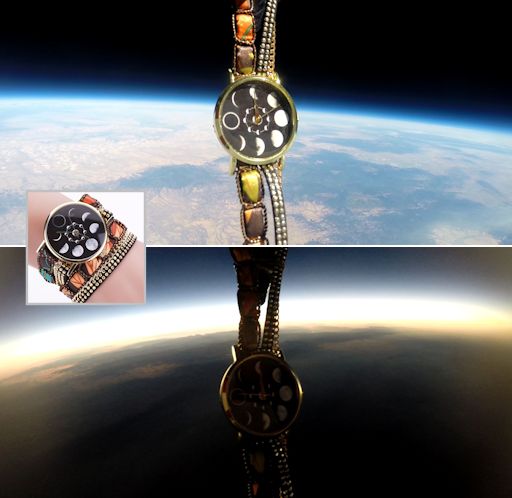
With the sun, Earth, and Moon perfectly aligned, the watch entered the space-cold shadow of the Moon … and kept on ticking! Watch the video. It survived temperatures lower than -49 C and cosmic ray dose rates more than 100 times sea level.
Each timepiece comes with a unique gift card showing the watch floating at the top of Earth's atmosphere and touching the shadow of the Moon. The interior of the card tells the story of the flight and confirms that this gift has been to the edge of space and back again.
Far Out Gifts: Earth to Sky Store
All proceeds support hands-on STEM education