SOLAR WIND, INCOMING: Today, a hole in the sun's atmosphere is facing Earth. An emerging stream of solar wind could reach our planet as early as Nov. 19th, with G1-class geomagnetic storms possible on Nov. 20th when Earth moves deeper into the gaseous material. Arctic sky watchers should be alert for auroras on Sunday and Monday. Free: Aurora Alerts.

ARCTIC METEOR TURNS NIGHT INTO DAY: On the evening of Nov. 16th, aurora tour guide Tony Bateman of northern Finland was indoors, warming up between auroras, when his surroundings began to vibrate. "There was a huge bang and the cottage shook violently," he reports. "At first I thought it was an earthquake. Or maybe a tree fell on the cottage roof! I walked outside and inspected the trees. Everything looked okay." A quick replay of his aurora webcam solved the mystery. "It was an incredible meteor," he says.
"It gave me goosebumps to see the night sky turn blue as the meteor exploded," he says. "Auroras and a fireball--what a night!"
This week Earth has been moving through a stream of debris from Comet Encke, source of the annual Taurid meteor shower. Taurids are rich in fireballs. However, the trajectory of this meteor suggests it was no Taurid.
It appears to have been a sporadic--that is, a random meteor from no particular comet. Every day, Earth is peppered with sporadic meteors from a diffuse swarm filling the inner solar system. NASA statistics show that sporadic fireballs as bright as Venus appear somewhere on Earth more than 100 times daily. Fireballs as bright as a quarter Moon occur once every ten days, and fireballs as bright as a full Moon once every few months or so. The Arctic fireball of Nov. 16th belongs in the rarest of those three categories--a lucky catch, indeed.
THE STRANGE FATE OF THE MEXICAN SPACE CORN: On Nov. 10th, Spaceweather.com and Earth to Sky Calculus joined forces with students and professors from the Universidad Autonoma del Estado de México for the first-ever space weather balloon flight over Mexico. An ear of local red corn went along for the ride. This delicious astrobiology experiment aimed to compare the growth rate and morphology of corn exposed to cosmic rays to that of corn left behind on Earth. The corn traveled to the stratosphere, absorbed a dose of cosmic rays 200x greater than on the ground below, and parachuted back to Earth.

Then something strange happened.
When the recovery team found the payload in the Mexican backcountry, the corn was gone! Footage from the payload's video camera revealed its fate. Shortly after the corn landed, a group of Mexican cowboys drove a herd of cattle and horses right by the payload. The horses were delighted to find the corn. But before they could eat it, a ranch dog darted in and grabbed the corn for himself.

Without knowing any of this, the recovery team, which reached the payload after dark, immediately suspected animal involvement in the kidnapping of the corn. Piles of horse poop near the payload were a pungent clue. So they scoured the grass around the payload and, amazingly, found dozens of kernels that had not been swallowed by the hasty culprit. The astrobiology experiment was saved!
Bonus: The balloon over Mexico carried more than corn. It also lofted an array of X-ray, gamma-ray, and neutron sensors to measure cosmic rays in the atmosphere. In the next few days we will share the results of that experiment, showing how atmospheric radiation over Mexico compares to that of the USA.
Realtime Space Weather Photo Gallery
CHRISTMAS GIFTS FROM SPACE: On Aug. 21st during the Great American Solar Eclipse, the students of Earth to Sky Calculus launched 11 space weather balloons from the path of totality. They aimed to photograph the Moon's shadow from the stratosphere--and they succeeded. As a fundraiser, some of the balloons carried jewelry, like this rose quartz pendant shown entering the Moon's shadow more than 90,000 feet above Oregon:
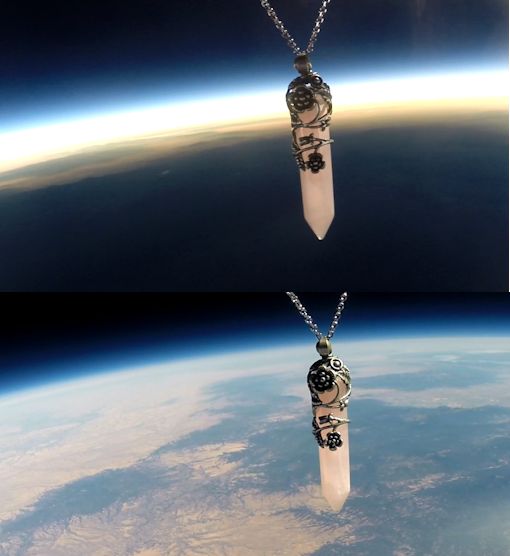
During the 2.5 hour flight, the pendants were wrapped in the Moon's shadow for more than two minutes, experiencing a spooky darkness colder than -50 C.
You can have one for $169.95. Each crystal pendant comes with a unique gift card showing the jewelry passing through the Moon's shadow and floating at the top of Earth's atmosphere. The interior of the card tells the story of the flight and confirms that this gift has been to the edge of space and back again.
Far Out Gifts: Earth to Sky Store
All proceeds support hands-on STEM education