SOLAR WIND, INCOMING: NOAA forecasters estimate a 40% chance of polar geomagnetic activity on Nov. 20th and 21st when a stream of solar wind is expected to make contact with our planet. The gaseous material is flowing from a hole in the sun's atmosphere:

This is a coronal hole, a region where the sun's magnetic field peels back and allows solar wind to escape. Flowing faster than 600 km/s (1.3 million mph), the emerging gas could cause G1-class geomagnetic storms when it reaches Earth. Arctic sky watchers should be alert for auroras in the nights ahead. Free: Aurora Alerts.

NEW ATMOSPHERIC RADIATION DATA: Last week's double launch of space weather balloons over Mexico and California was a success. The goal of our experiment was to measure cosmic rays in the atmosphere above both countries and compare the results. A first look at the data reveal big differences.

These curves show dose rate vs. altitude. They diverge rapidly above 15,000 feet, with radiation levels over central California typically 1.5 times higher than over Mexico. This means air travelers over California can expect to receive significantly greater doses of cosmic radiation compared to their counterparts flying south of the border. In both places, radiation levels reached a peak in the stratosphere. At those altitudes, dose rates were 60 times greater than sea level for Mexico, 90 times greater than sea level for California.
The reason for these differences is Earth's magnetic field which, generally speaking, provides greater shielding against cosmic rays near the equator (Mexico) than at mid-latitudes (California)
The radiation sensors onboard our helium balloons detect X-rays and gamma-rays in the energy range 10 keV to 20 MeV. These energies span the range of medical X-ray machines and airport security scanners. They trace secondary cosmic rays, the spray of debris created when primary cosmic rays from deep space hit the top of Earth's atmosphere.
Our payloads also carried neutron sensors. Stay tuned for updates next week as we continue our analysis of data from those detectors.
Realtime Space Weather Photo Gallery
CHRISTMAS GIFTS FROM SPACE: On Aug. 21st during the Great American Solar Eclipse, the students of Earth to Sky Calculus launched 11 space weather balloons from the path of totality. They aimed to photograph the Moon's shadow from the stratosphere--and they succeeded. As a fundraiser, some of the balloons carried jewelry, like this rose quartz pendant shown entering the Moon's shadow more than 90,000 feet above Oregon:
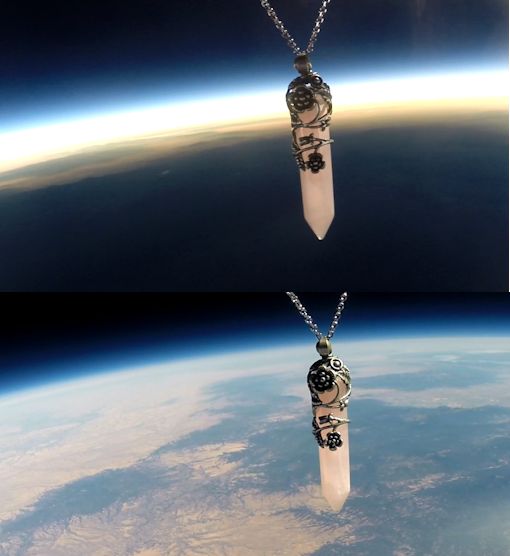
During the 2.5 hour flight, the pendants were wrapped in the Moon's shadow for more than two minutes, experiencing a spooky darkness colder than -50 C.
You can have one for $169.95. Each crystal pendant comes with a unique gift card showing the jewelry passing through the Moon's shadow and floating at the top of Earth's atmosphere. The interior of the card tells the story of the flight and confirms that this gift has been to the edge of space and back again.
Far Out Gifts: Earth to Sky Store
All proceeds support hands-on STEM education