CHANCE OF STORMS, TODAY AND TOMORROW: A stream of solar wind is approaching Earth. Estimated time of arrival: today. NOAA forecasters say there is a 40% chance of G1-class geomagnetic storms on Nov. 21st and 22nd as Earth moves through the gaseous material, which is flowing from a hole in the sun's atmosphere. Arctic sky watchers should be alert for auroras after local nightfall.Free: Aurora Alerts.


INTERSTELLAR ASTEROID "LIKE NOTHING SEEN BEFORE": In Oct. 2017, the Pan-STARRS 1 telescope in Hawai'i picked up a faint point of light moving across the sky. At first it appeared to be an ordinary asteroid--but astronomers quickly realized it was something entirely different. The hurtling object, since named "'Oumuamua," came from interstellar space. At the time of its discovery, 'Oumuamua had just swung around the sun. Telescopes around the world swiveled to observe it before it could leave the Solar System. Findings from those rapid observations were published in today's issue of Nature, and they reveal a very strange object indeed:
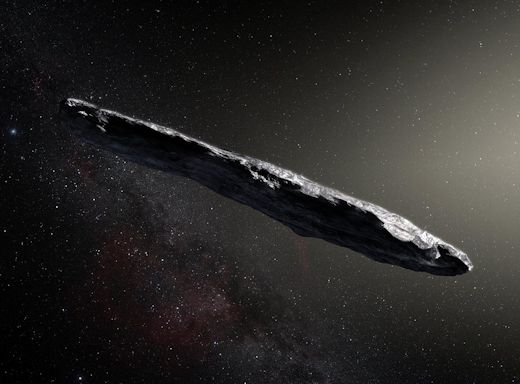
Above: an artist's concept of interstellar asteroid 'Oumuamua [more]
According to a European Southern Observatory (ESO) press release, 'Oumuamua is "like nothing seen before." It is red, made of dense rock or metal, and is shaped roughly like a giant cigar at least 400 meters long.
These are the findings of a team of astronomers led by Karen Meech (Institute for Astronomy, Hawai`i, USA) who combined images from the ESO's Very Large Telescope in Chile with other large telescopes. 'Oumuamua varies dramatically in brightness by a factor of ten as it spins on its axis every 7.3 hours. "This unusually large variation in brightness means that the object is highly elongated: about ten times as long as it is wide, with a complex, convoluted shape," says Meech.
The asteroid's dark red color is probably caused by cosmic rays irradiating its surface for millions of years in deep space. Cosmic rays have a similar coloring effect on asteroids and comets native to our outer Solar System.
Extrapolating 'Oumuamua's trajectory back in time, it seems to come from the direction of the star Vega. However, Vega itself moves and was not in the area when 'Oumuamua was last there ~300,000 years ago. 'Oumuamua may well have been wandering through the Milky Way, unattached to any star system, for hundreds of millions of years before its chance encounter with the Solar System.
Researchers estimate that interstellar asteroids similar to 'Oumuamua pass through the inner Solar System about once per year, but they are faint and so have been missed until now.Only recently have survey telescopes such as Pan-STARRS become powerful enough to discover them.
"We are continuing to observe this unique object," says team member Olivier Hainaut from the ESO in Garching, Germany. "And now that we have found the first interstellar rock, we are getting ready for the next ones!" Stay tuned.
NEW ATMOSPHERIC RADIATION DATA: Last week's double launch of space weather balloons over Mexico and California was a success. The goal of our experiment was to measure cosmic rays in the atmosphere above both countries and compare the results. A first look at the data reveal big differences.

These curves show dose rate vs. altitude. They diverge rapidly above 15,000 feet, with radiation levels over central California typically 1.5 times higher than over Mexico. This means air travelers over California can expect to receive significantly greater doses of cosmic radiation compared to their counterparts flying south of the border. In both places, radiation levels reached a peak in the stratosphere. At those altitudes, dose rates were 60 times greater than sea level for Mexico, 90 times greater than sea level for California.
The reason for these differences is Earth's magnetic field which, generally speaking, provides greater shielding against cosmic rays near the equator (Mexico) than at mid-latitudes (California)
The radiation sensors onboard our helium balloons detect X-rays and gamma-rays in the energy range 10 keV to 20 MeV. These energies span the range of medical X-ray machines and airport security scanners. They trace secondary cosmic rays, the spray of debris created when primary cosmic rays from deep space hit the top of Earth's atmosphere.
Our payloads also carried neutron sensors. Stay tuned for updates next week as we continue our analysis of data from those detectors.
Realtime Space Weather Photo Gallery
A CRYSTAL BALL IN THE STRATOSPHERE: For the first time ever, a crystal ball has visited the stratosphere. The students of Earth to Sky Calculus launched it on Oct. 19, 2017--a combination optics experiment and fundraiser. Watch the video as the crystal orb travels onboard a giant helium balloon 93,000 feet above Earth's surface, stretching, focusing, and inverting the incredible landscape of the Sierra Nevada mountains behind it:
This 800 gram crystal ball contains an embedded model of the Solar System, including the sun, eight planets and their moons. It makes an incredible gift for anyone interested in space.
We have flown only a small number of these heavyweight crystal balls. You can have one for $199. Each crystal ball comes with a unique gift card showing the item at the edge of space and telling the story of its flight. It also comes with a complementary crystal stand so you can display this unique keepsake on a desktop or shelf. QUANTITIES ARE LIMITED.
Far Out Gifts: Earth to Sky Store
All proceeds support hands-on STEM education