LONG-RANGE FORECAST: Mark your calendar. NOAA forecasters say there is a chance of moderately strong G2-class geomagnetic storms on Dec. 4th and 5th when a fast-moving stream of solar wind is expected to engulf Earth. Sky watchers in northern-tier US states from Maine to Washington may be able to see and photograph auroras. Free: Aurora Alerts.

SPOTLESS SUN SPARKS PINK AURORAS: On Nov. 22nd, the face of the sun was unblemished by sunspots, and NOAA classified solar activity as "very low." Nevertheless, the skies above Tromsø, Norway, exploded with a remarkable outburst of pink auroras. "Suddenly, the whole valley turned white (with a hint of pink)," says Frank Meissner, who witnessed and photographed the display. "It was over after about 20 seconds."
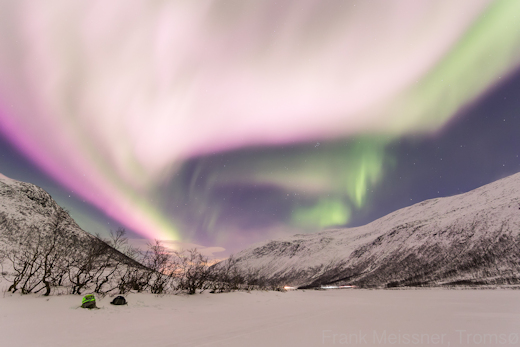
How bright was it? "The brightness of the auroras may be compared to the car lights in the background of my photo," points out Meissner.
In nearby Kvaløya, aurora tour guide Marianne Bergli witnessed a surge of pink that was, if anything, even more dramatic:
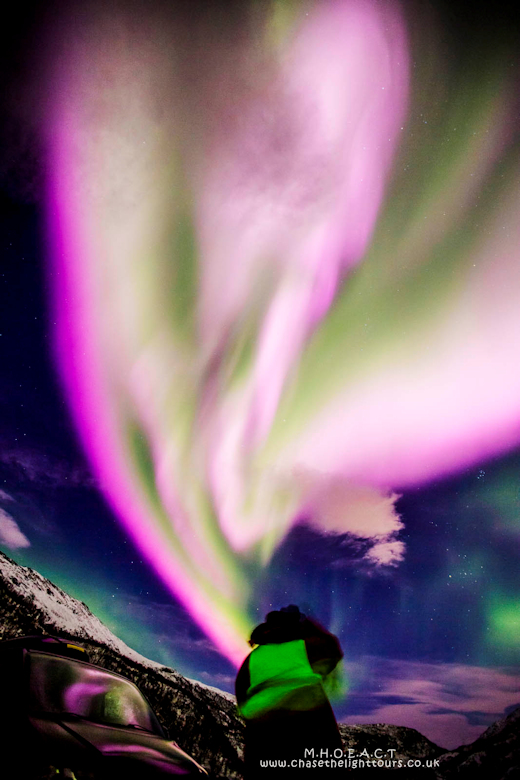
"Ironically, our guests stopped taking pictures," says Bergli. "They were awestruck and frozen to the spot by the incredible pink and green lights overhead."
This outburst was powered by a stream of solar wind flowing from a hole in the sun's atmosphere. Such holes are common during Solar Minimum, and they require no sunspots to form. That's why auroras continue throughout the 11-year solar cycle.

The pink color of the outburst tells us something interesting about the solar wind on Nov. 22nd: it seems to have been unusually penetrating. Most auroras are green–a verdant glow caused by energetic particles from space hitting oxygen atoms 100 km to 300 km above Earth's surface. Pink appears when the energetic particles descend lower than usual, striking nitrogen molecules at the 100 km level and below.
In recent winters, big displays of pink and white auroras have coincided with spotless suns often enough to make observers wonder if there is a connection. If so, more outbursts are in the offing as the sun continues its plunge toward a deep Solar Minimum. Stay tuned for pink!
A CRYSTAL BALL IN THE STRATOSPHERE: For the first time ever, a crystal ball has visited the stratosphere. The students of Earth to Sky Calculus launched it on Oct. 19, 2017--a combination optics experiment and fundraiser. Watch the video as the crystal orb travels onboard a giant helium balloon 93,000 feet above Earth's surface, stretching, focusing, and inverting the incredible landscape of the Sierra Nevada mountains behind it:
This 800 gram crystal ball contains an embedded model of the Solar System, including the sun, eight planets and their moons. It makes an incredible gift for anyone interested in space.
We have flown only a small number of these heavyweight crystal balls. You can have one for $199. Each crystal ball comes with a unique gift card showing the item at the edge of space and telling the story of its flight. It also comes with a complementary crystal stand so you can display this unique keepsake on a desktop or shelf. QUANTITIES ARE LIMITED.
Far Out Gifts: Earth to Sky Store
All proceeds support hands-on STEM education
UNUSUAL MAGNETIC FILAMENT: NASA's Solar Dynamics Observatory is monitoring an unusual filament of magnetism on the sun. This image, taken on Nov. 22nd, shows where magnetic forces are holding a massive curl of dense plasma just above the stellar surface:

Magnetic filaments on the sun are not uncommon. Usually they are linear, stretching in only one direction. This one, however, curls back on itself, circumscribing a region more than 280,000 km in diameter. The unusual architecture of the region may undermine its stability. Magnetic fields that criss-cross, like mismatching ends of an incomplete circle, can explode--a process called "magnetic reconnection." Any eruptions this week would likely be Earth-directed.
The scale of this filament makes it an easy target for backyard solar telescopes. Monitoring is encouraged.