GEOMAGNETIC STORM PREDICTED (G1-CLASS): NOAA forecasters say there is a 50% chance of G1-class geomagnetic storms on Nov. 29th when a CME is expected to sideswipe Earth's magnetic field. The solar storm cloud was hurled in our approximate direction by an exploding magnetic filament on Nov. 25th. Arctic sky watchers should be alert for auroras when the CME arrives. Free: Aurora Alerts.

WHAT IS HAPPENING TO THIS COMET? Just beyond the orbit of Mars, something is happening to Comet PanSTARRS (C/2016 R2). Astrophotographer Michael Jäger has been monitoring the comet from his private observatory in Gamlitz, Austria. "This blue-filtered image taken on Nov. 22nd shows multiple jets near the nucleus and a big blue cloud downstream in the tail," he says.
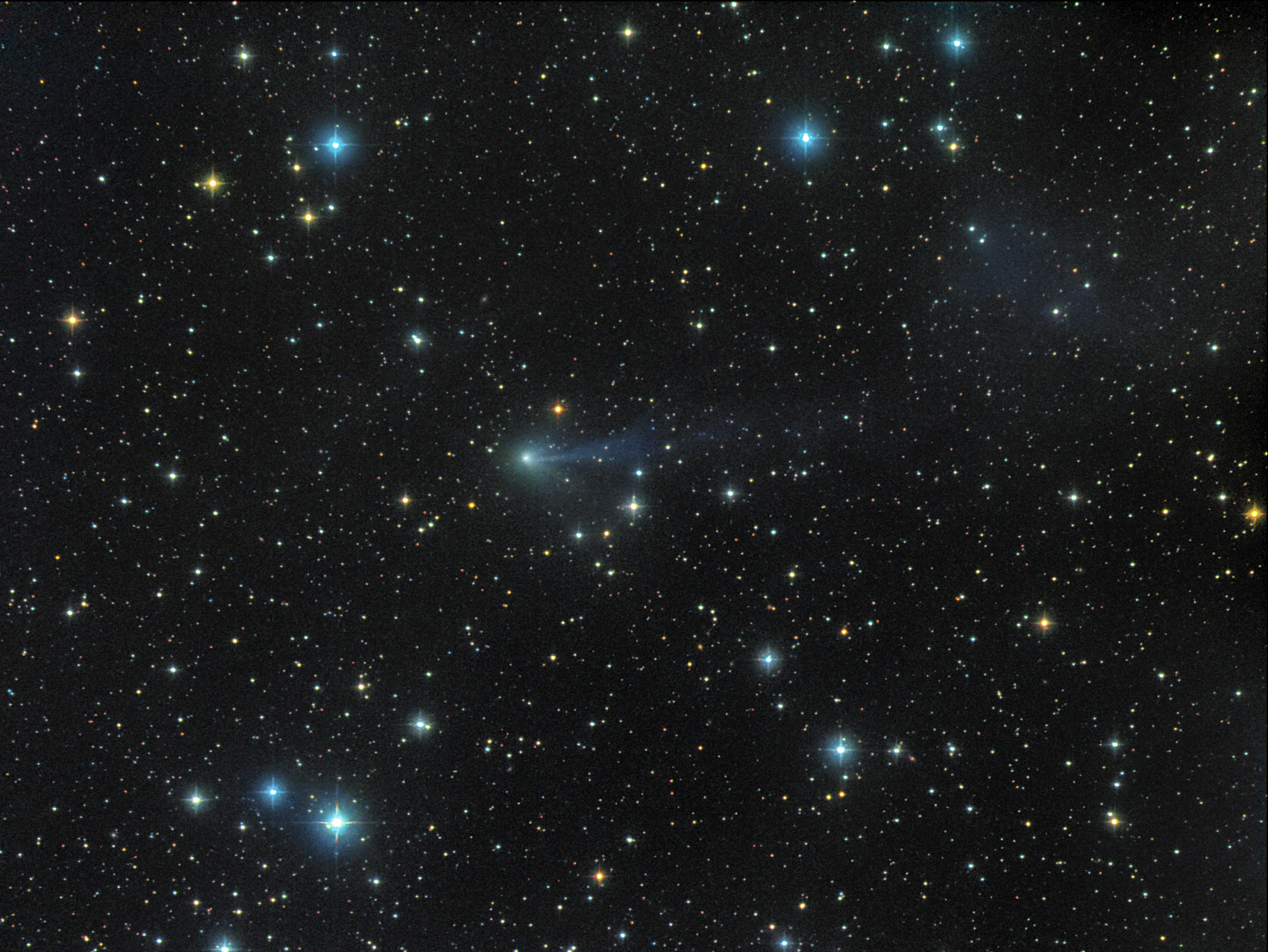
The comet was discovered in August 2016 by the PanSTARRS telescope on the summit of the Haleakalā volcano in Maui. The primary mission of the PanSTARRS sky survey is to detect near-Earth asteroids that threaten our planet. In the process, it sweeps up plenty of comets, variable stars and supernovas.
The tail of Comet PanSTARRS is so dynamic, it is changing visibly during a single observing session. Jäger made this animation using frames taken in less than a few hours on Nov. 22nd:

It shows gaseous blobs moving away from the nucleus as well as apparent activity in the comet's inner jets. What's happening? Sunlight could be vaporizing fragile ices in the comet's core, exposing caverns of frozen gas which are puffing clouds into space. Or the comet might be experiencing a magnetic storm. Magnetic storms in comet tails have been observed before--most famously in 2007 when NASA's STEREO spacecraft watched a CME crash into Comet Encke. Encke's tail was ripped into forms akin to those Jäger is seeing in Comet PanSTARRS (C/2016 R2).
Comet PanSTARRS (C/2016 R2) is currently moving through the constellation Orion, shining with the integrated brightness of an 11th magnitude star. This means it is a suitable target for large backyard telescopes equipped with modern deep-sky cameras. Experienced observers like Jäger may be able to see more action in the nights ahead. Monitoring is encouraged!
Realtime Space Weather Photo Gallery
A CRYSTAL BALL IN THE STRATOSPHERE: For the first time ever, a crystal ball has visited the stratosphere. The students of Earth to Sky Calculus launched it on Oct. 19, 2017--a combination optics experiment and fundraiser. Watch the video as the crystal orb travels onboard a giant helium balloon 93,000 feet above Earth's surface, stretching, focusing, and inverting the incredible landscape of the Sierra Nevada mountains behind it:
This 800 gram crystal ball contains an embedded model of the Solar System, including the sun, eight planets and their moons. It makes an incredible gift for anyone interested in space.
We have flown only a small number of these heavyweight crystal balls. You can have one for $199. Each crystal ball comes with a unique gift card showing the item at the edge of space and telling the story of its flight. It also comes with a complementary crystal stand so you can display this unique keepsake on a desktop or shelf. QUANTITIES ARE LIMITED.
Far Out Gifts: Earth to Sky Store
All proceeds support hands-on STEM education