GEOMAGNETIC STORM PREDICTED (G2-CLASS): A high-speed stream of solar wind is approaching Earth, and NOAA forecasters say there is a 75% chance of polar geomagnetic storms when it arrives on Dec. 4th and 5th. Periods of moderately-strong G2-class storming could send Northern Lights spilling across the Canadian border into upper-tier US states; interfere with shortwave radio propagation at high latitudes; and confuse wildlife that use magnetic cues for navigation. Free: Aurora Alerts.

SPACE STATION AND SUPERMOON: Last night's full Moon was a "supermoon", almost 8% wider and 16% brighter than an average full Moon. Thomas K. T. Fok was watching the oversized orb rise above Hong Kong when a black silhouette flitted across the great gray disk. It was the International Space Station:
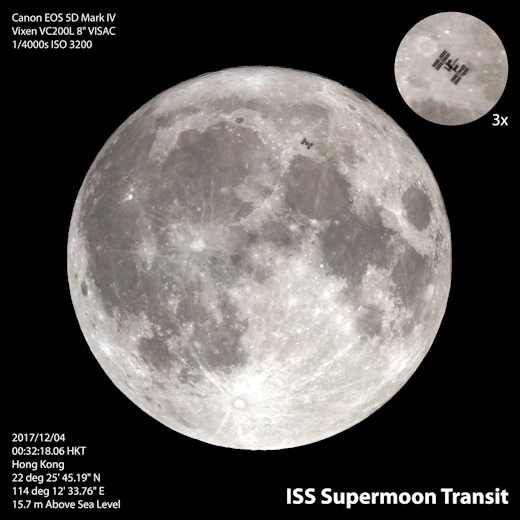
"The ISS crossed the Moon in a split second [as predicted by Calsky]," says Fok. "I captured the transit using an 8-inch telescope and a Canon EOS 5D digital camera at the Ho Koon Nature Education cum Astronomical Centre."
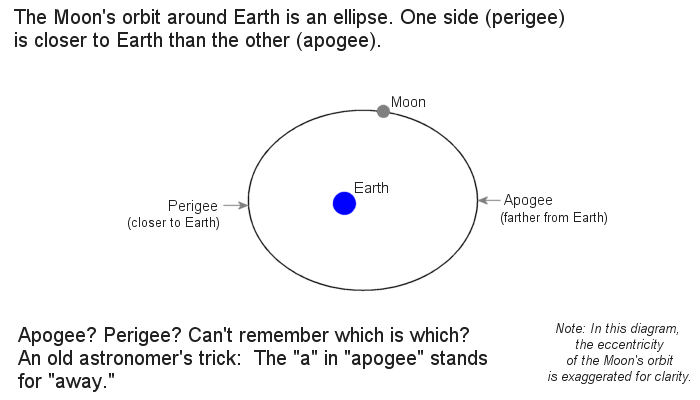
The moon's extra diameter made an ISS transit slightly more likely than usual. Full moons vary in size because the Moon's orbit is not a circle, it's an ellipse: diagram. One side of the Moon's orbit, called "perigee," is 50,000 km closer to Earth than the other side, "apogee." Last night's Moon became full only 16 hours away from perigee, closer than any other full Moon of 2017.
More amazing moonshots may be found in the real time photo gallery:
Realtime Space Weather Photo Gallery
STRANGE ARCTIC RAINBOW: Rainbows usually require liquid water. Droplets falling out of the sky intercept beams of sunlight, reflecting them back in a colorful spray of red, green, and blue. Yesterday, Valtteri Immonen saw such a rainbow over Muonio, Finland, but something was missing: the raindrops. "It was -6 degrees C, no rain and no snowfall," he says. "Yet there was a huge rainbow across the sky."
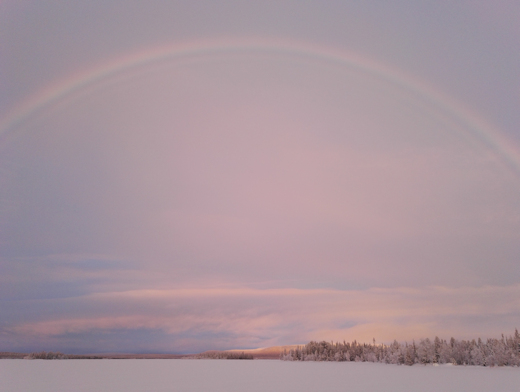
"I have never seen a rainbow during the winter and I didn't even know that it is possible for them to form when the temperature is below 0 degrees Celsius," he marvels.
Atmospheric optics expert Les Cowley says that raindrops must have been present: "The rainbow's appearance, narrow with a supernumerary, says that it was produced with reasonable size water drops, perhaps about 0.5 mm in diameter. I surmise that the there was high level precipitation that did not necessarily reach the ground. The drops could also have been supercooled below the normal freezing point of water," he speculates.
Supercooled raindrops can form when droplets of liquid water fall through layers of subfreezing air. Droplets containing specks of dust or even microbes readily freeze as ice crystals form around the impurities. But when rain droplets are especially pure, they can remain in a liquid state even when the temperature drops below freezing.
Last winter, supercooled rainbows were sighted in the Arctic as strange weather gripped the poles. Immonen's photo suggests that more of these rare rainbows may be in the offing. Stay tuned.
CHRISTMAS ORNAMENTS FROM SPACE: On Nov. 2, 2017, the students of Earth to Sky Calculus launched a space weather balloon to the stratosphere. These kids do science, and the payload of their balloon carried an array of cosmic ray sensors to measure radiation coming from deep space. A basket of Christmas ornaments went along for the ride. Watch the video to see what happened:
The ornaments were created by student artist Dana Wilcher, a longtime member of Earth to Sky Calculus. Each year she creates a limited batch of "space ornaments" to raise money for our balloon program.
You can have one for $59.95. Each ornament comes with a unique gift card showing the work of art floating at the top of Earth's atmosphere. The interior of the card tells the story of the flight and confirms that the ornament has been to the edge of space and back again. It *also* comes with a hanging mini-photo of the ornament in the stratosphere. Hang it on your tree alonside the actual ornament to impress holiday visitors!
Far Out Gifts: Earth to Sky Store
All proceeds support hands-on STEM education