WHEN WILL THE NEXT STREAM OF SOLAR WIND ARRIVE? Answer: Dec. 11th or 12th. The gaseous material is flowing from a canyon-like hole in the sun's atmosphere. Minor geomagnetic storms and Arctic auroras are likely when the fast-moving solar wind reaches Earth. Free: Aurora Alerts.

DIAMOND DUST SKI HALOS: Ski resorts are some of the best places to see sun halos--rings and pillars of light that surround the sun when ice crystals fill the air. The most sublime halos are caused by jewel-like crystals called "diamond dust." On Dec. 7th, Kameron Barge was skiing in Whitefish, Montana, when he saw these specimens:

"As we rode the chair down into the clouds today, we begin seeing all sorts of halos, and sundogs!" says Barge. "It was an unforgettable display."
Ordinary sun halos are caused by ice crystals floating in high cirrus clouds. "Ski halos," on the other hand, are formed by ice crystals near the ground, kicked into the air by the action of skis and snow-making machines. A close look at Barge's picture shows specks of light in the air. Those are the glittering crystals of diamond dust which make these halos so beautiful.

Barge documented a rare variety of forms: a 22-degree halo, sundogs, sub-sundogs, a sub-sun, a lower sun pillar, an upper tangent arc, a 46-degree halo, a circumzenithal arc, and a partial parhelic circle--all sculpted from sunlight by floating diamond dust.
If you're on the slopes this weekend, and the sun dips behind a cloud of ice, be alert for "ski halos." They can make your day.
ATMOSPHERIC RADIATION IS INCREASING: Since the spring of 2015, Spaceweather.com and the students of Earth to Sky Calculus have been flying balloons to the stratosphere over California to measure cosmic rays. Soon after our monitoring program began, we quickly realized that radiation levels are increasing. Why? The main reason is the solar cycle. In recent years, sunspot counts have plummeted as the sun's magnetic field weakens. This has allowed more cosmic rays from deep space to penetrate the solar system. As 2017 winds down, our latest measurements show the radiation increase continuing apace--with an interesting exception, circled in yellow:
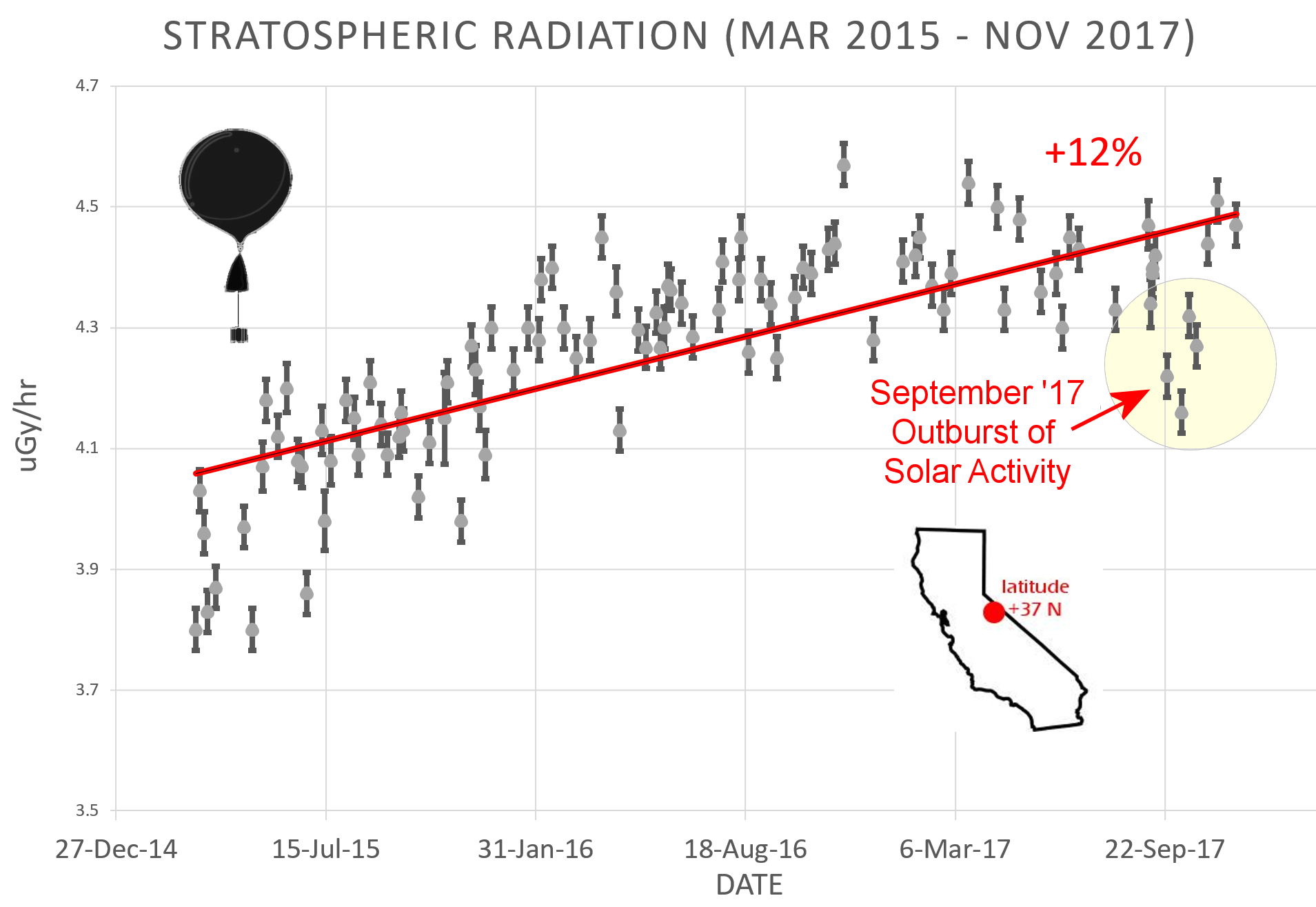
In Sept. 2017, the quiet sun surprised space weather forecasters with a sudden outburst of explosive activity. On Sept. 3rd, a huge sunspot appeared. In the week that followed, it unleashed the strongest solar flare in more than a decade (X9-class), hurled a powerful CME toward Earth, and sparked a severe geomagnetic storm (G4-class) with Northern Lights appearing as far south as Arkansas. During the storm we quickened the pace of balloon launches and found radiation dropping to levels we hadn't seen since 2015. The flurry of solar flares and CMEs actually pushed some cosmic rays away from Earth.

Interestingly, after the sun's outburst, radiation levels in the stratosphere took more than 2 months to fully rebound. Now they are back on track, increasing steadily as the quiet sun resumes its progress toward Solar Minimum. The solar cycle is not expected to hit rock bottom until 2019 or 2020, so cosmic rays should continue to increase, significantly, in the months and years ahead. Stay tuned for updates as our balloons continue to fly.
Technical note: The radiation sensors onboard our helium balloons detect X-rays and gamma-rays in the energy range 10 keV to 20 MeV. These energies, which span the range of medical X-ray machines and airport security scanners, trace secondary cosmic rays, the spray of debris created when primary cosmic rays from deep space hit the top of Earth's atmosphere.
Realtime Space Weather Photo Gallery
FAR OUT CHRISTMAS GIFTS: Helium doesn't pay for itself. That's why the students of Earth to Sky Calculus fly cool things to the edge of space on board their cosmic ray balloons--so you can buy them in our Christmas Store:

Crystal balls, solar eclipse pendants, pyramids, pickles and much more: they've all been to the edge of space and back, and they all make great holiday gifts. Every dollar spent in the store supports STEM education and high-altitude space weather research. Shop now!
Far Out Gifts: Earth to Sky Store
All proceeds support hands-on STEM education