CHANCE OF STORMS TOMORROW: NOAA forecasters say there is a 35% chance of G1-class geomagnetic storms on Dec. 11th and 12th when a stream of solar wind reaches Earth. The gaseous material is flowing from a canyon-like hole in the sun's atmosphere. Arctic sky watchers should be alert for auroras. Free: Aurora Alerts.


A ROCK COMET APPROACHES EARTH: On Dec. 16, 2017, an unusual space rock named "3200 Phaethon" will fly past Earth only 10.3 million km away. It's the closest approach in 40 years for this large object. Measuring 5 km across, 3200 Phaethon is half the size of the asteroid that wiped out the dinosaurs 65 million years ago. There's no danger of a collision, but it is close enough to see through backyard telescopes. On Dec. 8th, The Astronomy Club of the Sing Yin Secondary School in Hong Kong video-recorded 3200 Phaethon using a 4-inch refractor:
<
"We observed 3200 Phaethon, the parent body of the Geminid meteor shower, from the basketball court of our school campus," the club reports. "Our school is located close to the city center where the visual limiting magnitude is about 2 to 3. Despite the glare, we were able to record the motion of this object against the background stars for about 1 hour." (For others who wish to do this, Bob King of Sky & Telescope has written an excellent set of observing tips.)
What is 3200 Phaethon? Astronomers have struggled with this question for years. When 3200 Phaethon was discovered in 1983 by NASA's IRAS satellite, astronomers quickly realized that they had found the source of the annual Geminid meteor shower. The orbit of 3200 Phaethon was such a close match to that of the Geminid debris stream, no other conclusion was possible. Yet here was a puzzler: Meteor showers are usually caused by comets. Everything about 3200 Phaethon suggests it is an asteroid.
In fact, 3200 Phaethon resembles main belt asteroid Pallas so much, it could well be a 5-kilometer chip off that 544 km block. If 3200 Phaethon broke apart from asteroid Pallas long ago, as some researchers believe, then Geminid meteoroids might be debris from the breakup:

There is, however, another possibility: Perhaps 3200 Phaethon is a "rock comet." A "rock comet" is, essentially, an asteroid that comes very close to the sun--so close that solar heating scorches plumes of dust right off its rocky surface. Rock comets could thus grow comet-like tails made of gravely debris that produce meteor showers on Earth. 3200 Phaethon may well be this kind of object. It comes extremely close to the sun, only 0.14 AU away, less than half the distance of Mercury, so hot that lead would flow like water across its sun-blasted surface.
This year's close approach of 3200 Phaethon to Earth happens only days away from the peak of the Geminid meteor shower on Dec. 13th and 14th. Forecasters don't expect to see any extra Geminids, however. Meteoroids leaving 3200 Phaethon need time to drift over to the orbit of our planet. "It would take at least another revolution around the sun before material from this flyby could encounter Earth - probably longer," explains Bill Cooke of NASA's Meteoroid Environment Center.
Fortunately, the Geminids don't need any help. As usual, more than 100 meteors per hour are expected on the nights of Dec. 13th and 14th when Earth crosses the debris stream. Stay tuned for more information about that as peak night approaches.
Realtime Space Weather Photo Gallery
FAR OUT CHRISTMAS GIFTS: Helium doesn't pay for itself. That's why the students of Earth to Sky Calculus fly cool things to the edge of space onboard their cosmic ray balloons--so you can buy them in our Christmas Store:
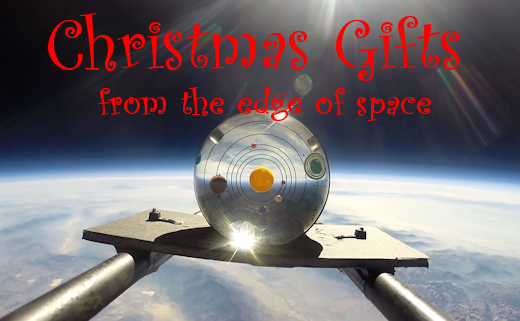
Crystal balls, solar eclipse pendants, pyramids, pickles and much more: they've all been to the edge of space and back, and they all make great holiday gifts. Every dollar spent in the store supports STEM education and high-altitude space weather research. Shop now!
Far Out Gifts: Earth to Sky Store
All proceeds support hands-on STEM education
DIAMOND DUST SKI HALOS: Ski resorts are some of the best places to see sun halos--rings and pillars of light that surround the sun when ice crystals fill the air. The most sublime halos are caused by jewel-like crystals called "diamond dust." On Dec. 7th, Kameron Barge was skiing in Whitefish, Montana, when he saw these specimens:
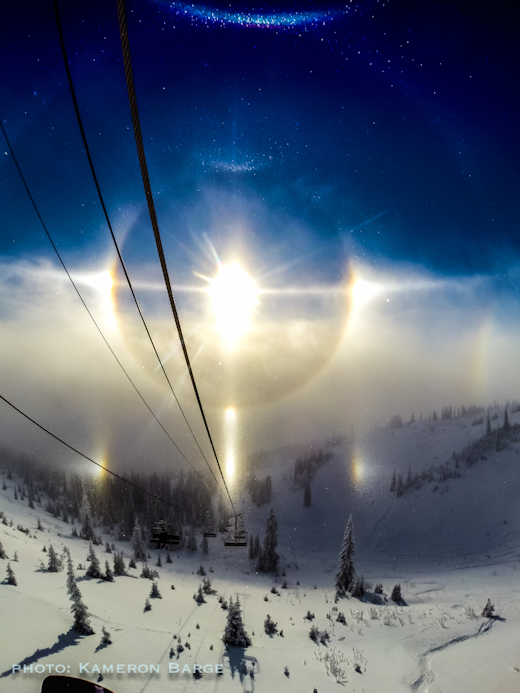
"As we rode the chair down into the clouds today, we begin seeing all sorts of halos, and sundogs!" says Barge. "It was an unforgettable display."
Ordinary sun halos are caused by ice crystals floating in high cirrus clouds. "Ski halos," on the other hand, are formed by ice crystals near the ground, kicked into the air by the action of skis and snow-making machines. A close look at Barge's picture shows specks of light in the air. Those are the glittering crystals of diamond dust which make these halos so beautiful.

Barge documented a rare variety of forms: a 22-degree halo, sundogs, sub-sundogs, a sub-sun, a lower sun pillar, an upper tangent arc, a 46-degree halo, a circumzenithal arc, and a partial parhelic circle--all sculpted from sunlight by floating diamond dust.
If you're on the slopes this weekend, and the sun dips behind a cloud of ice, be alert for "ski halos." They can make your day.