EXITING THE SOLAR WIND STREAM: After only one day inside, Earth is already exiting a narrow stream of solar wind flowing from a hole in the sun's atmosphere. This development reduces, but does not eliminate, the odds of polar auroras tonight. NOAA forecasters say there is still a 35% chance of minor G1-class geomagnetic storms. Free: Aurora Alerts.


A ROCK COMET APPROACHES EARTH: You've heard of comets. But have you ever heard of a rock comet? They exist, and a big one is approaching Earth this week. 3200 Phaethon will fly past our planet on Dec. 16th only 10 million km away. Measuring 5 km in diameter, this strange object is large enough for amateur astronomers to photograph through backyard telescopes. A few nights ago, the Astronomy Club of the Sing Yin Secondary School in Hong Kong video-recorded 3200 Phaethon's approach using a 4-inch refractor:
"We observed 3200 Phaethon from the basketball court of our school campus," the club reports. "Our school is located close to the city center where the visual limiting magnitude is about 2 to 3. Despite the glare, we were able to record the motion of this object." (For others who wish to do this, Bob King of Sky & Telescope has written an excellent set of observing tips.)
3200 Phaethon is the source of the annual Gemini meteor shower, which is also coming this week. Sky watchers can see dozens of Geminids per hour on Dec. 13th and 14th as gravelly bits of the rock comet disintegrate in Earth's upper atmosphere. The best time to look is during the dark hours before sunrise when Gemini is high in the sky.

"This is 3200 Phaethon's closest encounter with Earth until December of 2093, when it will come to within 1.8 million miles," notes Bill Cooke of NASA's Meteoroid Environment Office. Despite the proximity of the rock comet, he doesn't expect to see any extra Geminids this year. "It would take at least another revolution around the sun before new material from this flyby could encounter Earth - probably longer."
A "rock comet" is an asteroid that comes very close to the sun--so close that solar heating scorches plumes of dust right off its stony surface. 3200 Phaethon comes extremely close to the sun, only 0.14 AU away, less than half the distance of Mercury, making it so hot that lead could flow like water across its sun-blasted surface. Astronomers believe that 3200 Phaethon might occasionally grow a comet-like tail of gravelly debris--raw material for the Geminid meteor shower. Indeed, NASA STEREO-A spacecraft may have seen this happening in 2010. There is much to learn about 32900 Phaethon, which is why NASA radars will be pinging it as it passes by. Stay tuned for updates.
Realtime Space Weather Photo Gallery
FAR OUT CHRISTMAS GIFTS: Helium doesn't pay for itself. That's why the students of Earth to Sky Calculus fly cool things to the edge of space onboard their cosmic ray balloons--so you can buy them in our Christmas Store:
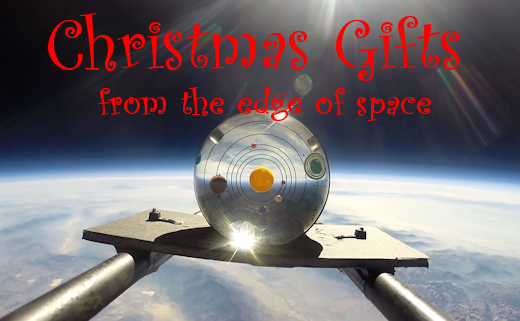
Crystal balls, solar eclipse pendants, pyramids, pickles and much more: they've all been to the edge of space and back, and they all make great holiday gifts. Every dollar spent in the store supports STEM education and high-altitude space weather research. Shop now!
Far Out Gifts: Earth to Sky Store
All proceeds support hands-on STEM education
THE END OF THE MORNING STAR: Since last April, Venus has been a fixture of the dawn sky, shining more brightly than anything other than the Moon and the rising sun itself. Not anymore. The second planet is swinging behind the sun and getting lost in the glare. Human eyes can't see it, but coronagraphs onboard the Solar and Heliospheric Observatory (SOHO) can:

Horizontal lines bisecting Venus in this image are not planetary rings, but rather digital artifacts caused by the effect of Venus' extreme brightness on the spacecraft's camera.
For approximately the next two months, Venus will be a bright dot in daily SOHO coronagraph images, moving from right to left. SOHO will be able to track Venus as it passes by the sun, transitioning from a Morning Star in 2017 to an Evening Star in 2018. Superior conjunction, when Venus is almost directly behind the sun, occurs on Jan. 8, 2018. Join SOHO for a ringside seat.