THE NEXT SOLAR WIND STREAM: A hole in the sun's atmosphere is facing Earth, and it is spewing a stream of solar wind toward our planet. Estimated time of arrival: Dec. 17th. Arctic sky watchers should be alert for auroras when the gaseous material arrivals. Free: Aurora Alerts.

THE SUN IS DIMMING: Today at Cape Canaveral, SpaceX launched a new sensor to the International Space Station named TSIS-1. Its mission: to measure the dimming of the sun. As the sunspot cycle plunges toward its 11-year minimum, NASA satellites are tracking a decline in total solar irradiance (TSI). Across the entire electromagnetic spectrum, the sun's output has dropped nearly 0.1% compared to the Solar Maximum of 2012-2014. This plot shows the TSI since 1978 as observed from nine previous satellites:

Click here for a complete explanation of this plot.
The rise and fall of the sun's luminosity is a natural part of the solar cycle. A change of 0.1% may not sound like much, but the sun deposits a lot of energy on the Earth, approximately 1,361 watts per square meter. Summed over the globe, a 0.1% variation in this quantity exceeds all of our planet's other energy sources (such as natural radioactivity in Earth's core) combined. A 2013 report issued by the National Research Council (NRC), "The Effects of Solar Variability on Earth's Climate," spells out some of the ways the cyclic change in TSI can affect the chemistry of Earth's upper atmosphere and possibly alter regional weather patterns, especially in the Pacific.
NASA's current flagship satellite for measuring TSI, the Solar Radiation and Climate Experiment (SORCE), is now more than six years beyond its prime-mission lifetime. TSIS-1 will take over for SORCE, extending the record of TSI measurements with unprecedented precision. It's five-year mission will overlap a deep Solar Minimum expected in 2019-2020. TSIS-1 will therefore be able to observe the continued decline in the sun's luminosity followed by a rebound as the next solar cycle picks up steam. Installing and checking out TSIS-1 will take some time; the first science data are expected in Feb. 2018. Stay tuned.
Realtime Space Weather Photo Gallery
ARCTIC GEMINID FIREBALLS: Geminid meteor activity is rapidly subsiding on Dec. 15th--but not without a closing flourish. As Friday dawned in Abisko, Sweden, Lights over Lapland guest David Williams witnessed "a great display of both Northern Lights and some spectacular Geminids." He photographed several bright fireballs streaking over his snowy campsite:
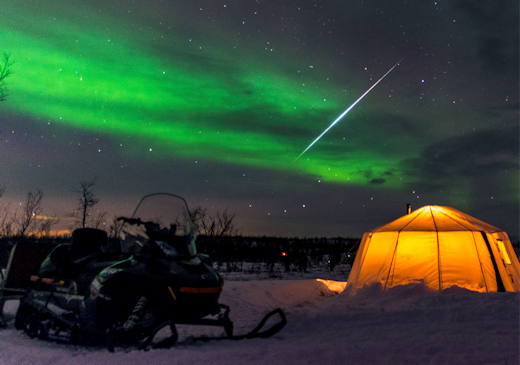
Meteor expert Peter Jenniskens of NASA Ames says late Geminid fireballs are not unusual. "Geminids seen during the night of Dec. 14/15 tend to be brighter, on average, than those during the peak night of Dec. 13/14, because the debris stream of rock comet 3200 Phaethon is mass segregated." Smaller meteoroids arrive first, followed by bigger particles as the shower begins to subside.
The Geminid meteor shower will probably be finished, fireballs and all, by Dec. 16/17. Until then, keep an eye on the constellation Gemini during the dark hours before dawn. Something bright might surprise you. [sky map]

Realtime Space Weather Photo Gallery
URSINE ASTRONAUTS: Looking for a gift for the young scientist in your life? Consider the space bear. On Dec. 9, 2017, the students of Earth to Sky Calculus launched an array of cosmic ray sensors to the stratosphere onboard a giant helium balloon. These bears went along for the ride. As they ascended, the sun set, and the rays of the setting sun colored the mountainous landscape vivid pink:
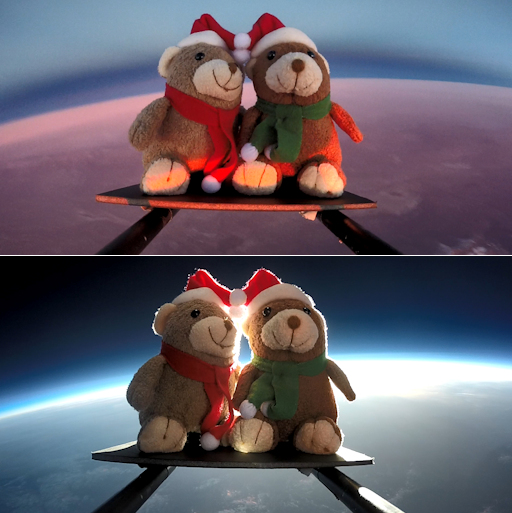
The payload flew 33.5 km (109,908 feet) above the Sierra Nevada mountains of central California. According to the radiation sensors, cosmic ray levels were 100 times Earth-normal as the Ursine Astronauts reached the top of our planet's atmosphere and touched the edge of space.
You can have one for $49.95. Each bear comes with a Christmas card showing the cuddly creature in space. The inside flap tells the story of the flight and confirms that the bear has traveled to the edge of space and back again.
Far Out Gifts: Earth to Sky Store
All proceeds support hands-on STEM education