NORTHERN WINTER BEGINS: Today, Dec. 21st, is the shortest day of 2017 for anyone living north of the equator. It's the December solstice, when the sun reaches its lowest point on the celestial sphere. Northern winter begins at 11:28 a.m. EST. Because seasons are reversed on opposite sides of the equator, southern summer begins at the same time. Happy Solstice!
POLAR STRATOSPHERIC CLOUDS: The stratosphere above the Arctic Circle is getting cold ... very cold. That's the only way to explain these colorful clouds that materialized over Kvaløya, Norway, on Dec. 20th:
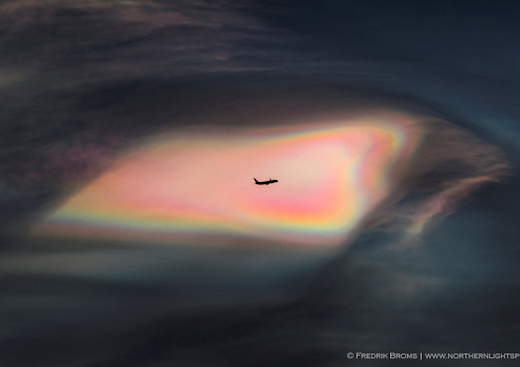
These are polar stratospheric clouds (PSCs), and they require temperatures around -85ºC to form.
"Today, heavy rainclouds and a bitter wind greeted the people of Tromsø in northern Norway when they woke up. But all of a sudden, the clouds parted and the sky cracked open to reveal an absolutely stunning display of stratospheric clouds high above the ordinary gray rainclouds," says photographer Fredrik Broms. "Seldom have I seen PSCs with such vivid colours as today."
The stratosphere is extremely dry, which makes it hard for clouds of any type to form. Only when the air up there becomes extremely cold do widely-spaced water molecules coalesce to form ice crystals--the "stuff" of PSCs. High-altitude sunlight shining through these ice particles produces the clouds' characteristic bright iridescent colors.
Today's sighting in Norway and a related sighting in Sweden marks the beginning of the 2017-18 winter season for polar stratospheric clouds. Stay tuned for more.
Realtime Space Weather Photo Gallery
A COMET AND TWO GEMINIDS: How intense was the 2017 Geminid meteor shower? Consider this: Astronomers couldn't manage NOT to observe it. On peak night, Dec. 13-14, Yasushi Aoshima of Shizuoka, Japan, trained his telescope on faint Comet Heinze (C/2017 T1) to see how the newly discovered comet was developing. Two bright Geminids intervened:
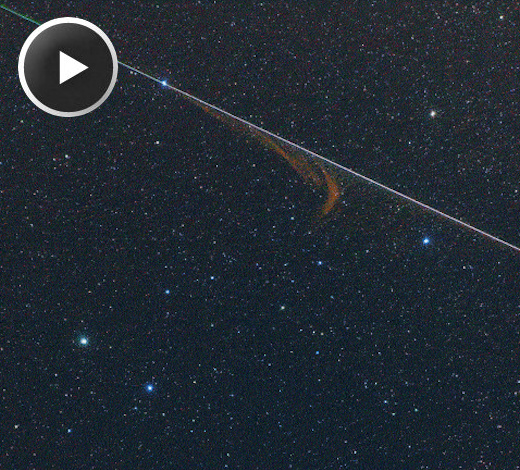
One of the Geminids evaporated so flamboyantly that plumes of "meteor smoke" sprayed across the field of view.
Despite the interference, Aoshima was able to spot the comet and its expanding atmosphere. "Comet Heinze (C/2017 T1) is still small, but already wears a faint pale-green coma," he says.
It won't remain small and faint. "On January 4th, the comet will pass just 33 million km from Earth. Despite its intrinsic faintness, it's predicted to peak at magnitude 8.8 (JPL Horizons and Seichi Yoshida), putting it within range of small scopes and 50-mm or larger binoculars," writes Bob King of Sky & Telescope. Stay tuned.
STUDENT CHRISTMAS SPECIAL: Christmas shopping for a young scientist? Consider this: For the holiday season only, we're reducing the cost of payload space on Earth to Sky Calculus balloons from $500 to only $299. Buy a ticket to space before Dec. 25th and your student can send an experiment, photo, or keepsake item to the stratosphere, completely supported by an Earth to Sky Calculus launch and recovery team.

This is not only a great Christmas gift, but also a good kickstarter for science fair projects. Experiments will be flown and returned along with video footage, GPS tracking, temperature, pressure, altimetry and radiation data.
To take advantage of the discounted rate, payment must be received before Dec. 25th. However, the flight can take place at any time in the next 12 months.
Conditions: No mammals. Plants and non-pathogenic microbes are allowed. Generally speaking, experiments should weigh less than a few hundred grams and occupy a volume less than that of a school lunchbox. A brainstorming session is included with each certificate. Dr. Tony Phillips and other members of the Earth to Sky team will chat with recipients to help them craft an experiment that will work in the harsh environment of the stratosphere.
Far Out Gifts: Earth to Sky Store
All proceeds support hands-on STEM education