SOLAR SECTOR BOUNDARY CROSSING: On Dec. 22nd or 23rd, Earth will cross a fold in the heliospheric current sheet--a vast wavy structure in interplanetary space separating regions of opposite magnetic polarity. This is called a "solar sector boundary crossing," and it could trigger geomagnetic activity around Earth's poles. Arctic sky watchers should be alert for auroras when the crossing occurs. Free: Aurora alerts.
SUNSPOT SURPRISE: A new sunspot is rapidly growing in the sun's northern hemisphere. In only 48 hours, AR2692 has multiplied 10-fold in area and now sprawls across more than 100,000 km of solar "terrain." This movie from the NASA's Solar Dynamics Observatory shows the sunspot's rapid development:

The expanding sunspot is crackling with minor B-class solar flares. Activity could intensify if the sunspot's magnetic field becomes tangled as it grows. Magnetic fields that criss-cross, mixing polarities, can explode--a process called "magnetic reconnection." Astronomers with safe solar telescopes are encouraged to monitor this region for further developments.
Realtime Space Weather Photo Gallery
GIGANTIC JETS: Back in the 1980s, researchers were amazed when they discovered sprites--luminous red forms dancing on top of intense electrical storms, reaching their strangely-shaped tentacles up to the edge of space. Since then, sprites have been photographed by astronomers around the world. Now a new form of upper atmospheric lightning is being seen: the Gigantic Jet. "They are related to sprites, but more powerful and easier to see with the naked eye," says Frankie Lucena of Cabo Rojo, Puerto Rico, who has photographed almost 2 dozen this year so far:
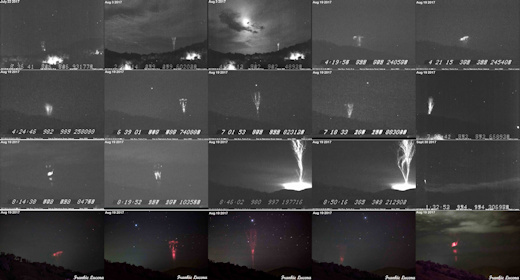
"Gigantic Jets are more rare than sprites," notes Oscar van der Velde, a member of the Lightning Research Group at the Universitat Politècnica de Catalunya. "While sprites were discovered in 1989 and have since been photographed by the thousands, it was not until 2001-2002 that Gigantic Jets were first recorded from Puerto Rico and Taiwan."
Before 2017, Gigantic Jet sightings numbered in the dozens. Lucena alone has added approximately 20 to that total in a single year. "These jets came from 4 different storms," says Lucena. "They were all tropical waves except for tropical storm Harvey, which was by far the most prolific producer of the jets."
The most recent event in Lucena's collection was on Sept 30, 2017--"just 10 days after Hurricane Maria devastated my island," he points out. The capture is a testament to Lucena's dedication and observing skill. He powered his cameras using a gasoline generator and a backup battery because the island's electrical grid was almost completely disabled. "I wish I had solar power at my house because the lines for gasoline were very long and money spent on it really hurt the pocket. We went 82 days without power," he adds.
Gigantic Jets and their cousins the sprites inhabit the upper atmosphere alongside auroras, meteors and noctilucent clouds. Some researchers believe they are linked to cosmic rays: subatomic particles from deep space striking the top of Earth's atmosphere produce secondary electrons that could, in turn, provide the spark for these upward bolts.
The link to cosmic rays is particularly interesting at this time. For the past two+ years, space weather balloons have observed a steady increase in deep space radiation penetrating our atmosphere. This increase is largely due to the decline in the solar cycle. Flagging solar wind pressure and weakening sunspot magnetic fields allow more cosmic rays into the inner solar system--a trend which is expected to continue for years to come. These changes could add up to even more Gigantic Jets in the future. Stay tuned!
Realtime Space Weather Photo Gallery
A COMET AND TWO GEMINIDS: How intense was the 2017 Geminid meteor shower? Consider this: Astronomers couldn't manage NOT to observe it. On peak night, Dec. 13-14, Yasushi Aoshima of Shizuoka, Japan, trained his telescope on faint Comet Heinze (C/2017 T1) to see how the newly discovered comet was developing. Two bright Geminids intervened:
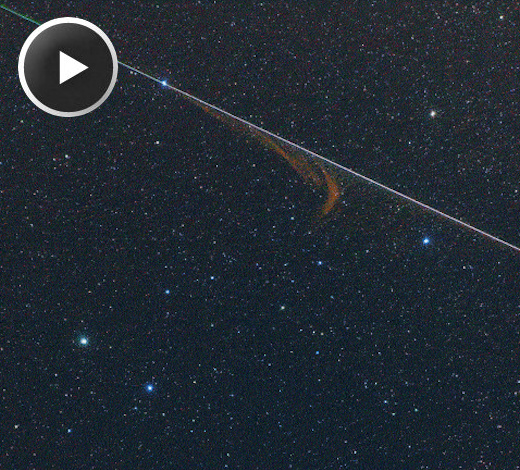
One of the Geminids evaporated so flamboyantly that plumes of "meteor smoke" sprayed across the field of view.
Despite the interference, Aoshima was able to spot the comet and its expanding atmosphere. "Comet Heinze (C/2017 T1) is still small, but already wears a faint pale-green coma," he says.
It won't remain small and faint. "On January 4th, the comet will pass just 33 million km from Earth. Despite its intrinsic faintness, it's predicted to peak at magnitude 8.8 (JPL Horizons and Seichi Yoshida), putting it within range of small scopes and 50-mm or larger binoculars," writes Bob King of Sky & Telescope. Stay tuned.
STUDENT CHRISTMAS SPECIAL: Christmas shopping for a young scientist? Consider this: For the holiday season only, we're reducing the cost of payload space on Earth to Sky Calculus balloons from $500 to only $299. Buy a ticket to space before Dec. 25th and your student can send an experiment, photo, or keepsake item to the stratosphere, completely supported by an Earth to Sky Calculus launch and recovery team.

This is not only a great Christmas gift, but also a good kickstarter for science fair projects. Experiments will be flown and returned along with video footage, GPS tracking, temperature, pressure, altimetry and radiation data.
To take advantage of the discounted rate, payment must be received before Dec. 25th. However, the flight can take place at any time in the next 12 months.
Conditions: No mammals. Plants and non-pathogenic microbes are allowed. Generally speaking, experiments should weigh less than a few hundred grams and occupy a volume less than that of a school lunchbox. A brainstorming session is included with each certificate. Dr. Tony Phillips and other members of the Earth to Sky team will chat with recipients to help them craft an experiment that will work in the harsh environment of the stratosphere.
Far Out Gifts: Earth to Sky Store
All proceeds support hands-on STEM education