CHRISTMAS LIGHTS: Do you believe in Santa Claus? Last night Oliver Wright may have spotted the Jolly Old Elf flying over Abisko, Sweden. "I was leading a Christmas tour for Lights over Lapland," he explains. "The clouds parted and we saw a band of lights that looked like Santa getting pulled across the sky by aurora reindeer!" In this snapshot, Santa's sleigh is on the left:
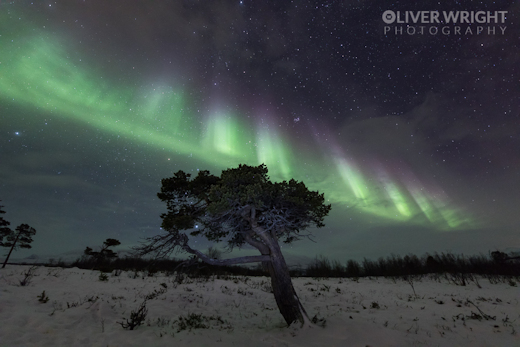
"Straight after this, a huge corona developed above the yurt which looked like the ghost of Christmas future from Dicken's Christmas Carol," says Wright. "What a great Christmas outing!"

Meanwhile in the southern hemisphere, Paul Stewart witnessed a similar display over Timaru, New Zealand:
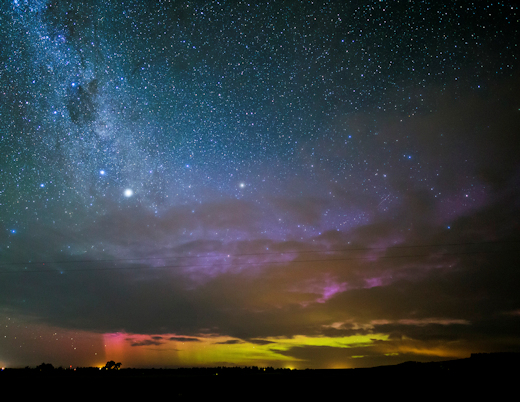
"I took this picture during the early hours of Christmas in our country," Stewart says.
The scientific explanation for these auroras involves the solar wind: A stream of gaseous material flowing from a hole in the sun's atmosphere hit Earth on Christmas Eve, causing energetic particles from space to rain down on our planet's upper atmosphere. Auroras are the result of that otherworldly rainfall.

Or.... Santa gets around. Merry Christmas! Free: Aurora alerts.
STUDENT CHRISTMAS SPECIAL: Christmas shopping for a young scientist? Consider this: For the holiday season only, we're reducing the cost of payload space on Earth to Sky Calculus balloons from $500 to only $299. Buy a ticket to space on or before Dec. 25th and your student can send an experiment, photo, or keepsake item to the stratosphere, completely supported by an Earth to Sky Calculus launch and recovery team.

This is not only a great Christmas gift, but also a good kickstarter for science fair projects. Experiments will be flown and returned along with video footage, GPS tracking, temperature, pressure, altimetry and radiation data.
To take advantage of the discounted rate, payment must be received before Dec. 25th. However, the flight can take place at any time in the next 12 months.
Conditions: No mammals. Plants and non-pathogenic microbes are allowed. Generally speaking, experiments should weigh less than a few hundred grams and occupy a volume less than that of a school lunchbox. A brainstorming session is included with each certificate. Dr. Tony Phillips and other members of the Earth to Sky team will chat with recipients to help them craft an experiment that will work in the harsh environment of the stratosphere.
Far Out Gifts: Earth to Sky Store
All proceeds support hands-on STEM education
ROCK COMET RADAR: On Dec. 16th, the strange parent of the Geminids meteor shower, rock comet 3200 Phaethon, made a close approach to Earth--only 10 million km away. Astronomers at the giant Arecibo radar in Puerto Rico took advantage of the flyby, pinging the space rock with powerful pulses of radio energy. Now we know what a rock comet looks like:

The new radar images show that 3200 Phaethon is roughly ball-shaped, like a miniature planet, and it is a bit larger than previously thought. The rock comet has a diameter of about 6 km -- roughly 1 km larger than earlier estimates. There is also a large concavity, or depression, at least several hundred meters in extent near its equator, and a conspicuous dark, circular feature near one of the poles (marked by an arrow).
These images are a significant achievement for Arecibo, the most powerful astronomical radar system on Earth. On Sept. 20, Puerto Rico was devastated by Hurricane Maria. The great radar dish suffered only minor structural damage, but it couldn't return to normal operations while the island around it was in distress. Arecibo served as a base for relief efforts to surrounding communities. Radar observations, which require high power and diesel fuel for generators at the site, resumed operations in early December -- just in time for the rock comet flyby -- after commercial power returned to the observatory and the generators could then be used exclusively for the radar.