EXITING THE SOLAR WIND STREAM: Earth is exiting a fast-moving stream of solar wind that lit up the Arctic Circle with auroras on Dec. 25th. As the solar wind subsides, NOAA forecasters have reduced the odds of polar geomagnetic storms on Dec. 26th to only 25%. Free: Aurora alerts.
POLAR STRATOSPHERIC CLOUDS: Are we heading for a outbreak of polar stratospheric clouds (PSCs)? Winter has barely begun, yet sky watchers around the Arctic Circle have already witnessed several colorful apparitions. Moreover, the clouds appear to be spreading to lower latitudes. On Dec. 23rd, Alan C Tough saw their aurora-like colors peeking through a gap in ordinary rainclouds over Elgin, Scotland, a full 10 degrees below the Arctic Circle:
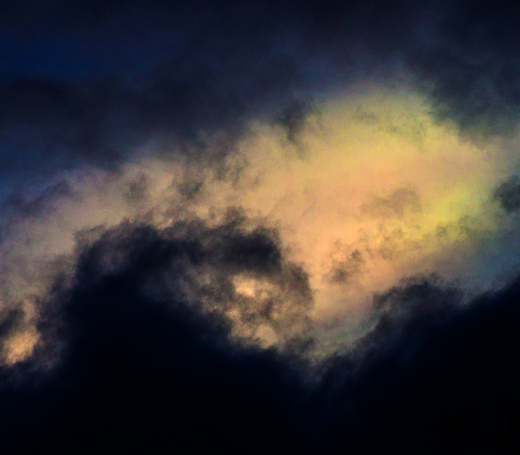
The next night, Dec. 24th, Ivo Dinsbergs saw them from Riga, Latvia--like Tough's sighting, they were 10 degrees below the Arctic Circle. "Type I PSCs are not very often visible at these latitudes," says Dinsbergs. "The last time when they were observed in Latvia was 7 years ago."
Polar stratospheric clouds are a sign of extraordinarily cold temperatures in the stratosphere. Colorful Type II PSCs require temperatures around -85º C to form. The stratosphere is drier than almost any desert on Earth. Only when the air up there becomes profoundly cold do widely-spaced water molecules coalesce to form ice crystals--the "stuff" of PSCs. High-altitude sunlight shining through these ice particles produces the clouds' characteristic bright iridescent colors.
In recent years, some photographers sending their images to Spaceweather.com have expressed their impression that PSCs are appearing earlier in winter and spreading over a greater range of latitudes. So far, the polar stratospheric clouds of 2017-2018 are conforming to those reports. Stay tuned for more sightings as northern winter deepens.
GREEN CHRISTMAS: Some people wish for a White Christmas. In Abisko, Sweden, aurora tour guide Sarah Skinner was hoping for a different color: Green. "I got my wish!" she says. "I headed out with my Lights over Lapland group on Christmas night, and we were bathed in auroras for more than 3 hours." At the peak of the display, the whole landscape turned green:
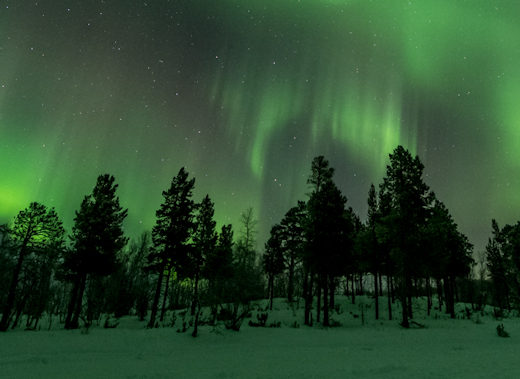
"I will never forget this tour," she says. "There were bright auroras overhead, one guest enjoying their birthday and, to top it off, a marriage proposal. Christmas doesn't get much better than that!"
The reason for the display, and possibly the marriage proposal, was the solar wind. A stream of gaseous material flowing from a hole in the sun's atmosphere hit Earth on Christmas Eve, causing energetic particles from space to rain down on our planet's upper atmosphere. Green auroras were observed all around the Arctic Circle. Free: Aurora alerts.

EXTENDED! STUDENT CHRISTMAS SPECIAL: For the holiday season only, we're reducing the cost of payload space on Earth to Sky Calculus balloons from $500 to only $299. Buy a ticket to space on or before Jan. 1st and your student can send an experiment, photo, or keepsake item to the stratosphere, completely supported by an Earth to Sky Calculus launch and recovery team.

This is not only a great Christmas gift, but also a good kickstarter for science fair projects. Experiments will be flown and returned along with video footage, GPS tracking, temperature, pressure, altimetry and radiation data.
To take advantage of the discounted rate, payment must be received before Jan. 1st. However, the flight can take place at any time in the next 12 months.
Conditions: No mammals. Plants and non-pathogenic microbes are allowed. Generally speaking, experiments should weigh less than a few hundred grams and occupy a volume less than that of a school lunchbox. A brainstorming session is included with each certificate. Dr. Tony Phillips and other members of the Earth to Sky team will chat with recipients to help them craft an experiment that will work in the harsh environment of the stratosphere.
Far Out Gifts: Earth to Sky Store
All proceeds support hands-on STEM education