NEW YEAR'S AURORA FORECAST: The New Year could begin with a geomagnetic storm. NOAA forecasters say there is a chance of G1-class storming on Jan. 1, 2018, when a stream of solar wind is expected to buffet Earth's magnetic field. A full Moon on the same date will bathe Arctic landscapes in a silvery glow, contrasting beautifully with green auroras overhead. Free: Aurora alerts.

BE ALERT FOR SUPER MOONDOGS: The first full Moon of 2018 is a supermoon--almost 8% wider and 16% brighter than average full Moons later in the year. The extra brightness of the full Moon on the night of Jan. 1-2 may have some side effects. Namely, super moondogs:

Moondogs are rainbow-colored splashes of light to the left and right of bright moons, created by the light-bending action of ice crystals in high cirrus clouds. Heiko Ulbricht photographed this one on Dec. 26th over Radebeul, Germany. "It was intense," he says.
They're about to get even more intense as the Moon waxes full. The coming full Moon is "super" because it occurs at perigee--the side of the Moon's elliptical orbit closest to Earth. It will be more than 50,000 km closer to Earth than full Moons on the opposite side of the Moon's orbit, apogee. Super moons naturally produce super moondogs. Watch for them in the nights ahead.

Realtime Space Weather Photo Gallery
ACTIVE COMET PANSTARRS: Distant comets, sailing quietly through the cold recesses of the solar system beyond Mars, usually don't change much from night to night. Comet PanSTARRS (C/2016 R2) is different. It's changing by the hour. Click to play a 2-hour movie recorded on Christmas night by astrophotographer Michael Jäger of Jauerling, Austria, and watch what happens to the indicated cloud:
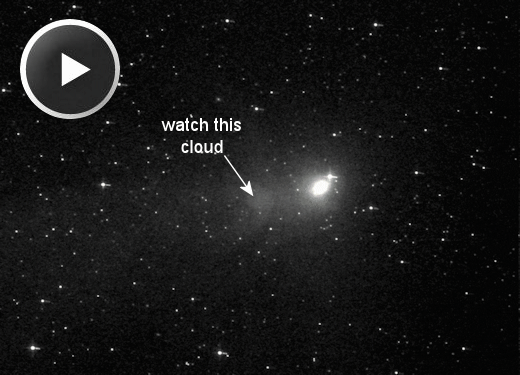
The movie shows a whole section of the comet's tail disconnecting and billowing away. Jäger has been tracking this comet for months, and this kind of activity is not unusual. On multiple occasions since November, he has recorded blobs moving away from the nucleus as well as apparent activity in the comet's inner jets--each time in just a few hours. Comet PanSTARRS (C/2016 R2) is remarkably active.
What's happening? Sunlight could be vaporizing fragile ices in the comet's core, exposing caverns of sublimating gas and puffing clouds into space. Or the comet might be experiencing magnetic storms. Magnetic storms in comet tails have been observed before--most famously in 2007 when NASA's STEREO spacecraft watched a CME crash into Comet Encke. Encke's tail was ripped into forms akin to those Jäger has been seeing in Comet PanSTARRS (C/2016 R2). Given the quiet state of solar activity, however, the former hypothesis seems more likely.
Comet PanSTARRS (C/2016 R2) is currently moving through the constellation Taurus, shining with the integrated brightness of an 11th magnitude star. This means it is a suitable target for large backyard telescopes equipped with modern deep-sky cameras. Experienced observers like Jäger may be able to see more action in the nights ahead. Monitoring is encouraged.
EXTENDED! STUDENT CHRISTMAS SPECIAL: For the holiday season only, we're reducing the cost of payload space on Earth to Sky Calculus balloons from $500 to only $299. Buy a ticket to space on or before Jan. 1st and your student can send an experiment, photo, or keepsake item to the stratosphere, completely supported by an Earth to Sky Calculus launch and recovery team.

This is not only a great Christmas gift, but also a good kickstarter for science fair projects. Experiments will be flown and returned along with video footage, GPS tracking, temperature, pressure, altimetry and radiation data.
To take advantage of the discounted rate, payment must be received before Jan. 1st. However, the flight can take place at any time in the next 12 months.
Conditions: No mammals. Plants and non-pathogenic microbes are allowed. Generally speaking, experiments should weigh less than a few hundred grams and occupy a volume less than that of a school lunchbox. A brainstorming session is included with each certificate. Dr. Tony Phillips and other members of the Earth to Sky team will chat with recipients to help them craft an experiment that will work in the harsh environment of the stratosphere.
Far Out Gifts: Earth to Sky Store
All proceeds support hands-on STEM education