GEOMAGNETIC STORM PREDICTED: NOAA forecasters say there is a 50% chance of G1-class geomagnetic storms on Jan. 1, 2018, when a stream of solar wind is expected to engulf Earth's magnetic field. Arctic sky watchers should be alert for auroras mixed with bright moonlight. Happy New Year! Free: Aurora alerts.

CRAZY CARBON MONOXIDE COMET: For months, amateur astronomers have been watching Comet PanSTARRS (C/2016 R2) beyond the orbit of Mars, essentially, go crazy. Jets of material have been spewing from its nucleus, sometimes waving back and forth, as clouds of blue gas billow down the comet's strangely-formed tail. Here is a typical movie recorded on Dec. 25th by Michael Jäger of Austria showing a blob of material catapulting away from the comet's core:

What's going on? The answer may be "carbon monoxide" (CO). New observations by astronomers K. Wierzchos and M. Womack of the University of South Florida suggest that CO is abundant in Comet PanSTARRS. They used the Arizona Radio Observatory's 10-m Submillimeter Telescope at Mount Graham to detect as many as 4.7 x 1028 CO molecules emerging from the comet's core every second. "This comet appears to be very CO-rich," they wrote in International Astronomical Union telegram CBET 4464.
Carbon monoxide can make a comet behave strangely because, when frozen as it is in comets, CO is extremely volatile. It can sublimate (change suddenly from solid to gas) at temperatures as low as -248 C (25 K). Only a little bit of sunlight is therefore required to turn deposits of frozen CO into wild jets and billowing clouds. Furthermore, ionized CO+ produces a blue glow--the same color as the tail of Comet PanSTARRS.
"It is quite a rare sight," says veteran comet observer Michael Mattiazzo of Australia. "The last notable comet with high CO was Comet Humason in 1962. It will be very interesting to watch this comet as it makes its closest approach to the sun (2.6 AU) in May 2018."
FALSE AURORAS: The space weather forecast did not call for auroras in New Hampshire last night. Yet when Stephanie Graudons of Lebanon NH looked outside at 3 am, the sky was filled with colorful lights. "An unexpected sight," she says, "these light pillars were so amazing that I dragged my fiance out of bed and out into the -14 degree night to photograph them!"
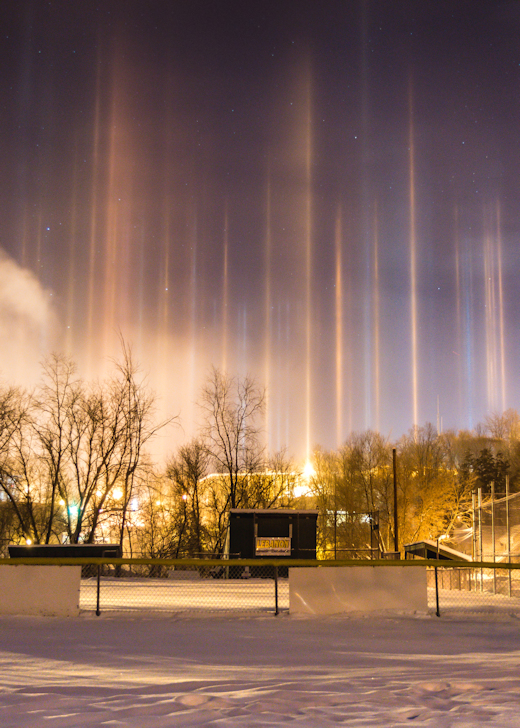
"Shivering in a foot of new snow in a nearby baseball field, we watched until they faded away," says Graudons. "It was well worth the lack of sleep."
Sometimes called "false auroras," light pillars are caused by ice crystals in the air. The crystals' flat faces intercept urban lights and spread them into colorful columns. No solar activity is required for the phenomenon. The only ingredients are ice and light pollution.
The different colors of the pillars are caused by various color temperatures of street lights. Warm orange pillars come from traditional high pressure sodium lamps, while bright white pillars come from newer LED lamps.
EXTENDED! STUDENT CHRISTMAS SPECIAL: For the holiday season only, we're reducing the cost of payload space on Earth to Sky Calculus balloons from $500 to only $299. Buy a ticket to space on or before Jan. 1st and your student can send an experiment, photo, or keepsake item to the stratosphere, completely supported by an Earth to Sky Calculus launch and recovery team.

This is a great kickstarter for springtime science fair projects. Experiments will be flown and returned along with video footage, GPS tracking, temperature, pressure, altimetry and radiation data.
To take advantage of the discounted rate, payment must be received before Jan. 1st. However, the flight can take place at any time in the next 12 months.
Conditions: No mammals. Plants and non-pathogenic microbes are allowed. Generally speaking, experiments should weigh less than a few hundred grams and occupy a volume less than that of a school lunchbox. A brainstorming session is included with each certificate. Dr. Tony Phillips and other members of the Earth to Sky team will chat with recipients to help them craft an experiment that will work in the harsh environment of the stratosphere.
Far Out Gifts: Earth to Sky Store
All proceeds support hands-on STEM education
LUNAR FOGBOW VS. NORTHERN LIGHTS: Deep inside the Arctic Circle, aurora tour guide Tim Nordström of Abisko, Sweden, routinely sees green curtains hanging down from the sky. On Dec. 28th, he saw something different: a pale arc reaching out of the ground:
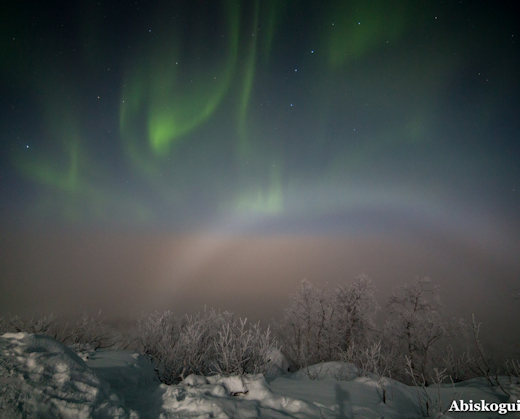
"It was amazing," says Nordström. "We were hiking through a frost-covered forest. The air was cold (-25 C) and crisp. At first the fog was thick above us, but after a while it started to thin out so we could see the green auroras overhead. A bright shaft of moonlight lanced through the fog --and that's when we saw the fogbow."
Fogbows are cousins of rainbows and they are formed in essentially the same way: light bounces in and out of water droplets to produce a luminous arc. In this case, the droplets were supercooled (to remain liquid in the freezing air) and much smaller than typical raindrops. Tiny droplets cause a diffraction effect not seen in ordinary rainbows; as a result, the colors are smeared together resulting in a nearly-white arc.