QUADRANTID METEOR SHOWER: On Jan. 3rd, Earth will pass through a stream of debris from shattered comet 2003 EH1, source of the annual Quadrantid meteor shower. This is normally a strong shower. In 2018, however, meteor counts will be sharply depressed by glare from the waning supermoon. Northern sky watchers may see little more than a handful of Quadrantids per hour after nightfall on Wednesday. The shower's forecasted peak around 22:00 UT favors Europe and east Asia. Free: Meteor alerts.
ELECTRIC-BLUE CLOUDS CIRCLING ANTARCTICA: NASA's AIM spacecraft is monitoring a vast ring of electric-blue clouds circling high above Antarctica. These are noctilucent clouds (NLCs), made of ice crystals frosting specks of "meteor smoke" in the mesosphere 83 km above the frozen continent. Here is an animation from the past week:

This is the season for southern noctilucent clouds. Every year around this time, summertime water vapor billows up into the high atmosphere over Antarctica, providing moisture needed to form icy clouds at the edge of space. Sunlight shining through the high clouds produces an electric-blue glow, which AIM can observe from Earth orbit.
"The current season began on Nov. 19th," says Cora Randall, a member of the AIM science team at the University of Colorado's Laboratory for Atmospheric and Space Physics. "Compared to previous years of AIM data, this season seems to be fairly average, but of course one never knows what surprises lie ahead, particularly since the southern hemisphere seasons are so variable."

The formation of strange clouds in the high atmosphere over remote Antarctica may seem to be of little practical interest--but that would be incorrect. Researchers studying NLCs have discovered unexpected teleconnections between these clouds and weather patterns thousands of miles away. Two years ago, for instance, Randall and colleagues found that the winter air temperature in many northern US cities was well correlated with the frequency of noctilucent clouds over Antarctica. Understanding how these long-distance connections work could improve climate models and weather forecasting--all the more reason to study eerily beautiful NLCs.

Realtime Space Weather Photo Gallery
VALENTINE'S DAY IS ONLY 6 WEEKS AWAY: Christmas is over. Next up: Valentine's Day. If you are looking for a far-out Valentine's gift, consider this:
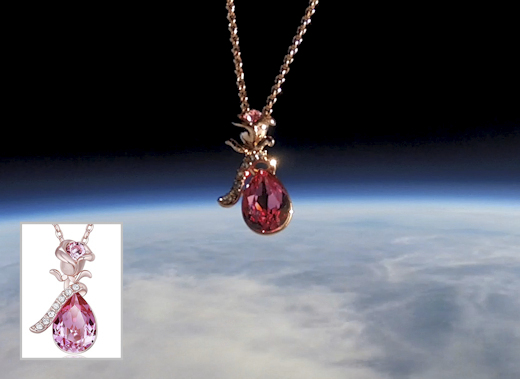
On Dec. 29, 2017, the students of Earth to Sky Calculus flew a payload-full of these 18k rose gold plated Valentine's pendants to the stratosphere onboard a high-altitude helium balloon. The necklaces reached an altitude of 36 km (118,110 feet) during a breathtaking 3 hour flight. You can have one for $79.95.
Each glittering pendant comes with a greeting card showing the jewelry in flight and telling the story of its journey to the edge of space. Sales support the Earth to Sky Calculus cosmic ray ballooning program and hands-on STEM research.
Far Out Gifts: Earth to Sky Store
All proceeds support hands-on STEM education
BE ALERT FOR SUPERMOON HALOS: This week's full Moon is the biggest and brightest of 2018. It's a perigee "supermoon"--as much as 8% wider and 16% brighter than average full moons later in the year. A super moon also brings super moon halos. Noel Keating photographed this one from a playground in Ballintra, Co Donegal, Ireland:
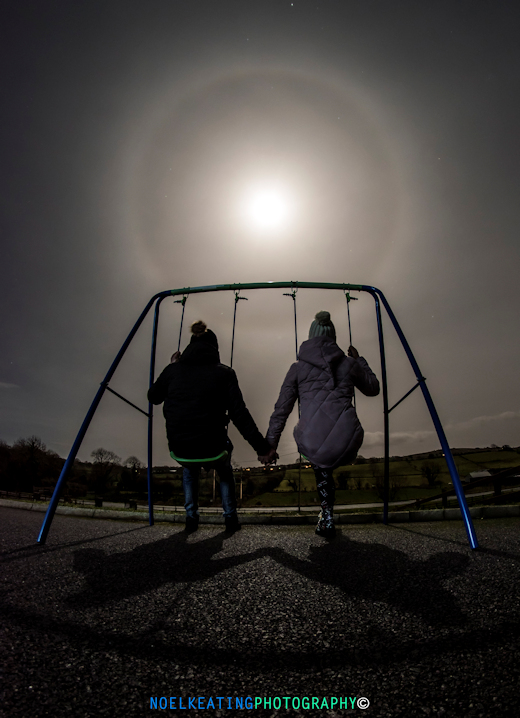
The ring around the Moon was caused by the light-bending action of ice crystals in high cirrus clouds. "This is the first of many Lunar halos I hope to catch during 2018," says Keating. "They do say that ice halos are signs of an incoming storm and it seems to be right with this one as we await our first winter storm of the year."
The Moon is "super" because it occurs at perigee--the side of the Moon's elliptical orbit closest to Earth. This places it about 50,000 km closer to Earth than full Moons on the opposite side of the Moon's orbit, apogee. Supermoons naturally produce super moon halos. Watch for luminous rings, pillars, and dogs around the bright lunar disk--and have a Happy New Year!

Realtime Space Weather Photo Gallery