GEOMAGNETIC UNREST EXPECTED: A stream of solar wind is expected to reach Earth on Jan. 8th, passing mainly north of our planet's magnetic field. The grazing encounter could spark auroras around the Arctic Circle, albeit not a full-fledged geomagnetic storm. The gaseous material is flowing from a northern hole in the sun's atmosphere. Free: Aurora Alerts.

AURORA STARTRAILS: Last night in Saariselka, Finland, photographer Matt Robinson took a picture that proves two things: The Earth spins on its axis and the solar wind blows. "I call it Aurora Startrails," he says.

"It was brief but pleasing display of auroras that hugged the northern horizon as the sky spun overhead," says Robinson, who assembled this 30 minute image from a sequence of 4 second exposures. "I particularly like the white flashes on the snow, which is moonlight reflecting on the frozen crystals."
There was no geomagnetic storm on Jan. 4th. The auroras appeared when the interplanetary magnetic field (IMF) near Earth tipped south. This opened a crack in our planet's magnetosphere. Solar wind poured into fuel the green display.

MARS + JUPITER CONJUNCTION: Awake before sunrise? Go outside and look southeast. Jupiter and Mars are converging for a beautiful conjunction. At closest approach on Jan. 6th and 7th, the Red Planet and the giant planet will be no more than a quarter of a degree (1/4o) apart--half the diameter of a full Moon. This morning in Canada, Alan Dyer photographed the gathering worlds in the twilight sky over Gleichen, Alberta:
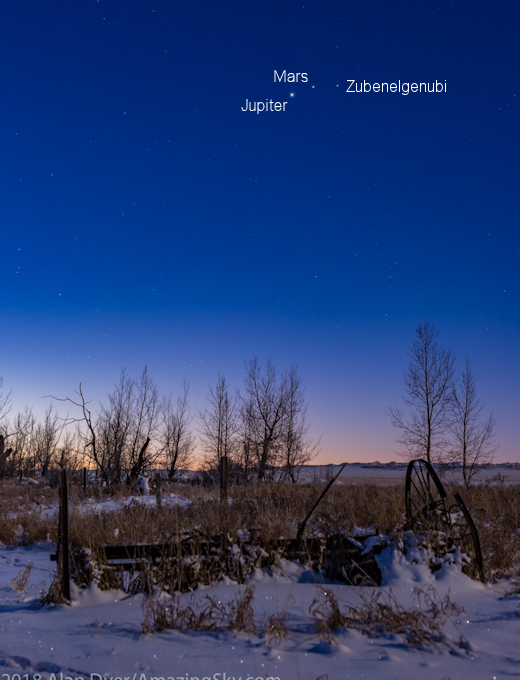
"Here is Jupiter (brightest) and Mars (reddish) along with Zubenelgenubi, the brightest star in the constellation Libra," says Dyer. "The two planets are getting together for one of the best conjunctions of 2018."
No telescope is required to see the conjunction. Both planets are easy to see with the naked eye. Set your alarm for dawn and enjoy the show! [sky map]

Realtime Space Weather Photo Gallery
VALENTINE'S DAY IS ONLY 6 WEEKS AWAY: Christmas is over. Next up: Valentine's Day. If you are looking for a far-out Valentine's gift, consider this:
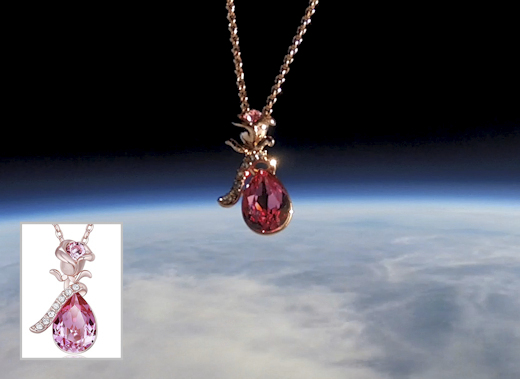
On Dec. 29, 2017, the students of Earth to Sky Calculus flew a payload-full of these 18k rose gold plated Valentine's pendants to the stratosphere onboard a high-altitude helium balloon. The necklaces traveled alongside an array of cosmic ray sensors, which the students use to monitor deep-space radiation penetrating Earth's atmosphere.
You can have one for $119.95. Each glittering pendant comes with a greeting card showing the jewelry in flight and telling the story of its journey 36 km (118,110 feet) above the Sierra Nevada mountains of central California. Sales support the Earth to Sky Calculus cosmic ray ballooning program and hands-on STEM research.
Far Out Gifts: Earth to Sky Store
All proceeds support hands-on STEM education