GEOMAGNETIC UNREST EXPECTED: A stream of solar wind is expected to reach Earth on Jan. 8th, passing mainly north of our planet's magnetic field. The grazing encounter could spark auroras around the Arctic Circle, albeit not a full-fledged geomagnetic storm. The gaseous material is flowing from a northern hole in the sun's atmosphere. Free: Aurora Alerts.

MARS VISITS JUPITER: Seeing two planets in a telescope at the same time is rare. This morning in Brisbane, Australia, amateur astronomer Dennis Simmons saw two planets and four moons. Mars, Jupiter, and the Galilean satellites appeared together during the closest conjunction of the two worlds in years:
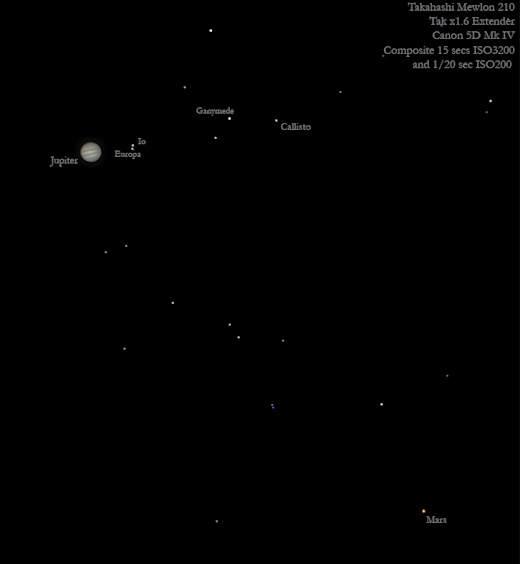
"I was hoping that the tightly spaced Jupiter/Mars pair would clear the trees before the dawn sky brightened too much," says Simmons. "The trees blocking my Eastern horizon had grown considerably in the last 12 months. Tantalizing glimpses of Jupiter and the four Galilean moons materialized on the LCD on the back of the camera as the topmost branches swayed in the light breeze when finally, Jupiter and Mars cleared the top of the trees and I could get to work recording this close conjunction."

He used a Canon 5D digital camera looking through a 210 mm telescope to record the extraordinary gathering. "I took several frames at varying ISO speeds (ISO100 to ISO3200) and shutter speeds (1/8 sec to 30 secs), then combined them to show the planets, moons, and background stars in a single image," he explains.
At closest approach on Jan. 6-7, Mars and Jupiter were approximately 0.25 degrees apart--half the diameter of a full Moon. They won't meet again this way until March of 2020. Rare indeed! Browse the Space Weather photo gallery for more snapshots.
Realtime Space Weather Photo Gallery
SPACE STATION VISITS THE BAY OF RAINBOWS: Sometimes, the best astronomy happens in a fraction of a second. On Jan. 5th, astrophotographer Maximilian Teodorescu experienced one of those moments. "I took a short trip outside Bucharest for a much shorter astro-event: the transit of the International Space Station (ISS) over the Moon."
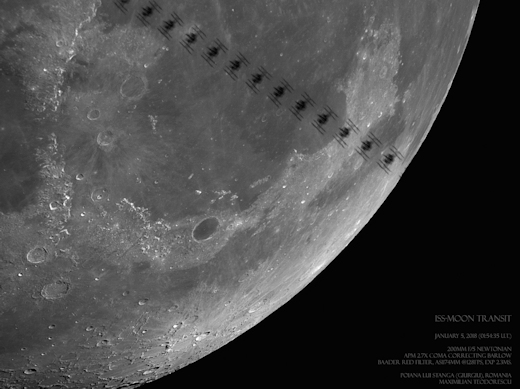
"The station passed in front of the large lava-filled crater Sinus Iridum (Bay of Rainbows)," he says. "This short video shows the transit happening about 10 times slower than real time."

Lunar transits by the ISS are not rare, but they are challenging to observe because the space station traveling 17,000 mph crosses the 0.5o face of the Moon in a split second. Usually the human behind the camera sees nothing until a later search through video frames reveals the fleeting silhouette. Teodorescu knew when to look, and where, thanks to predictions from Calsky.com.
VALENTINE'S DAY IS ONLY 6 WEEKS AWAY: Christmas is over. Next up: Valentine's Day. If you are looking for a far-out Valentine's gift, consider this:
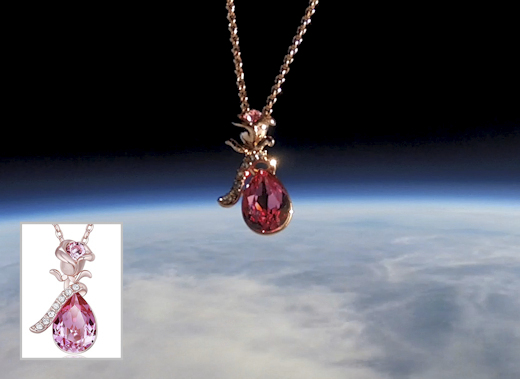
On Dec. 29, 2017, the students of Earth to Sky Calculus flew a payload-full of these 18k rose gold plated Valentine's pendants to the stratosphere onboard a high-altitude helium balloon. The necklaces traveled alongside an array of cosmic ray sensors, which the students use to monitor deep-space radiation penetrating Earth's atmosphere.
You can have one for $119.95. Each glittering pendant comes with a greeting card showing the jewelry in flight and telling the story of its journey 36 km (118,110 feet) above the Sierra Nevada mountains of central California. Sales support the Earth to Sky Calculus cosmic ray ballooning program and hands-on STEM research.
Far Out Gifts: Earth to Sky Store
All proceeds support hands-on STEM education