SOLAR MINIMUM IS COMING: As 2018 unfolds, sunspot numbers continue to plummet, signaling the approach of a deep Solar Minimum. The sun's extreme UV and X-ray output has flatlined, sharply reducing the ionization of Earth's upper atmosphere. Shortwave radio operators experience this when they try (and often fail) to skip long-distance signals off of Earth's thinning ionosphere. Meanwhile, cosmic rays are intensifying in a yin-yang relationship with the solar cycle. Stay tuned.

SOLAR WIND STREAMS: Today, Jan. 10th, Earth is exiting a stream of solar wind that sparked a night of lovely auroras around the Arctic Circle. Another stream of solar wind is on the way. It is flowing from this hole in the sun's atmosphere:
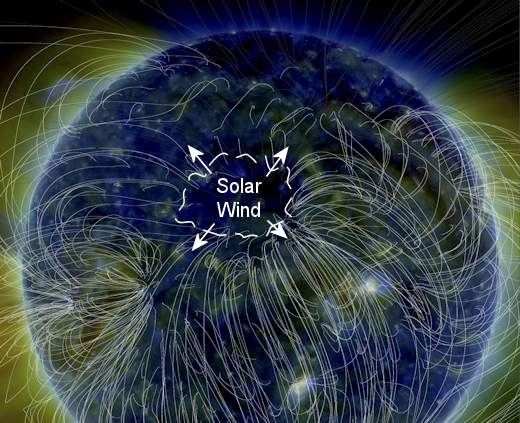
This is a "coronal hole"--a region in the sun's atmosphere where the magnetic field peels back and allows solar wind to escape. Gaseous material is emerging from the gap faster than 500 km/s (1.1 million mph). Estimated time of arrival: Jan. 13th. Another outbreak of Arctic auroras is likely on that date. Free: Aurora Alerts.
STRANGE BLUE COMET: Beyond the orbit of Mars, blue Comet PanSTARRS (C/2016 R2) is behaving strangley. Active jets of gaseous material are spewing from the comet's core, feeding a chaotic tail marked by rough swirls and an unusual rectangular "knee." Michael Jäger photographed it from St. Oswald, Austria, on Jan. 6th:
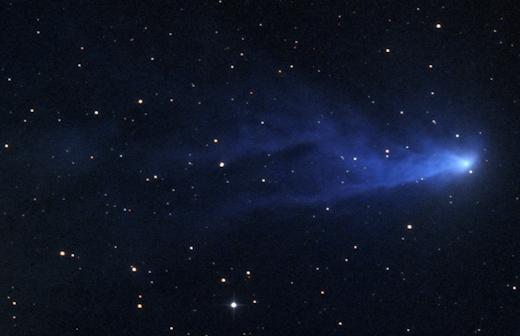
"I took 30 shots in 90 minutes, which allowed me to make a nice animation," says Jäger.
What's happening to this comet? Blue is the telltale clue. That's the color of ionized carbon monoxide (CO+) fluorescing in the the near-vacuum of interplanetary space.
Comet PanSTARRS has abundant stores of CO. Last month, astronomers K. Wierzchos and M. Womack of the University of South Florida used the Arizona Radio Observatory's 10-m Submillimeter Telescope at Mount Graham to detect as many as 4.7 x 1028 CO molecules emerging from the comet's core every second. "This comet appears to be very CO-rich," they wrote in International Astronomical Union telegram CBET 4464.
Carbon monoxide can make a comet behave strangely because it is extremely volatile. CO can sublimate (change suddenly from solid to gas) at temperatures as low as -248 C (25 K). Only a little bit of sunlight is therefore required to turn deposits of frozen CO into wild jets and billowing clouds.
"The last notable comet with high CO was Comet Humason in 1962, so this is quite a rare sight," notes veteran comet observer Michael Mattiazzo of Australia. "It will be very interesting to watch Comet PanSTARRS as it makes its closest approach to the sun (2.6 AU) in May 2018." Stay tuned!
Realtime Space Weather Photo Gallery
NOTHING SAYS "I LOVE YOU" LIKE A SPACE PENDANT: Christmas is over. Next up: Valentine's Day. If you are looking for a far-out Valentine's gift, consider this:
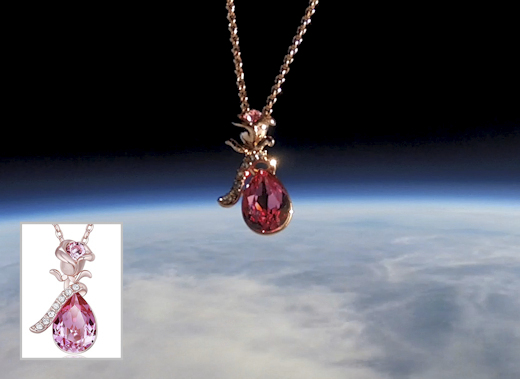
On Dec. 29, 2017, the students of Earth to Sky Calculus flew a payload-full of these 18k rose gold plated Valentine's pendants to the stratosphere onboard a high-altitude helium balloon. The necklaces traveled alongside an array of cosmic ray sensors, which the students use to monitor deep-space radiation penetrating Earth's atmosphere.
You can have one for $139.95. Each glittering pendant comes with a greeting card showing the jewelry in flight and telling the story of its journey 36 km (118,110 feet) above the Sierra Nevada mountains of central California. Sales support the Earth to Sky Calculus cosmic ray ballooning program and hands-on STEM research.
Far Out Gifts: Earth to Sky Store
All proceeds support hands-on STEM education