GEOMAGNETIC STORM PREDICTED: NOAA forecasters say there is a 45% chance of G1-class geomagnetic storms on Jan. 13th when a co-rotating interaction region (CIR) hits Earth's magnetic field. CIRs are transition zones between slow- and fast-moving solar wind streams. They contain shock-like density gradients and enhanced magnetic fields that can do a good job sparking polar auroras. Free: Aurora Alerts.

WILD ACTIVITY IN BLUE COMET PANSTARRS: Located far beyond the orbit of Mars, Comet PanSTARRS (C/2016 R2) is gliding through a cold and distant region of interplanetary space where things ordinarily change slowly, if at all. But PanSTARRS is no ordinary comet. On Jan. 10th, Austrian astrophotographer Michael Jäger recorded dramatic changes in only two hours:
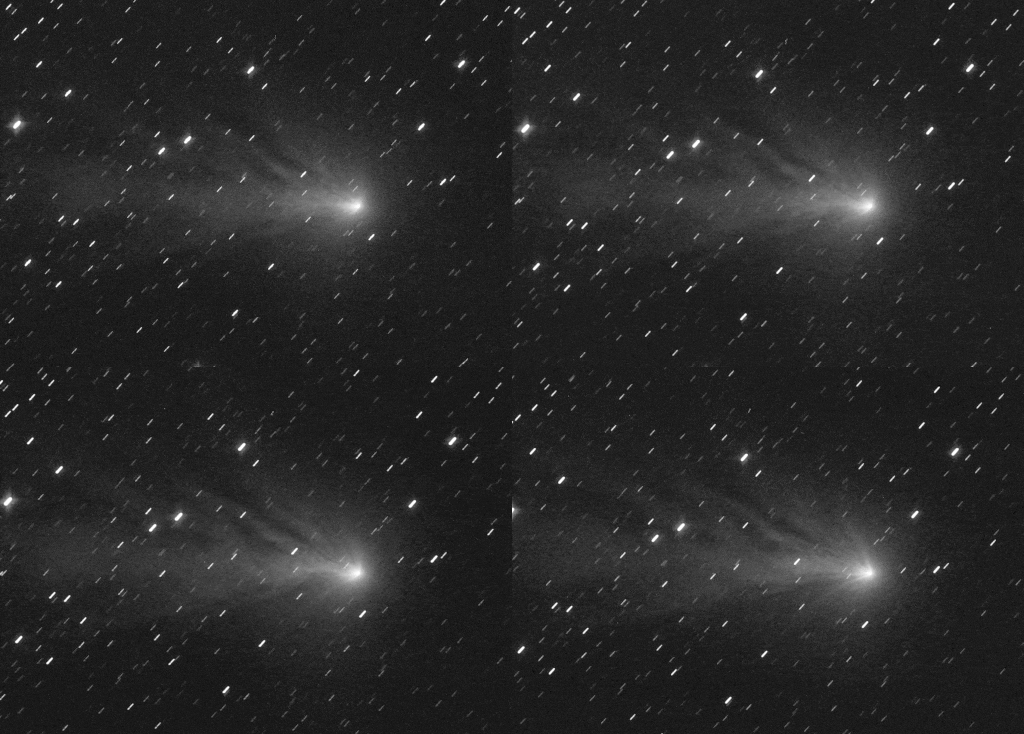
Jäger is a veteran observer of comets, and he says he has never seen one quite like this. "Over the years, I have photographed 850 comets. But there was no other comet that changed its appearance so quickly at such great distances from the sun. I remember a few comets like 2015 Comet Lovejoy with significant changes from day to day, but they were much closer to the sun [where hot sunlight could drive activity]," says Jäger.
Only a few days ago, Comet PanSTARRS looked substantially different. Jäger took this color photo on Jan. 6th:

Since November 2017, Comet PanSTARRS has changed its appearance almost every time astronomers look at it. Images show jets waving wildly around the comet's core and clouds of gas billowing through the comet's tail.
What's happening? Blue is the telltale clue. That's the color of ionized carbon monoxide (CO+) fluorescing in the the near-vacuum of interplanetary space.
Comet PanSTARRS has abundant stores of CO. Last month, astronomers K. Wierzchos and M. Womack of the University of South Florida used the Arizona Radio Observatory's 10-m Submillimeter Telescope at Mount Graham to detect as many as 4.7 x 1028 CO molecules emerging from the comet's core every second. "This comet appears to be very CO-rich," they wrote in International Astronomical Union telegram CBET 4464.
Carbon monoxide can make a comet behave strangely because it is extremely volatile. CO can sublimate (change suddenly from solid to gas) at temperatures as low as -248 C (25 K). Only a little bit of sunlight is required to turn deposits of frozen CO into wild jets and billowing clouds.
"The last notable comet with high CO was Comet Humason in 1962, so this is quite a rare sight," notes another veteran comet observer, Michael Mattiazzo of Australia. "It will be very interesting to watch Comet PanSTARRS as it makes its closest approach to the sun (2.6 AU) in May 2018." Stay tuned!
GLOWING 3D PRINTED MOON GLOBE: Looking for an over-the-Moon Valentine's gift? Consider this: On Jan. 4, 2017, the students of Earth to Sky Calculus flew this 3D printed Moon globe to the stratosphere:
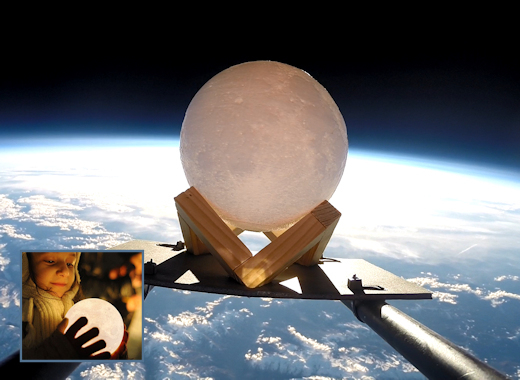
The surface of the sphere is an accurate topo-map of lunar terrain, tracing every major crater and mountain range. It is also a night light. A built-in USB-rechargeable battery provides up to 20 hours of romantic illumination.
A helium-filled space weather balloon lifted the globe to the stratosphere, reaching an altitude of 36.3 km (119,095 ft) above California's Sierra Nevada mountains. After the balloon exploded, as planned, the payload parachuted back to Earth. The Moon was still glowing when the student recovery team found it in the wilderness.
You can have one for $149.95. Each glowing orb comes with a greeting card showing the Moon in flight and telling the story of its journey to the edge of space. Sales support the Earth to Sky Calculus cosmic ray ballooning program and hands-on STEM research.
Far Out Gifts: Earth to Sky Store
All proceeds support hands-on STEM education
Realtime Space Weather Photo Gallery