THE NEXT GEOMAGNETIC STORM IS EXPECTED ON... Jan. 19th. That's when a new stream of solar wind will reach Earth. The gaseous material is flowing from a hole in the sun's atmosphere and could cause G1-class geomagnetic storms when it arrives. Arctic sky watchers should be alert for auroras this weekend. Free: Aurora Alerts.

MAMMATUS AURORAS: Auroras come in many forms: curtains, rays, arcs, etc. On Jan. 15th. James Helmericks of Alaska may have spotted a new one: the "Mammatus Aurora." He sends this picture from the Colville River Delta:

"This is the first time I have observed this type of formation and it reminded me of mammatus clouds," says Helmericks. "The display lasted about an hour. Towards the end the small puffs merged into a more solid formation."
These puffy "mammatus" formations may be disorganized cousins of picket fence auroras, in which beams of electrons rain down on Earth's upper atmosphere, creating evenly-space columns of green and yellow light. Plasma waves and magnetic cavities in Earth's magnetosphere can help organize these structures, although the details are not well understood. For now, add "mammatus" to the catalogue of auroral forms -- and stay tuned for more sightings as northern winter unfolds.
VALENTINE'S DAY IS COMING: Nothing says "I Love You" like a Valentine's pendant from the edge of space. On Dec. 31, 2017, the students of Earth to Sky Calculus flew a payload-full of these heart-shaped pendants to the stratosphere, 35.1 km (115,158 feet) above Earth's surface:
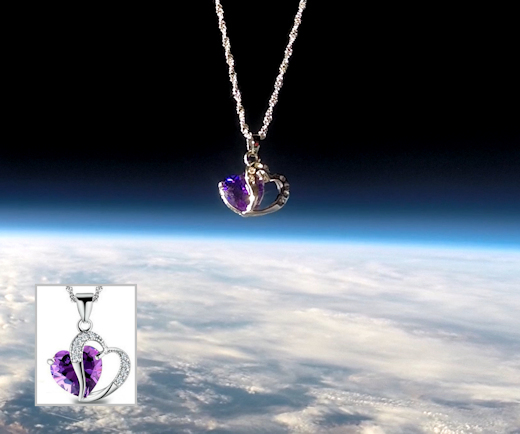
You can have one for $99.95. Each glittering pendant comes with a greeting card showing the jewelry in flight and telling the story of its journey to the edge of space. Sales of this pendant support the Earth to Sky Calculus cosmic ray ballooning program and hands-on STEM research.
Far Out Gifts: Earth to Sky Store
All proceeds support hands-on STEM education
SUN PILLAR AND MOCK SUN: When dawn broke over Cheyenne, Wyoming, on Jan. 10th, a bright orange source of light appeared in the east. Strangely, it wasn't the sun. "The sun wouldn't rise for another 9 minutes," says Jan Curtis, who took this picture:

"This atmospheric optical effect is caused by the reflection of sunlight by ice crystals in the clouds," says Curtis.
On that wintry morning in Cheyenne, plate-shaped crystals of ice fluttered down from cirrus clouds over the eastern horizon. The crystals' flat faces caught the rays of the advancing sun and spread the light into a vertical column--a sun pillar. A clump of crystals in the cloud deck produced the bright mock sun.
With low-hanging suns beaming through freezing air, northern winter is a good time to see sun pillars and other ice halos. Watch for them especially at sunrise and sunset.