AURORA FORECAST: A hole in the sun's atmosphere is turning toward Earth and blowing a stream of solar wind toward our planet. Estimated time of arrival: Jan. 20th. Polar geomagnetic storms (G1-class) and Arctic auroras are therefore possible this weekend. Free: Aurora Alerts.

METEOR EXPLODES OVER MICHIGAN (UPDATED): Sonic booms, rattling windows, and a bright flash of light washed over Michigan and surrounding states Tuesday evening when a meteoroid exploded in the atmosphere over the Great Lakes region of the USA. This video from a backyard security camera in southeastern Michigan shows the snowy landscape brightening like day during a rapid double-flash in the sky overhead:
So far, the International Meteor Organization has received almost 400 reports of the explosion from observing sites in Michigan, Illinois, Pennsylvania, Ohio, Indiana, Wisconsin, Ontario, and Iowa, most agreeing that the explosion occured around 8:10 pm local time on Jan. 16th (01:10 UT on Wednesday, Jan. 17th).
This shadow-casting fireball was brighter than the full Moon and it produced loud sonic booms – a sign that it penetrated deep in the atmosphere and may have dropped meteorites on the ground. Indeed, the USGS says the explosion may have caused a magnitude 2.0 earthquake. Stay tuned for updates about this event as more information becomes available.
Realtime Space Weather Photo Gallery
MAMMATUS AURORAS: Auroras come in many forms: curtains, rays, arcs, etc. On Jan. 15th. James Helmericks of Alaska may have spotted a new one: the "Mammatus Aurora." He sends this picture from the Colville River Delta:

"This is the first time I have observed this type of formation and it reminded me of mammatus clouds," says Helmericks. "The display lasted about an hour. Towards the end the small puffs merged into a more solid formation."
These puffy "mammatus" formations may be disorganized cousins of picket fence auroras, in which beams of electrons rain down on Earth's upper atmosphere, creating evenly-space columns of green and yellow light. Plasma waves and magnetic cavities in Earth's magnetosphere can help organize these structures, although the details are not well understood. For now, add "mammatus" to the catalogue of auroral forms -- and stay tuned for more sightings as northern winter unfolds.
VALENTINE'S DAY IS COMING: Nothing says "I Love You" like a Valentine's pendant from the edge of space. On Dec. 31, 2017, the students of Earth to Sky Calculus flew a payload-full of these heart-shaped pendants to the stratosphere, 35.1 km (115,158 feet) above Earth's surface:
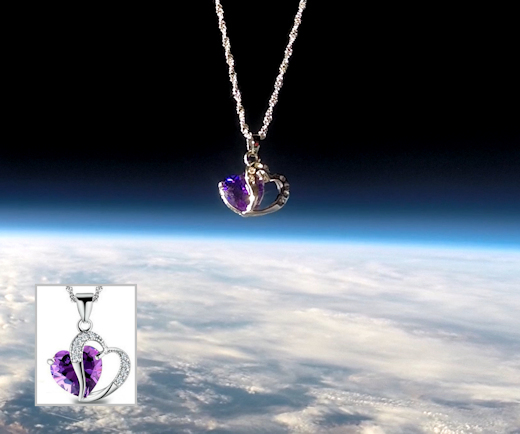
You can have one for $99.95. Each glittering pendant comes with a greeting card showing the jewelry in flight and telling the story of its journey to the edge of space. Sales of this pendant support the Earth to Sky Calculus cosmic ray ballooning program and hands-on STEM research.
Far Out Gifts: Earth to Sky Store
All proceeds support hands-on STEM education