A HOLE IN THE SUN'S ATMOSPHERE: Polar geomagnetic storms are possible this weekend when a stream of fast-moving solar wind is expected to hit Earth's magnetic field. The gaseous material is flowing from a crescent-shaped hole in the sun's atmosphere, shown here in an image based on data from NASA's Solar Dynamics Observatory:

This is a "coronal hole"--a region where the sun's magnetic field opens up and allows solar wind to escape. NASA's STEREO-A spacecraft has sampled the solar wind stream and measured its velocity: ~575 km/s (1.3 million mph). NOAA forecasters say there is a 45% chance of G1-class geomagnetic storms when the stream arrives on Jan. 20th.

Good news for auroraphiles: This stream is probably preceded by a CIR (co-rotating interaction region). CIRs are transition zones between slow- and fast-moving solar wind. They contain shock-like density gradients and enhanced magnetic fields that often do a good job sparking auroras when they reach Earth. Free: Aurora Alerts.
COMET PANSTARRS UPDATE: Will Comet PanSTARRS (C/2016 R2) ever relax? For the 3rd month in a row, the hyperactive comet is putting on a show for amateur astronomers now monitoring its progress through the constellation Taurus. "My latest images from Jan. 14th show multiple knots of gas traveling down the comet's twisted tail," reports Michael Jäger of St. Oswald, Austria. "In this 2-hour animation, note how one knot near the comet's core disappears."

This kind of activity is nothing new for observers of Comet PanSTARRS. The reason may be summed up in two words: carbon monoxide (CO). The comet is unusually rich in frozen CO, a substance which vaporizes explosively when exposed to even the slightest amount of warming sunlight. The abundance of CO in Comet PanSTARRS is responsible not only for its hyperactivity, but also for its beautiful blue color. Ionized carbon monoxide (CO+) fluoresces with a azure glow in the near vacuum of interplanetary space.
Stay tuned for more action from this comet as it approaches the sun for a 2.6 AU perihelion in May of 2018.
Realtime Space Weather Photo Gallery
VALENTINE'S DAY IS COMING: Nothing says "I Love You" like a Valentine's pendant from the edge of space. On Dec. 31, 2017, the students of Earth to Sky Calculus flew a payload-full of these heart-shaped pendants to the stratosphere, 35.1 km (115,158 feet) above Earth's surface:
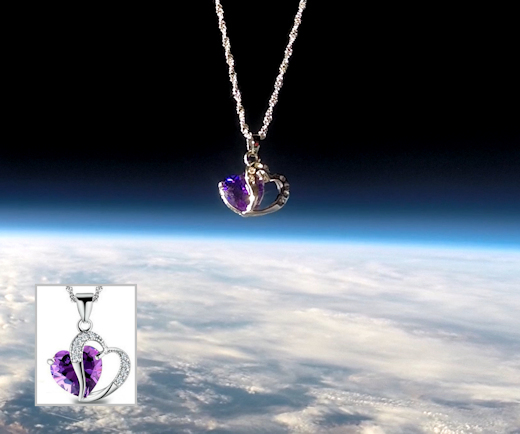
You can have one for $99.95. Each glittering pendant comes with a greeting card showing the jewelry in flight and telling the story of its journey to the edge of space. Sales of this pendant support the Earth to Sky Calculus cosmic ray ballooning program and hands-on STEM research.
Far Out Gifts: Earth to Sky Store
All proceeds support hands-on STEM education