SOLAR WIND, INCOMING: NOAA forecasters say there is a 45% chance of G1-class geomagnetic storms on Jan. 20th when a stream of solar wind is expected to hit Earth's magnetic field. The gaseous material is flowing from a crescent-shaped hole in the sun's atmosphere. Arctic sky watchers should be alert for auroras this weekend. Free: Aurora Alerts.


NOCTILUCENT ROCKET FUMES OVER JAPAN: On Jan. 18th, the Japanese space agency JAXA launched a small rocket from the Uchinoura Space Center. It made a big display. Japanese artist and photographer Kagaya captured dramatic images of the rocket's exhaust glowing in the starry pre-dawn sky over the Pacific:
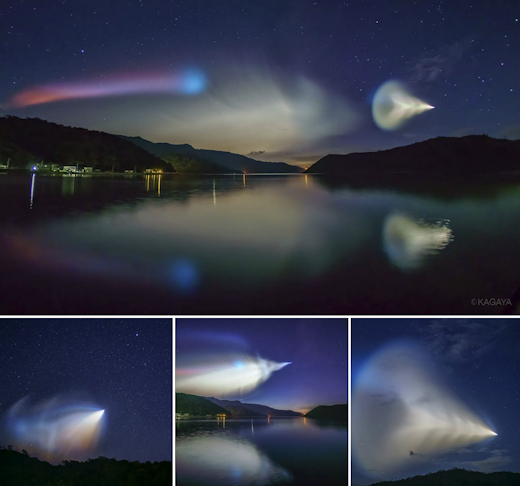
"I watched the launch from Okinawa Island and photographed it using my Sony α7RIII camera," says Kagaya, who has posted a must-see video of the event on Youtube.
Japan's new Epsilon rocket is relatively small, designed to launch scientific satellites at a fraction of the cost of its larger predecessors. On this occasion, the Epsilon propelled an Earth observing satellite to orbit, the ASNARO-2. Power by solar cells and carrying a large X-band antenna, ASNARO-2 is a synthetic aperture radar capable of imaging the surface of our planet with 1-meter resolution.
Shortly after the launch, noctilucent (night shining) clouds were seen over a broad swath of western Japan as ice crystals forming in the rocket's wake caught the rays of the rising sun. These clouds occur naturally around Earth's poles, but they are very rare at lower latitudes such as Japan's. In polar regions, noctilucent clouds are seeded by specks of meteor smoke, which become frosted by naturally occurring water vapor drifting up toward the edge of space. Over Japan, the ingredients were provided by JAXA: water vapor in the rocket's exhaust mixed with solid-booster aerosols to create the display.
Noctilucent clouds (both manmade and natural) are of keen interest to scientists because of what they reveal about long-range teleconnections and climate change in Earth's atmosphere. Read more here.
Realtime Space Weather Photo Gallery
VALENTINE'S DAY IS COMING: Nothing says "I Love You" like a Valentine's pendant from the edge of space. On Dec. 31, 2017, the students of Earth to Sky Calculus flew a payload-full of these heart-shaped pendants to the stratosphere, 35.1 km (115,158 feet) above Earth's surface:
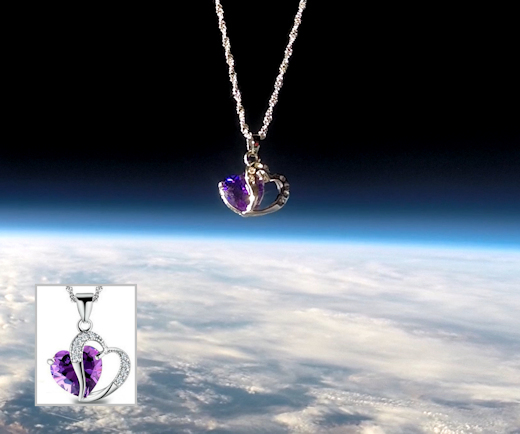
You can have one for $99.95. Each glittering pendant comes with a greeting card showing the jewelry in flight and telling the story of its journey to the edge of space. Sales of this pendant support the Earth to Sky Calculus cosmic ray ballooning program and hands-on STEM research.
Far Out Gifts: Earth to Sky Store
All proceeds support hands-on STEM education
CRESCENT MOON ALERT: When the sun goes down tonight, step outside and face west. A slender crescent Moon is beaming through the twilight. Yuri Beletsky sends this picture from the Las Campanas observatory in Chile:

"This evening we witnessed an incredible view of the Moon setting over the Pacific ocean," says Beletsky. "It was going down through the inversion layer and the colors were truly spectacular!"
When you see tonight's Moon, be sure to notice the ghostly image of the full Moon inside the arms of the bright crescent. That is "Earthshine"--sunlight reflected from our own planet illuminating the Moon's nighttime landscape. Enjoy the show!
Realtime Space Weather Photo Gallery