SOLAR WIND ADVISORY: A stream of solar wind flowing from a crescent-shaped hole in the sun's atmosphere has reached Earth and it is now applying pressure to our planet's magnetic field. This could cause geomagnetic disturbances in polar regions on Jan. 21st and 22nd. Arctic sky watchers should remain alert for auroras this weekend. Free: Aurora Alerts.

THE PACIFIC RADIATION BOWL: For years, Spaceweather.com and the students of Earth to Sky Calculus have been flying balloons to the stratosphere to monitor cosmic rays penetrating Earth's atmosphere. Lately, we've been flying the same payloads onboard airplanes. We want to map Earth's radiation environment at aviation altitudes where millions of people are routinely exposed to elevated levels of cosmic rays.
Recently we encountered an interesting feature in data taken over the Pacific Ocean: a "radiation bowl." On Nov. 30th, 2017, Hervey Allen, a computer scientist at the University of Oregon, carried our radiation sensors onboard a commercial flight from San Francisco, California, to Auckland, New Zealand: map. As his plane cruised at a nearly constant altitude (35,000 ft) across the equator, radiation levels gracefully dipped, then recovered, in a bowl-shaped pattern:


In one way, this beautiful curve is no surprise. We expect dose rates to reach a low point near the equator, because that is where Earth's magnetic field provides the greatest shielding against cosmic rays. Interestingly, however, the low point is not directly above the equator. A parabolic curve fit to the data shows that the actual minimum occurred at 5.5 degrees N latitude.
Is Earth's "radiation equator" offset from the geographic equator? Very likely it is. Earth's magnetic field is tilted with respect to Earth's spin axis and, moreover, there are many inhomogeneities in our planetary magnetic field that may create radiation zones of interest in unexpected places.
We are now planning additional trips across the equator to map the band of least radiation girdling our planet. In fact, we are working on a dataset now that includes an equator-crossing between the USA and Chile. Stay tuned for updates.
Realtime Space Weather Photo Gallery
DOUBLE MAGNETIC SHOCK SPARKS BRIGHT AURORAS: On Friday, Jan. 19th, aurora tour guide Sara Skinner of Abisko, Sweden, kept an expectant eye on the sky because she knew that a solar wind stream was approaching Earth. "I told our guests that a display might begin soon," she says. "What we saw, however, was way beyond what I expected! A crazy vibrant aurora boomed into action, turning everything around us green."
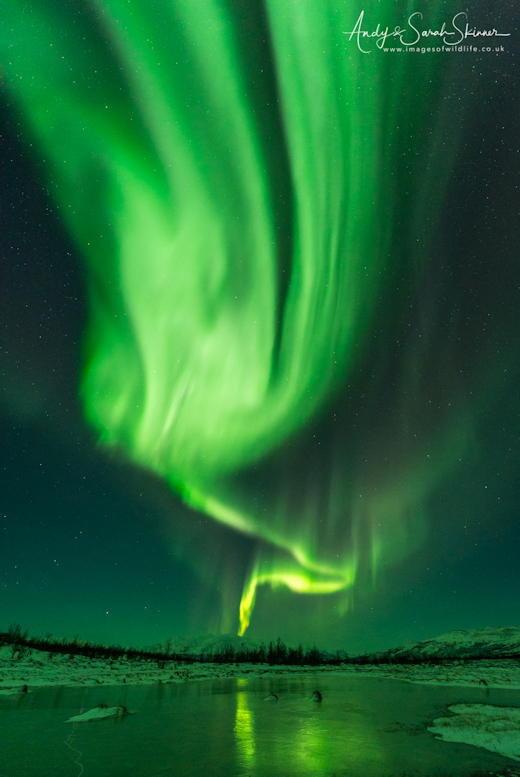
"There are little words to describe what we witnessed for the next two hours," she says. "It was totally awesome!"
The strange thing about this display was not its beauty--stunning auroras are seen routinely in Abisko--but rather its timing. The solar wind stream hadn't yet arrived.
Solar wind speeds wouldn't begin to increase until hours after Skinner witnessed the outburst. What happened? A magnetometer operated by Rob Stammes at the Polarlightcenter in Norway may provide an answer. "My instruments recorded a double magnetic shockwave," he says. "With each pulse of magnetism, electric currents flowed through the ground outside our observatory and bright auroras appeared overhead."
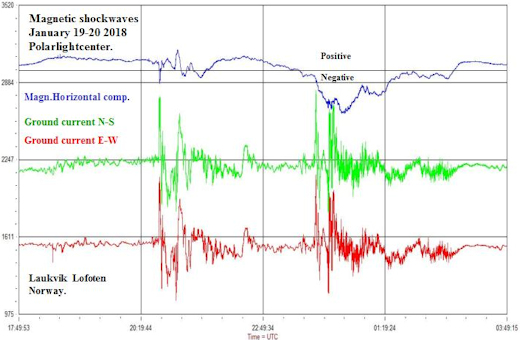
"These signatures are normally associated with CMEs (big explosions on the sun), not solar wind streams flowing from coronal holes," notes Stammes, who has been monitoring magnetic activity in Arctic Norway for decades.
The pulses Stammes recorded may have been delivered by a co-rotating interaction region (CIR). CIRs are transition zones between slow- and fast-moving regions of solar wind, often traveling just ahead of solar wind streams. They contain shock-like density gradients and enhanced magnetic fields that can sometimes mimic the effect of more powerful CMEs.
Meanwhile, the solar wind has arrived, so more Arctic auroras are likely tonight. Stay tuned. Free: Aurora Alerts.
VALENTINE'S DAY IS COMING: Nothing says "I Love You" like a Valentine's pendant from the edge of space. On Dec. 31, 2017, the students of Earth to Sky Calculus flew a payload-full of these heart-shaped pendants to the stratosphere, 35.1 km (115,158 feet) above Earth's surface:
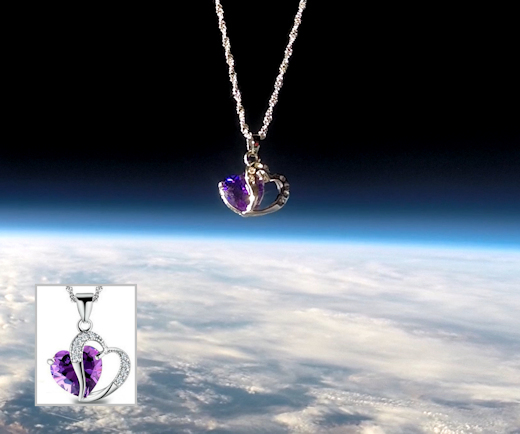
You can have one for $119.95. Each glittering pendant comes with a greeting card showing the jewelry in flight and telling the story of its journey to the edge of space. Sales of this pendant support the Earth to Sky Calculus cosmic ray ballooning program and hands-on STEM research.
Far Out Gifts: Earth to Sky Store
All proceeds support hands-on STEM education
NOCTILUCENT ROCKET FUMES OVER JAPAN: On Jan. 18th, the Japanese space agency JAXA launched a small rocket from the Uchinoura Space Center. It made a big display. Japanese artist and photographer Kagaya captured dramatic images of the rocket's exhaust glowing in the starry pre-dawn sky over the Pacific:
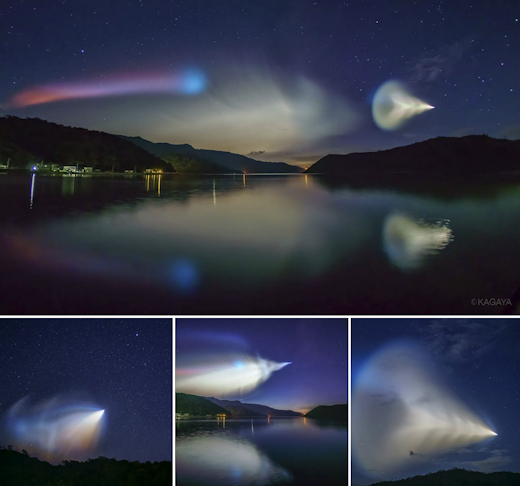
"I watched the launch from Okinawa Island and photographed it using my Sony α7RIII camera," says Kagaya, who has posted a must-see video of the event on Youtube.
Japan's new Epsilon rocket is relatively small, designed to launch scientific satellites at a fraction of the cost of its larger predecessors. On this occasion, the Epsilon propelled an Earth observing satellite to orbit, the ASNARO-2. Powered by solar cells and carrying a large X-band antenna, ASNARO-2 is a synthetic aperture radar capable of imaging the surface of our planet with 1-meter resolution.
Shortly after the launch, noctilucent (night shining) clouds were seen over a broad swath of western Japan as ice crystals forming in the rocket's wake caught the rays of the rising sun. These clouds occur naturally around Earth's poles, but they are very rare at lower latitudes such as Japan's. In polar regions, noctilucent clouds are seeded by specks of meteor smoke, which become frosted by naturally occurring water vapor drifting up toward the edge of space. Over Japan, the ingredients were provided by JAXA: water vapor in the rocket's exhaust mixed with solid-booster aerosols to create the display.
Noctilucent clouds (both manmade and natural) are of keen interest to scientists because of what they reveal about long-range teleconnections and climate change in Earth's atmosphere. Read more here.