SOLAR FLARE AND CME: Magnetic fields threading the remains of decaying sunspot AR2696 erupted on Jan. 22nd at approximately 0300 UT: movie. The explosion produced a minor B9-class solar flare and hurled a coronal mass ejection (CME) into space. Because of the blast site's location near the sun's western limb, the CME is unlikely to hit Earth. Nevertheless, NOAA analysts are modeling the CME's trajectory to rule out an impact. Stay tuned. Free: Aurora Alerts.
SOLAR WIND SPARKS ARCTIC AURORAS: For the second day in a row, a stream of solar wind is blowing around Earth faster than 500 km/s (1.1 million mph), lighting up the night sky around the Arctic Circle. Last night in the Lofoten Islands of Norway, Alex Conu photographed the display reflected from the waters of Fredvang:

"As the solar wind blew around Earth, the absence of any terrestrial wind in Fredvang improved the quality of the reflection," says Conu. "Both Orion and the Northern Lights show up nicely in the still waters."
More Arctic auroras are possible on Jan. 22-23 as the solar wind continues to blow. Free: Aurora Alerts.
THE PACIFIC RADIATION BOWL: For years, Spaceweather.com and the students of Earth to Sky Calculus have been flying balloons to the stratosphere to monitor cosmic rays penetrating Earth's atmosphere. Lately, we've been flying the same payloads onboard airplanes. We want to map Earth's radiation environment at aviation altitudes where millions of people are routinely exposed to elevated levels of cosmic rays.
Recently we encountered an interesting feature in data taken over the Pacific Ocean: a "radiation bowl." On Nov. 30th, 2017, Hervey Allen, a computer scientist at the University of Oregon, carried our radiation sensors onboard a commercial flight from San Francisco, California, to Auckland, New Zealand: map. As his plane cruised at a nearly constant altitude (35,000 ft) across the equator, radiation levels gracefully dipped, then recovered, in a bowl-shaped pattern:


In one way, this beautiful curve is no surprise. We expect dose rates to reach a low point near the equator, because that is where Earth's magnetic field provides the greatest shielding against cosmic rays. Interestingly, however, the low point is not directly above the equator. A parabolic curve fit to the data shows that the actual minimum occurred at 5.5 degrees N latitude.
Is Earth's "radiation equator" offset from the geographic equator? Very likely it is. Earth's magnetic field is tilted with respect to Earth's spin axis and, moreover, there are many inhomogeneities in our planetary magnetic field that may create radiation zones of interest in unexpected places.
We are now planning additional trips across the equator to map the band of least radiation girdling our planet. In fact, we are working on a dataset now that includes an equator-crossing between the USA and Chile. Stay tuned for updates.
Realtime Space Weather Photo Gallery
VALENTINE'S DAY IS COMING: Nothing says "I Love You" like a Valentine's pendant from the edge of space. On Dec. 31, 2017, the students of Earth to Sky Calculus flew a payload-full of these heart-shaped pendants to the stratosphere, 35.1 km (115,158 feet) above Earth's surface:
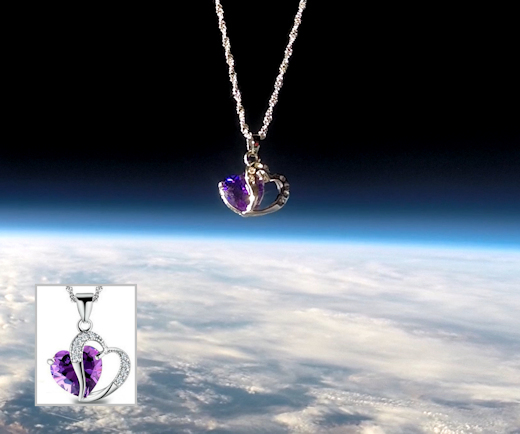
You can have one for $119.95. Each glittering pendant comes with a greeting card showing the jewelry in flight and telling the story of its journey to the edge of space. Sales of this pendant support the Earth to Sky Calculus cosmic ray ballooning program and hands-on STEM research.
Far Out Gifts: Earth to Sky Store
All proceeds support hands-on STEM education