ALL QUIET (FOR NOW): Earth is exiting a stream of fast-moving solar wind that caused bright Arctic auroras on Jan. 21st and 22nd. As the pressure of the solar wind subsides, Earth's magnetic field is quieting. No geomagnetic storms are expected for the next three days, at least. Free: Aurora Alerts.
BLUE MOON LUNAR ECLIPSE: On Wednesday, Jan. 31st, there's going to be a "Blue Moon"–the second full Moon in a calendar month. People who go outside to look may see a different hue: bright orange. This Blue Moon is going to be eclipsed, swallowed by copper-colored shadow of Earth for more than an hour. The eclipse will be visible from Asia, Australia, and most of North America: visibility map.

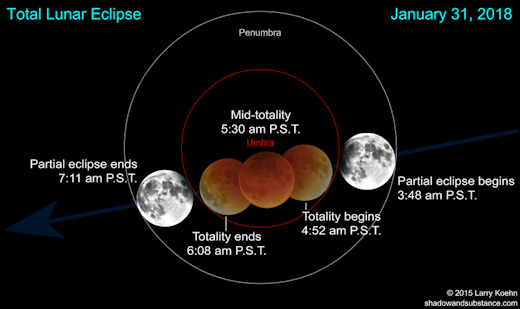
Other time zones: UT, EST, CST, MST, PST, HST. Credit: Larry Koehn.

The bright orange color of the eclipse may be chalked up to volcanic activity–or rather, lack thereof. Atmospheric scientist Richard Keen from the University of Colorado explains:
"During a lunar eclipse, most of the light illuminating the Moon passes through Earth's stratosphere where it is reddened by scattering," he says. "If the stratosphere is loaded with dust from volcanic eruptions, the eclipse will be dark. The cataclysmic explosion of Tambora in 1815, for instance, turned the Moon into a dark, starless hole in sky during two subsequent eclipses."
But Earth is experiencing a bit of a volcanic lull. We haven't had a major volcanic blast since 1991 when Mt Pinatubo awoke from a 500 year slumber and sprayed ten billion cubic meters of ash, rock and debris into Earth's atmosphere. Recent eruptions have been puny by comparison and have failed to make a dent on the stratosphere. To Keen, the interregnum means one thing: "This eclipse is going to be bright and beautiful."

From "Two Centuries of Volcanic Aerosols Derived from Lunar Eclipse Records" by R. A. Keen
Keen studies lunar eclipses because of what they can tell us about Earth's energy balance. A transparent stratosphere "lets the sunshine in" and actually helps warm the Earth below. "The lunar eclipse record indicates a clear stratosphere has contributed about 0.2 degrees to warming since the 1980s."
"Mt. Pinatubo finished a 110-year episode of frequent major eruptions that began with Krakatau in 1883," he says. "Since then, lunar eclipses have been relatively bright, and the Jan. 31st eclipse should be no exception."
In the USA, the best time to look is during the hours before sunrise. Western states are favored: The Moon makes first contact with the core of Earth's shadow at 3:48 am Pacific Time, kicking off the partial eclipse. Totality begins at 4:52 am PST as Earth's shadow engulfs the lunar disk for more than an hour. "Maximum orange" is expected around 5:30 am PST. Easternmost parts of the USA will miss totality altogether.

"I welcome any and all reports on the brightness of this eclipse for use in my volcano-climate studies," says Keen. While actual brightness measurements (in magnitudes) made near mid-totality are most useful, I can also make use of Danjon-scale ratings. Please be sure to note the time, method, and instruments used in your reports." Observations may be submitted here.
Realtime Space Weather Photo Gallery
VALENTINE'S DAY IS COMING: Nothing says "I Love You" like a Valentine's pendant from the edge of space. On Dec. 29, 2017, the students of Earth to Sky Calculus flew a payload-full of these 18k rose gold plated Valentine's pendants to the stratosphere onboard a high-altitude helium balloon:

The necklaces traveled alongside an array of cosmic ray sensors, which the students use to monitor deep-space radiation penetrating Earth's atmosphere.
You can have one for $169.95. Each glittering pendant comes with a greeting card showing the jewelry in flight and telling the story of its journey 36 km (118,110 feet) above the Sierra Nevada mountains of central California. Sales support the Earth to Sky Calculus cosmic ray ballooning program and hands-on STEM research.
Far Out Gifts: Earth to Sky Store
All proceeds support hands-on STEM education