LONG-DEAD NASA SPACECRAFT WAKES UP: Amateur astronomer Scott Tilley has a hobby: He hunts spy satellites. Using an S-band radio antenna in Roberts Creek, British Columbia, he regularly scans the skies for radio signals from classified objects orbiting Earth. Since he started 5 years ago, Tilley has bagged dozens of secret or unlisted satellites. "It's a lot of fun," he confesses.
Earlier this month, Tilley was hunting for Zuma--a secretive United States government satellite lost in a launch mishap on Jan. 8th--when a J-shaped curve appeared on his computer screen. "It was the signature of a lost satellite," he says, "but it was not Zuma."
In a stroke of good luck that has dizzied space scientists, Tilley found IMAGE, a NASA spacecraft that "died" more than 10 years ago.

An artist's concept of IMAGE flying over Earth's north pole.
Short for "Imager for Magnetopause-to-Aurora Global Exploration," IMAGE was launched in 2000 on a flagship mission to monitor space weather. Mapping the ebb and flow of plasma around Earth, IMAGE was able to watch our planet's magnetosphere respond almost like a living organism to blasts of solar activity, while its ultraviolet cameras took gorgeous pictures of Earth's global auroras.
"It had capabilities that no other spacecraft could match--before or since," says. Patricia Reiff, a member of the original IMAGE science team at Rice University.
IMAGE was in the 5th year of its extended mission on Dec. 18, 2005, when the spacecraft suddenly went silent. No one knows why, although suspicions have focused on a power controller for the spacecraft's transponder, which might have temporarily failed.
The one hope was a reboot: When IMAGE's solar-powered batteries drained to zero during a eclipse by the Earth, onboard systems could restart and begin transmitting again. "If revival occurs, the mission should be able to continue as before with no limitations," noted NASA's IMAGE Failure Review Board in their 2006 report.
A deep eclipse in 2007, however, failed to produce the desired result. "After that, we stopped listening," says Reiff.

Radio signals from IMAGE, detected by Scott Tilley on Jan. 20, 2018. [more]
That is, until Scott Tilley started looking for Zuma. "When I saw the radio signature, I ran a program called STRF to identify it," he says. Developed by Cees Bassa, a professional astronomer at the Netherlands Institute for Radio Astronomy, STRF treats Earth-orbiting satellites much like binary pulsars--deducing their orbital elements from the Doppler shifts of their radio signals. "The program immediately matched the orbit of the satellite I saw to IMAGE. It was that easy," says Tilley.
Sometime between 2007 and 2018--no one knows when--IMAGE woke up and started talking. Now, NASA has to find a way to answer.
"The good news is, NASA is working on a recovery plan," says Reiff. "UC Berkeley still has a ground station that was used for realtime tracking and control. They are scrambling to find the old software and see it they can get the bird to respond. Apparently there are data side lobes on the transmission, so that is a good sign."
Researchers would love to have IMAGE back. The spacecraft has a unique Big Picture view of Earth's magnetosphere and "its global-scale auroral imager would be fantastic for nowcasting space weather," says Reiff. "Fingers crossed!!"
This is a developing story. Stay tuned for updates.
VALENTINE'S DAY IS COMING: Nothing says "I Love You" like a Valentine's pendant from the edge of space. On Dec. 29, 2017, the students of Earth to Sky Calculus flew a payload-full of these 18k rose gold plated Valentine's pendants to the stratosphere onboard a high-altitude helium balloon:
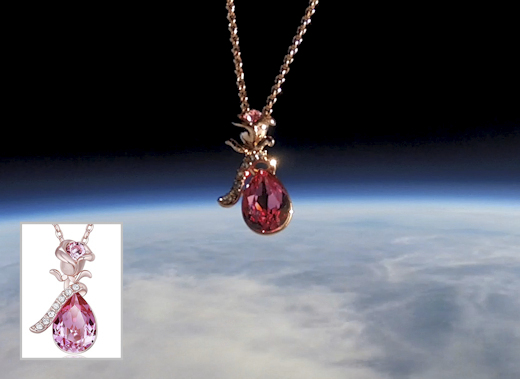
The necklaces traveled alongside an array of cosmic ray sensors, which the students use to monitor deep-space radiation penetrating Earth's atmosphere.
You can have one for $169.95. Each glittering pendant comes with a greeting card showing the jewelry in flight and telling the story of its journey 36 km (118,110 feet) above the Sierra Nevada mountains of central California. Sales support the Earth to Sky Calculus cosmic ray ballooning program and hands-on STEM research.
Far Out Gifts: Earth to Sky Store
All proceeds support hands-on STEM education
SPOTLESS SUN SPARKS AURORAS: The sun has been spotless and quiet for 6 consecutive days. Nevertheless, auroras are dancing around the Arctic Circle. On Jan. 24th, "the lights were absolutely amazing, they blew me away!" reports Marianne Bergli, who sends this picture from Tromsø, Norway:

"Even with no solar storm, the view was unparalleled," she says.
What's going on? The answer is "Tromsø." The island city in Norway is located beneath our planet's persistent auroral oval, a ring-shaped region surrounding the north pole where the geomagnetic field guides solar wind particles down onto the upper atmosphere. This extraterrestrial rain may ebb, but it never stops. Inside the oval, sputtering auroras can suddenly blossom into magnificent sprays of green and purple light--no solar storms required.
We predict that the sun will be spotless at least 50% of the time in 2018 as the solar cycle plunges toward a deep minimum expected in 2019-2020. Arctic auroras, however, will continue. Browse the realtime photo gallery for sightings. Free: Aurora Alerts.