NASA MAKES PROGRESS WITH LOST SATELLITE: Using 5 antennas to establish contact, NASA engineers have confirmed beyond doubt that a spacecraft found earlier this month by amateur astronomer Scott Tilley is indeed IMAGE, an important space weather satellite lost since 2005. Now they are attempting to regain control. Talking to IMAGE is a challenge due to the passage of time: Types of hardware and operating systems used when IMAGE was built no longer exist, requiring significant reverse-engineering. Good luck to the engineers working on this project! IMAGE's global aurora photos and other data have been sorely missed. Free: Aurora Alerts.
AURORAS VS. MOONLIGHT: Some photographers of the night sky lament the full Moon. Lunar glare can be overwhelming. Jeremy Schwartz of Fairbanks, Alaska, embraces it. "I took these pictures of auroras on Jan. 27th. Moonlight highlighted the scene beautifully," he says.
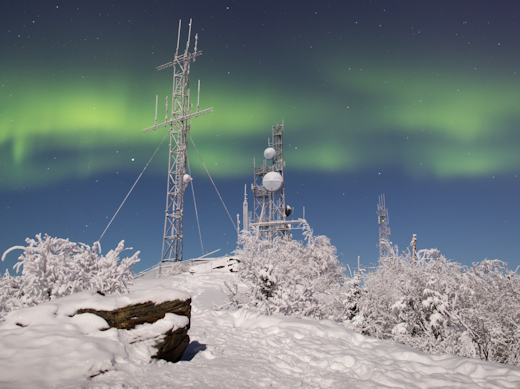
"I had been outside taking star trail photos for about an hour when I was suddenly interrupted by green," says Schwartz. "The auroras were able to compete not only with the waxing full Moon, but also to share the sky with light pollution coming from Fairbanks."
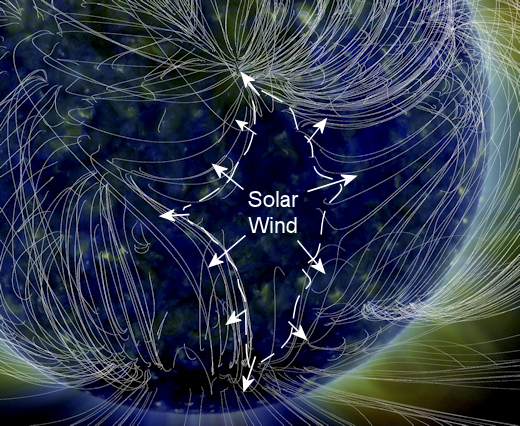
Auroras and moonlight are about to mix again. On Jan. 30th, solar wind flowing from a hole in the sun's atmosphere is expected to reach Earth. Geomagnetic unrest will likely spread auroras around the Arctic Circle, turning skies green above the radiant snow. Stay tuned. Free: Aurora Alerts.
BLUE MOON LUNAR ECLIPSE: On Wednesday, Jan. 31st, the second full Moon of January will pass through Earth's shadow, producing a rare "Blue Moon Lunar Eclipse." The Moon won't look blue, however. Researchers are predicting bright orange--a forecast based on studies of recent volcanic activity. Graphic artist Larry Koehn created this animation showing approximately how it will look:
The eclipse will be visible from Asia, Australia, and western parts of North America. In the USA, the best time to look is during the hours before sunrise. The Moon makes first contact with the core of Earth's shadow at 3:48 am Pacific Time, kicking off the partial eclipse. Totality begins at 4:52 am PST as Earth's shadow engulfs the lunar disk for more than an hour. "Maximum orange" is expected around 5:30 am PST. Other time zones: UT, EST, CST, MST, PST, HST.
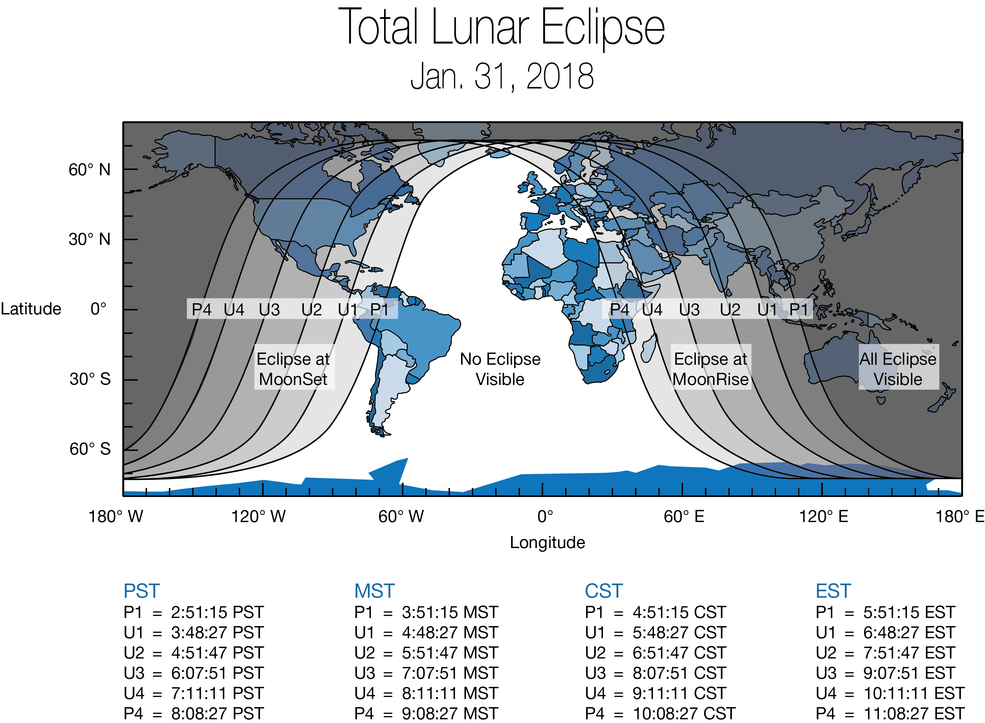


Can you see the eclipse? Check this visibility map.
Realtime Space Weather Photo Gallery
GLOWING 3D PRINTED MOON GLOBE: Looking for an over-the-Moon Valentine's gift? Consider this: On Jan. 4, 2018, the students of Earth to Sky Calculus flew this 3D printed Moon globe to the stratosphere--and you can have it for $149.95.
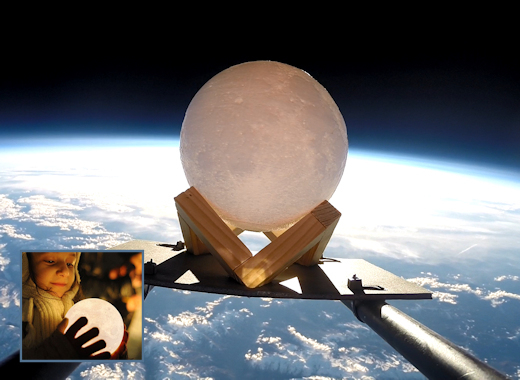
The surface of the sphere is an accurate topo-map of lunar terrain, tracing every major crater and mountain range. It is also a night light. A built-in USB-rechargeable battery provides up to 20 hours of romantic illumination.
A helium-filled space weather balloon lifted this globe and several others like it to the stratosphere, reaching an altitude of 36.3 km (119,095 ft) above California's Sierra Nevada mountains. After the balloon exploded, as planned, the payload parachuted back to Earth. The Moon was still glowing when the student recovery team found it in the wilderness.
Each glowing orb comes with a greeting card showing the Moon in flight and telling the story of its journey to the edge of space. Sales support the Earth to Sky Calculus cosmic ray ballooning program and hands-on STEM research.
Far Out Gifts: Earth to Sky Store
All proceeds support hands-on STEM education