NASA MAKES PROGRESS WITH LOST SATELLITE: Using 5 antennas to establish contact, NASA engineers have confirmed beyond doubt that a spacecraft found earlier this month by amateur astronomer Scott Tilley is indeed IMAGE, an important space weather satellite lost since 2005. Now they are attempting to regain control. Talking to IMAGE is a challenge due to the passage of time: Types of hardware and operating systems used when IMAGE was built no longer exist, requiring significant reverse-engineering. Good luck to the engineers working on this project! IMAGE's global aurora photos and other data have been sorely missed. Free: Aurora Alerts.
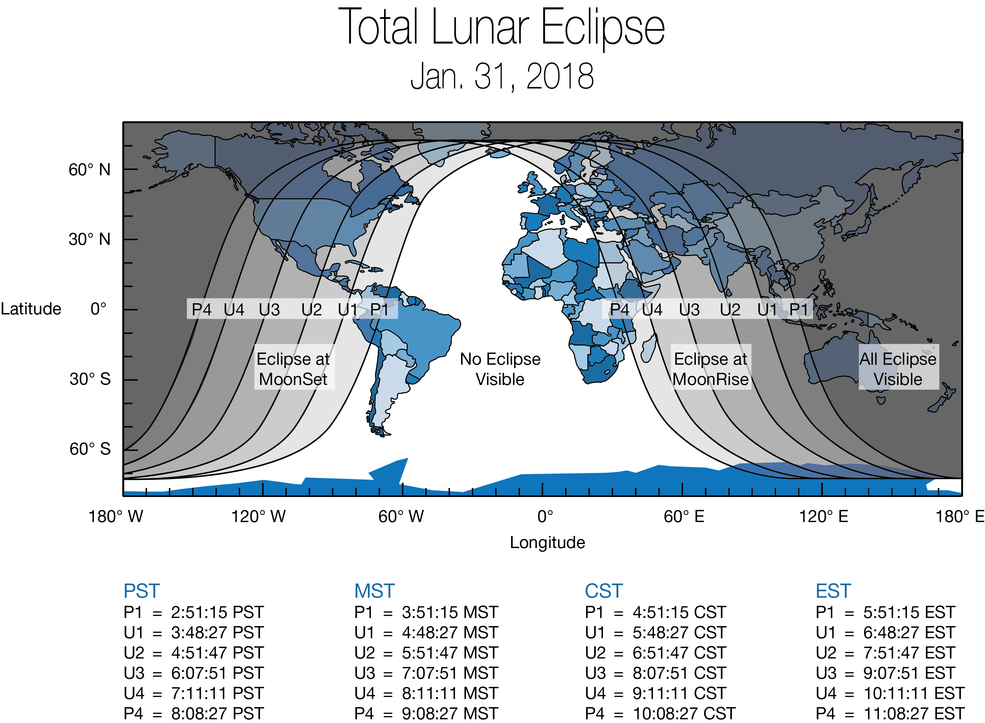
LUNAR ECLIPSE OBSERVING TIPS: The full Moon is about to pass through the shadow of Earth, turning the normally gray lunar disk a lovely shade of coppery-orange. When should you look? For people in the USA, the answer is Wednesday morning, Jan. 31st, just before sunrise. This graphic prepared by Larry Koehn of ShadowandSubstance.com depicts key moments of the eclipse in the Pacific Time Zone:

Other time zones are available, too: UT, EST, CST, MST, PST, HST.


The timing of the eclipse favors western US states. The Moon will spend more than an hour inside the core of Earth's shadow--and people on the Pacific side of the country will see all of it. On the Atlantic coast, people will see only a partial eclipse or no eclipse at all.

Elsewhere in the world, the eclipse will be fully visible across the Pacific Ocean, Asia, and Australia. The eclipse will not be visible in Africa, South America, or western Europe: global map.
Did you know that climate scientists pay special attention to lunar eclipses? Dark eclipses are a sign of volcanic aerosols in the stratosphere--particles that can reflect sunlight and cool the planet. Bright eclipses, on the other hand, are a sign that the stratosphere is clear. A clear stratosphere "lets the sunshine in" to warm the planet below.
"I welcome any and all reports on the brightness of this eclipse for use in my volcano-climate studies," says Emeritus Prof. Richard Keen of the University of Colorado. "While actual brightness measurements (in magnitudes) made near mid-totality are most useful, I can also make use of Danjon-scale ratings. Please be sure to note the time, method, and instruments used in your reports." Observations may be submitted here.
Realtime Eclipse Photo Gallery
GLOWING 3D PRINTED MOON GLOBE: Looking for an over-the-Moon Valentine's gift? Consider this: On Jan. 4, 2018, the students of Earth to Sky Calculus flew this 3D printed Moon globe to the edge of space:
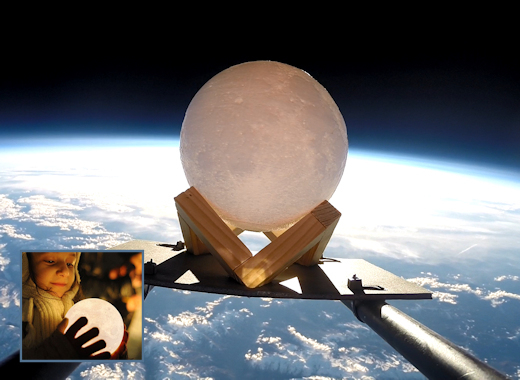
The surface of the sphere is an accurate topo-map of lunar terrain, tracing every major crater and mountain range. It is also a night light. A built-in USB-rechargeable battery provides up to 20 hours of romantic illumination. A helium-filled space weather balloon lifted this globe and several others to the stratosphere, reaching an altitude of 36.3 km (119,095 ft).
You can have one for $149.95. Each glowing orb comes with a greeting card showing the Moon in flight and telling the story of its journey to the edge of space. Sales support the Earth to Sky Calculus cosmic ray ballooning program and hands-on STEM research.
Far Out Gifts: Earth to Sky Store
All proceeds support hands-on STEM education
MAKE YOUR OWN LUNAR ECLIPSE GLASSES: Do you have left-over safety glasses from last August's solar eclipse? Geologist Rik Smoody of Portland, Oregon, shows us how to turn them into lunar eclipse glasses:

LOL Rik.
That's right, you don't need special glasses to view a lunar eclipse. The shadowed Moon is painless to behold. Observers in the USA should face west in the hours before sunrise on Wednesday, Jan. 31st. The orange orb sinking toward the horizon is safe to observe with the naked eye as well as unfiltered telescopes and binoculars. Enjoy the show!
Realtime Space Weather Photo Gallery