POLAR CROWN CORONAL HOLE: Solar wind spilling from a northern hole in the sun's atmosphere (a "polar crown coronal hole") could brush against Earth's magnetic field on Feb. 4th, possibly causing minor geomagnetic storms. Arctic sky watchers should be alert for auroras this weekend. Free: Aurora Alerts

THE EFFECT OF OZONE ON THE LUNAR ECLIPSE: When you think of a lunar eclipse, the color that comes to mind is red. The core of Earth's shadow is reddened by atmospheric scattering, and when that shadow falls across the Moon, the lunar landscape turns as red as a sunset. Yet some observers of the Jan. 31st lunar eclipse saw a different color: blue. George Ionas sends this picture from Palmerston North, New Zealand:

"A few seconds after totality ended, a soft blue band appeared," says Ionas. "Could this be the color of Earth's atmosphere projected onto the lunar surface?"
That's not far off. The source of the blue band is ozone. Eclipse researcher Richard Keen, an Emeritus professor at the University of Colorado explains: "Most of the light illuminating the Moon passes through the stratosphere, and is reddened by scattering. However, light passing through the upper stratosphere penetrates the ozone layer, which absorbs red light and actually makes the passing light ray bluer." This can be seen, he says, as a turquoise-blue fringe around the red.
Keen was in Hawaii for the eclipse, and he saw it, too. "The blue band was easy to see through binoculars during the last minutes of totality, although naked-eye observers might have missed it. A number of pictures submitted to Spaceweather.com do justice to the visual appearance." Browse the gallery for more ozone:

Realtime Lunar Eclipse Photo Gallery
UNIQUE VALENTINE'S GIFT: Nothing says "I Love You" like a Valentine's pendant from the edge of space. On Dec. 31, 2017, the students of Earth to Sky Calculus flew a payload-full of these heart-shaped pendants to the stratosphere, 35.1 km (115,158 feet) above Earth's surface:
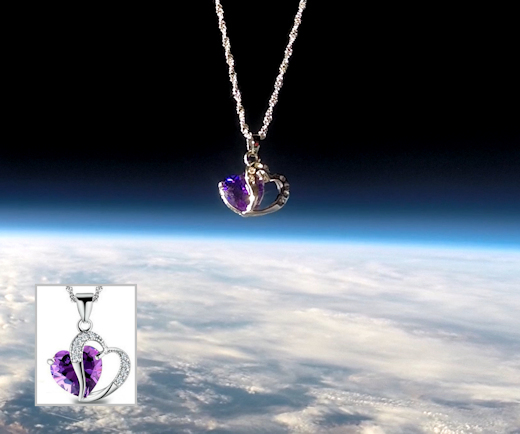
You can have one for $119.95. Each glittering pendant comes with a greeting card showing the jewelry in flight and telling the story of its journey to the edge of space. Sales of this pendant support the Earth to Sky Calculus cosmic ray ballooning program and hands-on STEM research.
Far Out Gifts: Earth to Sky Store
All proceeds support hands-on STEM education
AURORAS AND MOONSHADOWS: Everyone knows that auroras are best seen in the dark. Jan. 31st was an exception to that rule. "We witnessed a short but beautiful aurora outburst while the sky overhead was brightly lit and our shadows stretched across the ground," reports Eric Fokke of Vesterålen, Norway. Moonshadows, that is:

"With the supermoon we visited our neighbors on the archipelago of Vesterålen, and we went to the beach to see the show," says Fokke. "The northern lights were visible even against that bright moon."
On Jan. 31st, a solar wind stream sailed wide of Earth, barely grazing our planet's magnetic field. Surprising forecasters, the gentle graze was sufficient to spark several widely-seen episodes of green around the Arctic Circle. Lack of darkness was not a problem, after all.