SLIGHT CHANCE OF MAGNETIC STORMS: NOAA forecasters say there is a 25% chance of minor G1-class geomagnetic storms on Feb. 4-5 when a stream of solar wind sails north of Earth, possibly grazing our planet's magnetic field. Arctic sky watchers should be alert for auroras tonight. Free: Aurora Alerts

ACTION ON THE SUN'S EASTERN LIMB: A new sunspot is rotating into view over the sun's eastern limb, and it has announced itself with a flurry of B- and C-class solar flares. NASA's Solar Dynamics Observatory caught one of the explosions coinciding with the liftoff of a giant magnetic filament at 19:58 UT on Feb. 4th:

These flares are relatively weak and would probably escape notice during a more active phase of the solar cycle. However, we are now on the eve of Solar Minimum. C-class flares, albeit "weak," are sharp departures from months of tomb-like quiet on the solar surface.
Extreme UV radiation from these flares are causing minor waves of ionization in Earth's upper atmosphere. Otherwise, the explosions have not been geoeffective. Stay tuned for updates as the sunspot turns toward Earth.
UNIQUE VALENTINE'S GIFT: Nothing says "I Love You" like a Valentine's pendant from the edge of space. On Dec. 31, 2017, the students of Earth to Sky Calculus flew a payload-full of these heart-shaped pendants to the stratosphere, 35.1 km (115,158 feet) above Earth's surface:
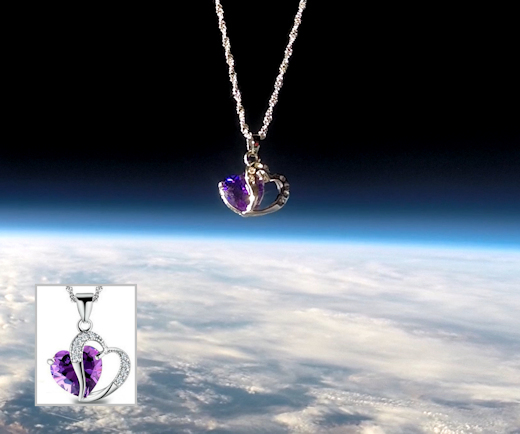
You can have one for $119.95. Each glittering pendant comes with a greeting card showing the jewelry in flight and telling the story of its journey to the edge of space. Sales of this pendant support the Earth to Sky Calculus cosmic ray ballooning program and hands-on STEM research.
Far Out Gifts: Earth to Sky Store
All proceeds support hands-on STEM education
PARASELENIC CIRCLES: When the Moon is full and it's really cold outside, strange things can happen in the sky. Consider the following: "Jan 31st was a very chilly night about, -24 C and with a windchill about -34 C," reports Sheila Wiwchar of Kaleida, Manitoba. "Stepping outside to look at the Moon, I saw something I've never seen before: One halo circling the Moon and another one cutting right through it."

"I photographed this strange double halo using a Canon 6D with a Sigma lens at 10mm--lots of vignetting, but I was able to fit in both halos," she says.
Atmospheric optics expert Les Cowley explains the apparition: "These are ice halos, formed by plate-shaped crystals in high clouds."
"The halo circling the moon is the familiar 22 degree halo," he says. "The circle through the Moon and around the sky is much more rare. It is a paraselenic circle, named after after Selene, the Greek goddess of the Moon and one of the ancient Titans. The equivalent around the sun is the parhelic circle after Helios, the personification of the sun and also a Titan."
Paraselenic circles aren't the only strange thing that happened ion Jan. 31st. Millions of people also witnessed a total eclipse of the Moon. Browse the photo gallery for moonshots.
Realtime Lunar Eclipse Photo Gallery