A RED ROADSTER IN SPACE: Earlier today, SpaceX successfully launched the world's most powerful rocket from the Kennedy Space Center. The Falcon Heavy roared into the blue Florida sky carrying a cherry red Tesla Roadster to interplanetary space. Live views from the driver's seat, where a space-suited dummy Starman sits behind the wheel, show the electric car temporarily orbiting our planet. Congratulations to SpaceX for an epic and stylish test flight.
SOLAR RADIO BURST: Sunspot AR2699, intruding on an otherwise quiet Solar Minimum, made some noise yesterday--literally. "I heard a surge of static coming from the loudspeaker of my shortwave radio telescope in New Mexico," reports amateur astronomer Thomas Ashcraft. "The source was AR2699." Click to play the sounds he recorded using two Sangean ATS-803A shortwave radios--one tuned to 22.1 MHz and the other at 22.2 MHz:

These radio sounds are caused by beams of electrons--in this case, accelerated by B-class explosions in the sunspot's magnetic canopy. As the electrons slice through the sun's atmosphere, they generate a ripple of plasma waves and radio emissions detectable on Earth 93 million miles away. Astronomers classify solar radio bursts into five types; Ashcraft's recording captured a Type III.
"This may be one the last solar radio bursts of the present solar cycle as we head into deep solar minimum," says Ashcraft. "I am hoping for more activity to appear on the spectrograph today." Free: Solar Flare Alerts
Realtime Space Weather Photo Gallery
BLUE FLASH OVER IRELAND: We've all heard of the green flash, the fleeting emerald pulse of light that sometimes appears just above the setting sun. But have you ever heard of the blue flash? Noel Keating photographed one on Feb. 4th from Rossnowlagh Beach in Ireland:

"Seeing the sun was being distorted by the atmosphere, I quickly setup my camera in hopes of capturing a green flash," says Keating. "Instead, a blue flash appeared! I snapped it as quickly as I could as it would only last little over a second. This is a first for me, I have captured many green flashes throughout the years, but never a blue flash, making these extremely rare here in Ireland."
Blue flashes are formed in the same way as green flashes: a mirage magnifies tiny differences in the atmospheric refraction of red, green and blue light. Blue flashes are generally harder to see than green flashes, because blue flashes blend into the surrounding blue sky. When the air is exceptionally clear, however, the blue flash emerges.
Atmospheric optics expert Les Cowley comments: "Green flashes are rare (unless you live on the California coast where they can be daily events). Blue flashes are very rare indeed. Keating's might be another rarity, a cloud top flash. We are unsure how these form. Rays bent between the cool moist air of a marine cloud deck and warmer air above is a possibility."
UNIQUE VALENTINE'S GIFT: Nothing says "I Love You" like a Valentine's pendant from the edge of space. On Dec. 31, 2017, the students of Earth to Sky Calculus flew a payload-full of these heart-shaped pendants to the stratosphere, 35.1 km (115,158 feet) above Earth's surface:
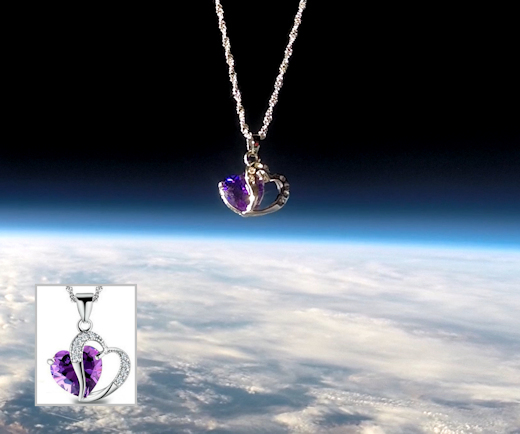
You can have one for $119.95. Each glittering pendant comes with a greeting card showing the jewelry in flight and telling the story of its journey to the edge of space. Sales of this pendant support the Earth to Sky Calculus cosmic ray ballooning program and hands-on STEM research.
Far Out Gifts: Earth to Sky Store
All proceeds support hands-on STEM education
Realtime Lunar Eclipse Photo Gallery