AMATEUR ASTRONOMERS PHOTOGRAPH ROADSTER IN SPACE: It's official. Elon Musk's cherry red Tesla Roadster is a spacecraft. NASA is now listing the electric car in its database of celestial objects with an ephemeris for tracking it available on JPL's Horizons web site.
Using that ephemeris, along with a remote-controlled telescope in Siding Spring, Australia, amateur astronomer Adriano Valvasori photographed the Roadster on Feb. 8th. It is the faint speck circled in red:
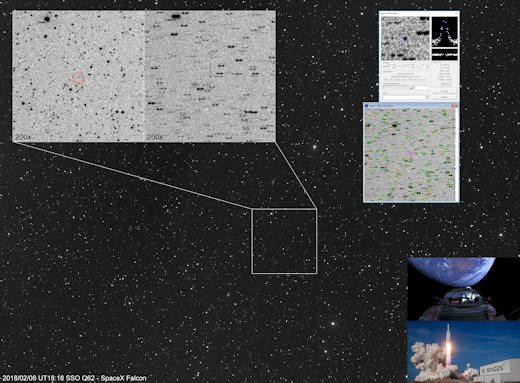
At the time, the car was 493,000 km (306,000) away, not far beyond the orbit of the Moon, receding from Earth about 3.7 km/s (8,300 mph). Reflecting sunlight, it shone about as brightly as a 16th magnitude star.
Another amateur astronomer, Raymond Kneip, photographed the Roadster about 3 hours before Valvasori did:
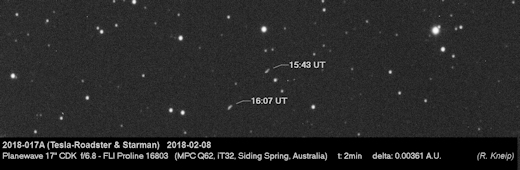
"It's the craziest thing I've ever captured with a telescope," he says. Like Valvasori, Kneip used an iTelescope at the Siding Spring Observatory to photograph the hurtling Tesla.
NASA designates the spacecraft "Tesla Roadster" with two aliases: "Starman" and "2018-017A," described in the ephemeris as follows:
Dummy payload from the first launch of SpaceX Falcon Heavy launch vehicle [on Feb. 6, 2018]. Consists of a standard Tesla Roadster automobile and a spacesuit-wearing mannequin nicknamed "Starman". Also includes a Hot Wheels toy model Roadster on the car's dash with a mini-Starman inside. A data storage device placed inside the car contains a copy of Isaac Asimov's "Foundation" novels. A plaque on the attachment fitting between the Falcon Heavy upper stage and the Tesla is etched with the names of more than 6,000 SpaceX employees.
To see the ephemeris for yourself, launch the Horizons web interface and follow these instructions: Click "change" next to Target Body. Type in "SpaceX" and hit enter. Click "Generate Ephemeris." The celestial coordinates of the Roadster will appear on your screen.
Realtime Space Weather Photo Gallery
A CRACK IN EARTH'S MAGNETIC FIELD: Lights over Lapland tour guide Oliver Wright wasn't expecting a great display of auroras on Feb. 8th when he took his guests into the snowy recesses of Sweden's Abisko National Park. There was no geomagnetic storm in the forecast. Nevertheless, this happened:
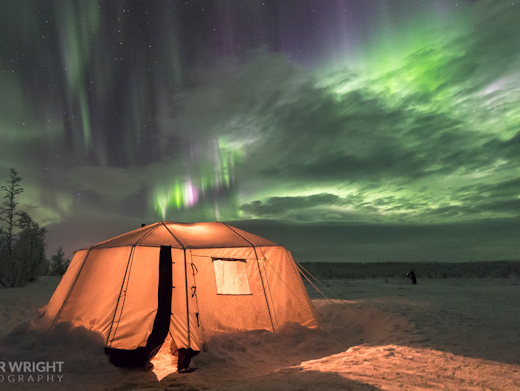
"The planetary K-index (Kp, an indicator of global geomagnetic activity) was less than 1--that is, very low. There should have been no auroras," says Wright. "Yet we saw a beautiful display of pink, blue and green."
What happened? Wright has the answer: "On Spaceweather.com, I saw 'B sub z' tipping south." This opened a crack in Earth's magnetic field. "Solar wind came flooding in and caused a nice display of auroras over Abisko."
"I've been telling our guests not to pay too much attention to Kp," says Wright. "Tonight was a brilliant example." Indeed it was. Around the Arctic Circle, auroras routinely defy Kp; browse the gallery for more examples. Free: Aurora Alerts
VALENTINE'S DAY IS NEXT WEEK! Does your sweetheart love auroras? As a Valentine's Day fundraiser, the students of Earth to Sky Calculus flew a payload-full of Northern Lights pendants to the stratosphere onboard a high-altitude helium balloon. Here's one 109,908 feet above the Sierras of central California:
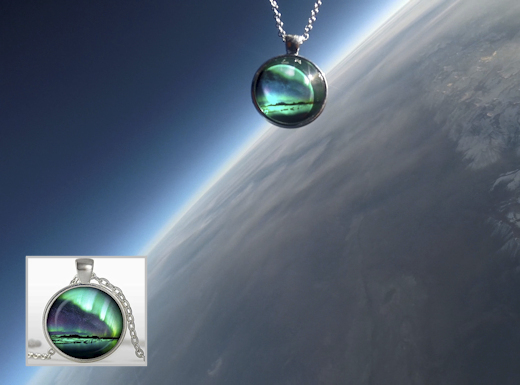
You have have one for $99.95. Each necklace comes with a greeting card showing the jewelry in flight and telling the story of its journey to the stratosphere and back again. Sales support the Earth to Sky Calculus cosmic ray ballooning program and hands-on STEM research.
Far Out Gifts: Earth to Sky Store
All proceeds support hands-on STEM education