SUBSIDING CHANCE OF FLARES: Sunspot AR2699 has begun to decay, losing almost half of its area in the past ~24 hours. As a result, the chance of solar flares is subsiding. NOAA forecasters say there is only a 10% chance of M-flares and no more than a 1% chance of X-flares on Feb. 14th. Free: Solar Flare Alerts
SUNSPOT EXPLODES, HURLS CME AT EARTH: On Feb. 12th, the magnetic canopy of sunspot AR2699 exploded--for more than 6 hours. The slow-motion blast produced a C1-class solar flare and hurled a coronal mass ejection (CME) almost directly toward Earth. This movie from the Solar and Heliospheric Observtory (SOHO) shows the CME leaving the sun:
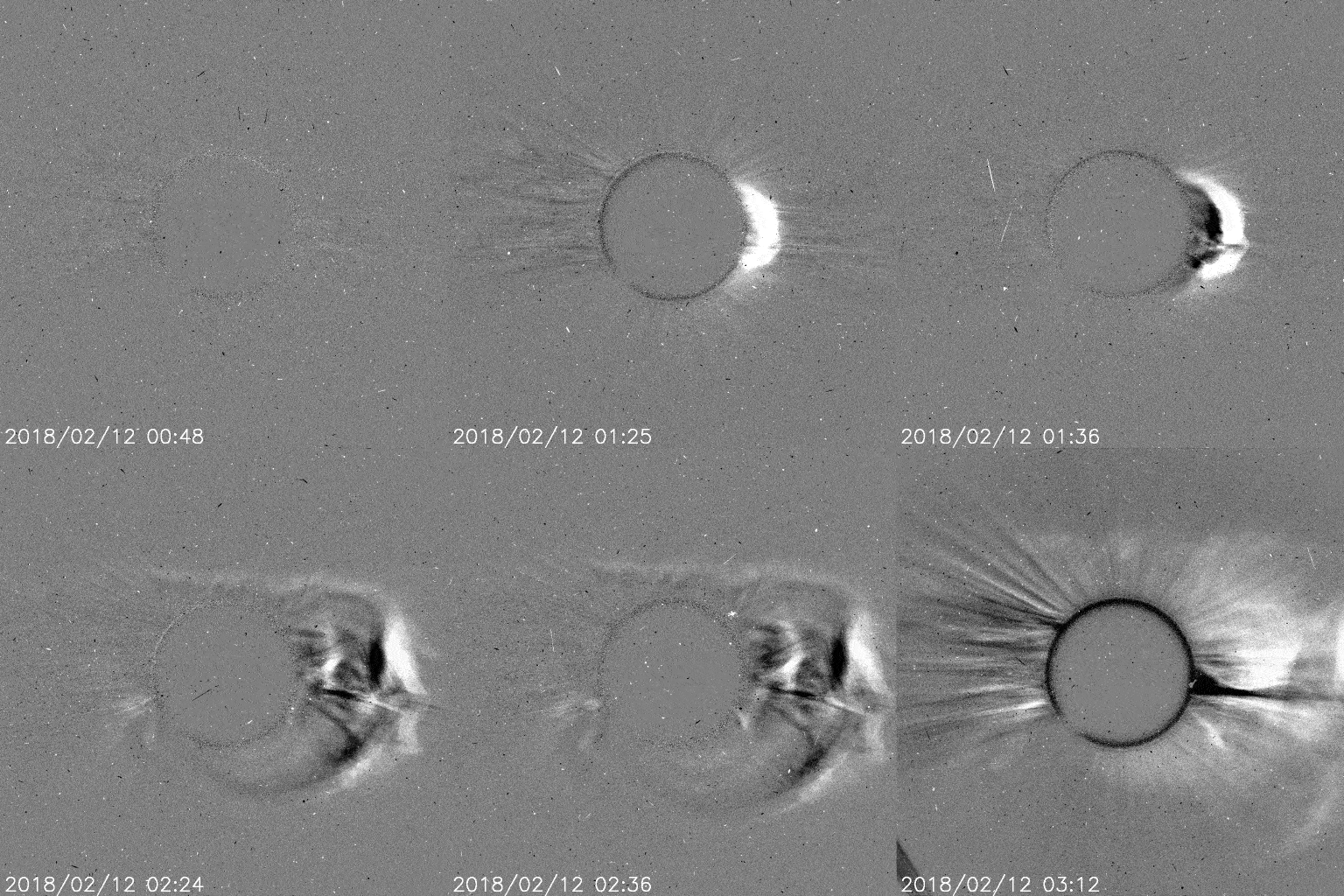
The CME could arrive as early as Feb. 14th, although Feb 15th is more likely. NOAA forecasters say there is a 60% chance of G1-class geomagnetic storms with isolated periods of stronger G2 storming.


The effectiveness of the CME could be enhanced by a stream of solar wind that was already en route to Earth when the sunspot exploded. The solar wind is flowing from a large wedge-shaped hole in the sun's atmosphere. If the approaching CME sweeps up material from that stream, snowplow-style, it could strike Earth's magnetic field with extra mass and potency.

Arctic sky watchers should be alert for auroras when the CME arrives. If the coming storm intensifies to category G2, observers in northern-tier US states from Maine to Washington could see auroras as well. Stay tuned for updates. Free: Aurora Alerts
Realtime Space Weather Photo Gallery
IT'S VALENTINE'S DAY! Did you forget to buy a Valentine's gift? Prediction: Your sweetheart will forgive the oversight if she receives this:
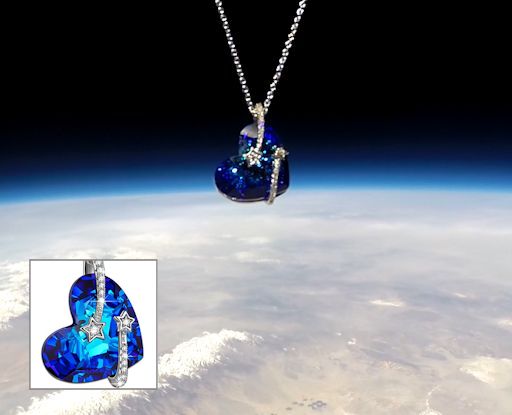
Nothing says "I love you" like a space pendant, and you can have one for $199.95.
The students of Earth to Sky Calculus flew a payload-full of these heart-shaped Venus pendants to the stratosphere onboard a high-altitude helium balloon. The one pictured above is floating 110,550 ft above the Sierra of Centrl California.
With a sterling silver backface that says "I Love You to the Moon and Back," these blue jewels make great Valentine's, Mother's Day, and birthday gifts. Each pendant comes with a greeting card showing the jewelry in flight and telling the story of its journey to the stratosphere and back again. Sales of this pendant support the Earth to Sky Calculus cosmic ray ballooning program and hands-on STEM research.
Far Out Gifts: Earth to Sky Store
All proceeds support hands-on STEM education
A BACKFLIP, WITH ATMOSPHERIC OPTICS: Last week, photographer Göran Strand set up his camera at the Åre ski resort in Sweden. His goal: To catch a skier performing a backflip. He succeeded in that and more. In the icy air behind the flying athlete he also recorded a bright subsun:

"This is my first ever backflip-subsun combo," says Strand. "A lucky catch!"
The subsun is a reflection of the actual sun from jewel-like ice crystals called "diamond dust." Take a closer look at Strand's photo. You can actually see the individual crystals glinting in the air.

Ski resorts turn out to be an excellent place to see subsuns and other luminous halos around the sun. Atmospheric optics expert Les Cowley explains: "Modern snow blowers are the key. Many use biological material as highly effective nuclei on which the desired snow crystals grow. Near optical perfect halo forming crystals (simple long and short hexagonal prisms) are an unintended by-product. The latter grow very slowly on the nuclei downwind of the blowers."
"I have several colleagues that twenty years or so ago traveled to the South Pole in order to study [complex ice halo] displays," he adds. "Now they travel instead to locations near ski slopes and study the halos at night using artificial suns."