THE SUN IS BLANK: The face of the sun is blank again today. The absence of sunspots heralds the approach of Solar Minimum. Sunspot numbers rise and fall with an ~11-year period, slowly oscillating between Solar Max and Solar Min. In 2018, the pendulum is swinging toward a deep minimum expected to reach nadir during the next 2 years. Space weather changes during solar minimum: Cosmic rays increase, Earth's upper atmosphere cools and shrinks, and auroras may change color. Stay tuned for "quiet." Free: Aurora Alerts

SOLAR WIND SPARKS OUTBURSTS OF PINK AURORA: A stream of high speed solar wind is buffeting Earth's magnetic field this weekend, causing intermittent auroras around the Arctic circle. Alan Dyer photographed this outbreak of lights over Churchill, Manitoba:

"It was an amazing show last night (Feb 16/17) as skies cleared and the aurora began to appear, all thanks to an impact of particles from a [hole in the sun's atmosphere]," says Dyer. "For about 90 minutes we had well-defined green curtains, often with rapid motion, and at times for brief seconds, bright outbursts with pinks along the bottom edge."

The pink fringes were likely a sign of nitrogran.Most auroras are green--a verdant glow caused by energetic particles from space hitting oxygen atoms 100 km to 300 km above Earth's surface. Pink appears when the energetic particles descend lower than usual, striking nitrogen molecules at the 100 km level and below.
NOAA forecasters say there is a 30% chance of geomagnetic storms on Feb. 18th as the solar wind continues to blow faster than 500 km/s (1.1 million mph). Stay tuned for more Arctic lights. Free: Aurora Alerts
STARMAN AT 3.2 MILLION KM: Astronomers around the world are racing to set an unlikely record: Who can take the most distant photo of a cherry red Tesla Roadster? At the moment, the record stands at 3.2 million km. Last night, observers at the McCarthy Observatory in Connecticut photographed it streaking almost invisibly among the stars of the constellation Hydra:

"We used a 0.4 meter telescope," says one of the observers, Monty Robson. "The car was fantastically dim, similar to a 20th magnitude star."
Launched on Feb. 6, 2018, by a Falcon Heavy Rocket at Cape Canaveral, Elon Musk's Roadster is traveling around the sun on an elliptical orbit that will take it beyond the orbit of Mars. Every day it is getting farther from Earth. For comparison, 3.2 million km is about 8 times farther away than the Moon.
Other amateur astronomers around the world have also been photographing the distant electric car, piloted by a space-suited mannequin named "Starman." The current record will almost certain fall again and again in the nights ahead, so stay tuned.
Realtime Space Weather Photo Gallery
VALENTINE'S DAY WAS ... LAST WEDNESDAY: Oops. Did you forget to buy a Valentine's gift? Your sweetheart might forgive you if she receives this:
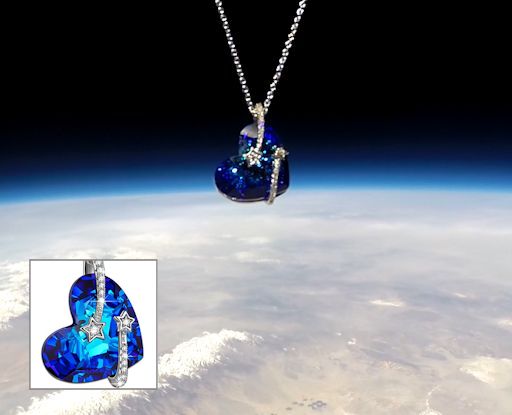
Nothing says "I love you" like a space pendant, and you can have one for $199.95.
The students of Earth to Sky Calculus flew a payload-full of these heart-shaped Venus pendants to the stratosphere onboard a high-altitude helium balloon. The one pictured above is floating 110,550 ft above the Sierra of Centrl California.
With a sterling silver backface that says "I Love You to the Moon and Back," these blue jewels make great Valentine's, Mother's Day, and birthday gifts. Each pendant comes with a greeting card showing the jewelry in flight and telling the story of its journey to the stratosphere and back again. Sales of this pendant support the Earth to Sky Calculus cosmic ray ballooning program and hands-on STEM research.
Far Out Gifts: Earth to Sky Store
All proceeds support hands-on STEM education