THE SUN IS BLANK: The face of the sun is blank again today. The absence of sunspots heralds the approach of Solar Minimum. Sunspot numbers rise and fall with an ~11-year period, slowly oscillating between Solar Max and Solar Min. In 2018, the pendulum is swinging toward a deep minimum expected to reach nadir during the next 2 years. Space weather changes during solar minimum: Cosmic rays increase, Earth's upper atmosphere cools and shrinks, and auroras may change color. Stay tuned for "quiet."

THE EVENING STAR IS BACK: This weekend, sky watchers admiring the crescent Moon saw something else they hadn't seen in a while: Venus. The 2nd planet is returning to the evening sky after an 11-month absence. David Blanchard photographed the "Evening Star" beaming trough the rosy glow of sunset over Grand Canyon National Park on Feb. 16th:

"The crescent Moon and Venus shone brightly above the South Rim of the Grand Canyon," says Blanchard. "A short sequence of images of the setting crescent Moon show distortion of the lower limb from atmospheric effects."

This is just the beginning for Venus. The planet is emerging from the glare of the sun, becoming easier to see every night, and it will be an increasingly bright fixture of the evening sky for the next 8 months. This animation created by Larry Koehn of ShadowandSubstance.com previews the action.
A date of special note is March 18, 2018. Less than one month from now, Venus, Mercury and the whisper-thin crescent Moon will gather in the sunset sky for a beautiful triple conjunction: sky map. Mark your calendar!

Realtime Space Weather Photo Gallery
GEOMAGNETIC STORM: Earth has entered a fast-moving stream of solar wind, now blowing almost 600 km/s (1.3 million mph) around our planet. During the early hours of Feb. 19th, the increasing pressure of the stream triggered a G1-class geomagnetic storm. In Churchill, Manitoba, auroras zig-zagged across the sky like lightning:


"We witnessed some beautiful greens and pinks during this active magnetic storm," says Nina, who took the picture.
The solar wind stream is flowing from a hole in the sun's atmosphere, so wide that Earth should remain inside it for at least another 24 hours. NOAA forecasters say there is a 30% chance of additional G1-class storms on Feb. 19th. G1-storms are relatively minor and have little effect on satellites or global power grids. However, they can spark bright auroras around the Arctic Circle and confuse migratory animals that navigate using magnetism at high latitudes. Free: Aurora Alerts

RETURN OF THE EASTERNAUTS: Easter is coming early this year: April 1, 2018. Hence the return of the Easternauts. To support their cosmic ray monitoring program, the students of Earth to Sky Calculus have flown a payload-full of bunnies to the edge of space:
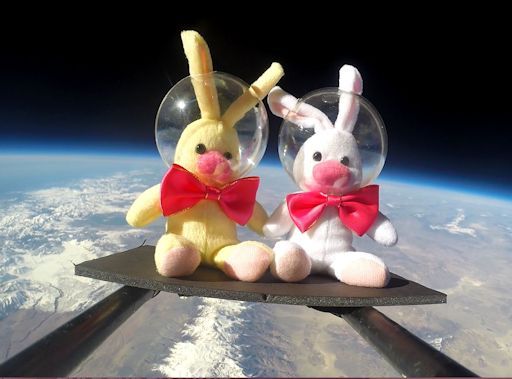
You can have one for $49.95. (Space helmet included!) They make great Easter gifts for young scientists, and all proceeds support STEM education. Each bunny comes with a greeting card showing the Easternaut in flight and telling the story of its journey to the stratosphere and back again.
Far Out Gifts: Earth to Sky Store
All proceeds support hands-on STEM education