EXITING THE SOLAR WIND STREAM: Earth is exiting a stream of solar wind that sparked a G1-class geomagnetic storm on Feb. 19th. Intermittent polar auroras should continue for the next 24 to 48 hours as the solar wind speed declines back to nominal levels. Monitor the aurora gallery for sightings. Free: Aurora Alerts

THE ROADSTER AND THE STAR CLUSTER: Elon Musk's cherry red Tesla Roadster is doing things no electric car has ever done before. On Feb. 6th it left Earth onboard a Falcon Heavy Rocket. On Feb. 8th it crossed the orbit of the Moon. Yesterday, the Roadster paid a visit to a star cluster:
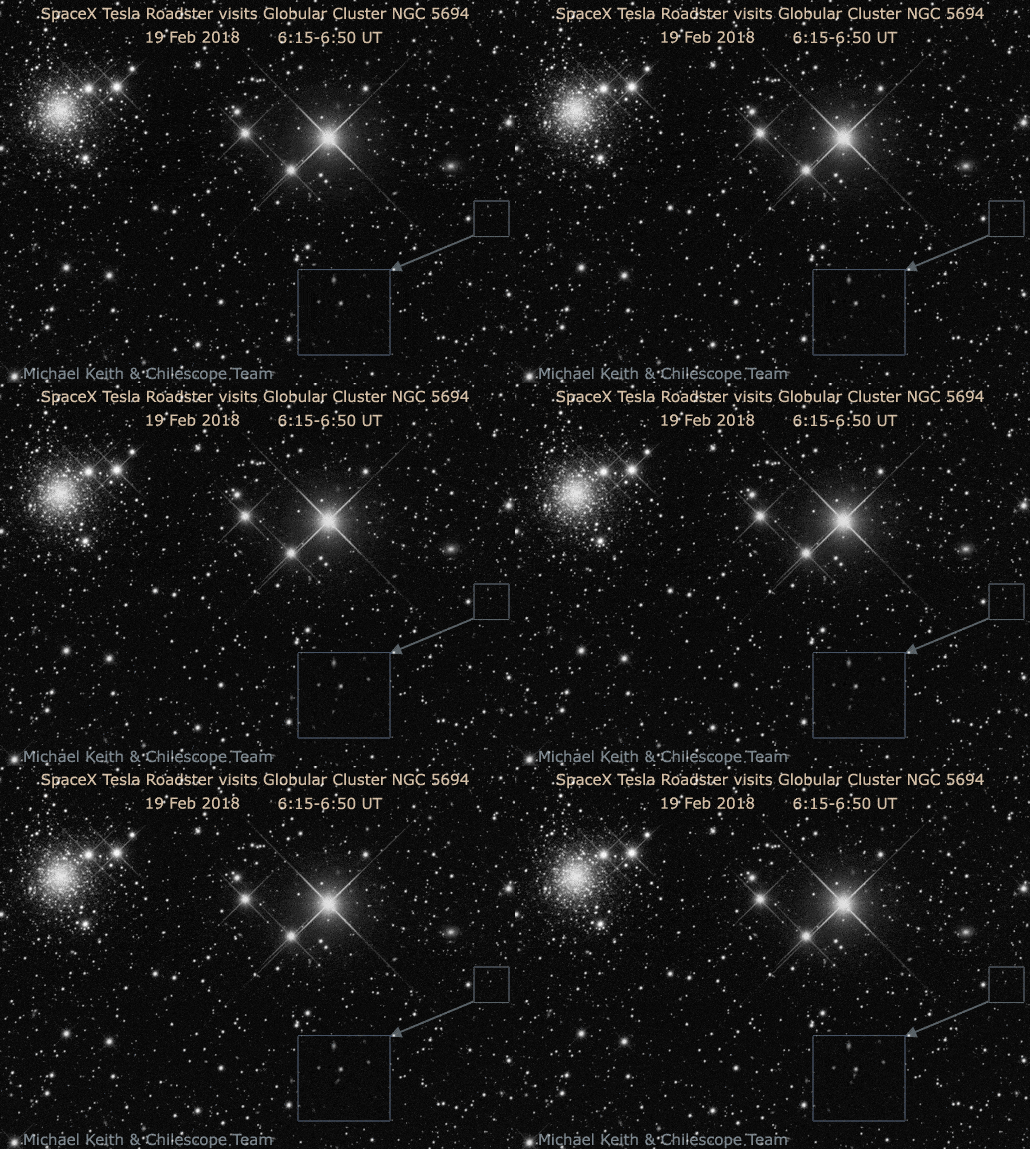
"I captured this series of photos from my cozy home office in New Jersey using a remote-controlled 0.5-meter telescope at the Chilescope observatory a few hours north of Santiago, Chile," says Michael Keith. "The Roadster was at a distance of 3.7 million km from Earth--a new record! Although it is was very dim (about magnitude 19.8) I wanted to try to capture it because it was close in the sky to a nice globular star cluster: NGC 5694 is much farther away than the Tesla Roadster, alnost 115,000 light years from Earth."
Since NASA published orbital elements for the Roadster on Feb. 8th, amateur astronomers have been tracking the electric car, with groups leapfrogging over one another in an effort to capture the most distant photo of this unique spacecraft. Among photos submitted to Spaceweather.com, Keith's is the record holder. For reference, 3.7 million km is almost 10 times farther from Earth than the Moon. This record will surely fall as astrophotographers around the world continue tracking the interplanetary Roadster. Whether anyone can take a more beautiful photo than Keith did, however, remains unknown. Stay tuned!
Realtime Tesla Roadster Photo Gallery
THE EVENING STAR IS BACK: This weekend, sky watchers admiring the crescent Moon saw something else they hadn't seen in a while: Venus. The 2nd planet is returning to the evening sky after an 11-month absence. David Blanchard photographed the "Evening Star" beaming trough the rosy glow of sunset over Grand Canyon National Park on Feb. 16th:

"The crescent Moon and Venus shone brightly above the South Rim of the Grand Canyon," says Blanchard. "A short sequence of images of the setting crescent Moon show distortion of the lower limb from atmospheric effects."

This is just the beginning for Venus. The planet is emerging from the glare of the sun, becoming easier to see every night, and it will be an increasingly bright fixture of the evening sky for the next 8 months. This animation created by Larry Koehn of ShadowandSubstance.com previews the action.
A date of special note is March 18, 2018. Less than one month from now, Venus, Mercury and the whisper-thin crescent Moon will gather in the sunset sky for a beautiful triple conjunction: sky map. Mark your calendar!

Realtime Space Weather Photo Gallery
RETURN OF THE EASTERNAUTS: Easter is coming early this year: April 1, 2018. Hence the return of the Easternauts. To support their cosmic ray monitoring program, the students of Earth to Sky Calculus have flown a payload-full of bunnies to the edge of space:
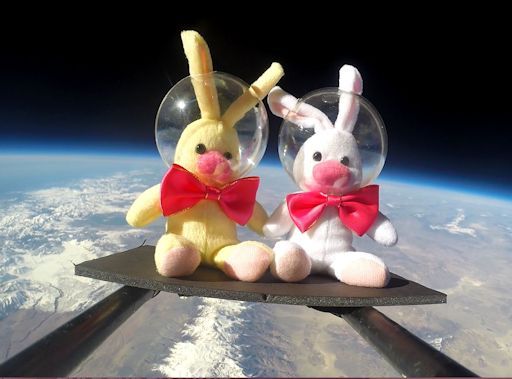
You can have one for $49.95. (Space helmet included!) They make great Easter gifts for young scientists, and all proceeds support STEM education. Each bunny comes with a greeting card showing the Easternaut in flight and telling the story of its journey to the stratosphere and back again.
Far Out Gifts: Earth to Sky Store
All proceeds support hands-on STEM education