GEOMAGNETIC UNREST POSSIBLE TOMORROW: Earth's magnetic field may be disturbed on Feb. 22nd by the glancing passage of a solar wind stream. The gaseous material is flowing from a southern hole in the sun's atmosphere, now facing our planet. NOAA forecasters say there is a 40% chance of minor G1-class geomagnetic storms when this stream arrives. Free: Aurora Alerts


THE ROADSTER AND THE STAR CLUSTER: Elon Musk's cherry red Tesla Roadster is doing things no electric car has ever done before. On Feb. 6th it left Earth onboard a Falcon Heavy Rocket. On Feb. 8th it crossed the orbit of the Moon. Yesterday, the Roadster paid a visit to a star cluster:

"I captured this series of photos from my cozy home office in New Jersey using a remote-controlled 0.5-meter telescope at the Chilescope observatory a few hours north of Santiago, Chile," says Michael Keith. "The Roadster was at a distance of 3.7 million km from Earth--a new record! Although it is was very dim (about magnitude 19.8) I wanted to try to capture it because it was close in the sky to a nice globular star cluster: NGC 5694 is much farther away than the Tesla Roadster, alnost 115,000 light years from Earth."
Since NASA published orbital elements for the Roadster on Feb. 8th, amateur astronomers have been tracking the electric car, with groups leapfrogging over one another in an effort to capture the most distant photo of this unique spacecraft. Among photos submitted to Spaceweather.com, Keith's is the record holder. For reference, 3.7 million km is almost 10 times farther from Earth than the Moon. This record will surely fall as astrophotographers around the world continue tracking the interplanetary Roadster. Whether anyone can take a more beautiful photo than Keith did, however, remains unknown. Stay tuned.
Realtime Tesla Roadster Photo Gallery
THE ROBOTIC PETRI DISH: Spaceweather.com and the students of Earth to Sky Calculus routinely launch space weather balloons to monitor cosmic rays in the stratosphere. Lately we've been wondering, what else is up there? To answer that question, the students have built a robotic Petri Dish and launched it on a cosmic ray balloon payload. Play the video to see what happened:
During the 2.5 hour test flight, an onboard computer commanded the Petri Dish to open and close, over and over again. The servo motor and control computer worked flawlessly in the extreme cold of the stratosphere, reaching an altitude greater than 116,100 feet.
Now that we have tested the basic hardware of the Petri Dish, we plan to fly it again, this time with oils inside the dish to capture particles and microbes in the stratosphere. The Petri Dish can be commanded to open and close at any altitude, allowing us to control the altitude range of material we capture. We are also testing a "landing pad" that will protect the Petri Dish from touchdown collisions with rocks and other hard objects.
Realtime Space Weather Photo Gallery
CROWD-FUNDING SPACE WEATHER RESEARCH: Did you know that cosmic rays in Earth's atmosphere are intensifying? It's true, and we are monitoring the phenomenon with regular space weather balloon flights to the stratosphere. This student science program is not supported by any government grant or corporate sponsorship. Instead, we raise our research funds by selling these:
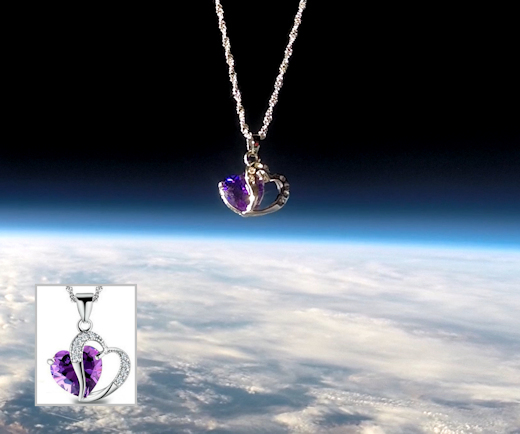
On Dec. 31, 2017, the students of Earth to Sky Calculus flew a payload-full of these heart-shaped pendants to the stratosphere, 35.1 km (115,158 feet) above Earth's surface. They make great birthday and Mother's Day gifts.
You can have one for $119.95. Each glittering pendant comes with a greeting card showing the jewelry in flight and telling the story of its journey to the edge of space. Sales of this pendant support the Earth to Sky Calculus cosmic ray ballooning program and hands-on STEM research.
Far Out Gifts: Earth to Sky Store
All proceeds support hands-on STEM education