THE SUN IS BLANK: For the 6th day in a row, the sun is blank--no sunspots. Almost half of the days in 2018 have been this way. Extended stretches of spotlessness are a herald of Solar Minimum. This "quiet" phase of the solar cycle brings extra cosmic rays, pink auroras, and a slight dimming of the sun. Cooling and contraction of Earth's upper atmosphere can also postpone the orbital decay of Chinese space stations. Stay tuned as the pendulum swings. Free: Aurora Alerts
EARTH'S MAGNETIC FIELD RINGING LIKE A BELL: Yesterday, a solar wind stream grazed Earth's magnetic field. Keyword: graze. The off-center impact of the solar wind caused something unusual to happen. Earth's polar magnetic field rang like a bell. Rob Stammes recorded the phenomenon from his magnetic observatory in Lofoton, Norway:

"On Feb. 22nd, the magnetic field around our observatory (as measured by ground currents) was swinging back an forth with a 100 second period," says Stammes. "This very stable oscillation went on for more than an hour."
This is quite different from what normally happens when a solar wind stream hits Earth, head-on. Here is an example of Stammes' recordings during a typical geomagnetic storm. Compared to the cacophany of a normal storm, yesterday's event was a sweet pure tone.
Researchers call these pure ultra-low frequency oscillations "pulsations continuous" (Pc). Pc waves energize particles in Earth's inner magnetosphere because they resonate with the natural motion of particles around the geomagnetic field. This energy, in turn, can supercharge the aurora borealis.
Indeed, hours after the Pc waves were observed, auroras exploded over Arctic Scandinavia. In Abisko, Sweden, Oliver Wright recorded three minutes of the display:
"I was guiding for Lights Over Lapland and we were treated to a fantastic geomagnetic storm," says Wright. "The auroras were so bright I just pointed my camera at the sky and recorded the lights in real time, hand-held."
The effect of the solar wind stream may be likened to a person blowing across the top of a soda bottle, the grazing breath producing a nearly monochromatic waveform. "This is quite rare," says Stammes. "Pulsating continuous signals like these are visible only 2 or 3 times a year."
RARE HAWAIIAN LIGHT PILLAR: Frankie Lucena of Puerto Rico frequently scans the automated Gemini webcam on Hawaii's Mauna Kea volcano, looking for sprites and other forms of exotic lightning. On Feb. 13th he saw something--but it wasn't lightning. "It was a rare Hawaiian light pillar," he says. Here is one frame from the complete video:

"I was searching for thunderstorms and just happened to come across this rarely seen event in this part of the world," says Lucena. "Light pillars usually occur in cold climates like Canada so to see them this far south is unusual."
Light pillars appear when urban lights reflect from the flat faces of ice crystals fluttering down from high freezing clouds. The source of the crystals, in this case, was probably a bank of altostratus/cumulus clouds shown in the video. "I do not recall seeing examples of these pillars so far south or in a location like Hawaii," says atmospheric optics expert Les Cowley. "So these are very rare indeed."
Realtime Space Weather Photo Gallery
CROWD-FUNDING SPACE WEATHER RESEARCH: Did you know that cosmic rays in Earth's atmosphere are intensifying? It's true, and we are monitoring the phenomenon with regular space weather balloon flights to the stratosphere. This student science program is not supported by any government grant or corporate sponsorship. Instead, we raise our research funds by selling these:
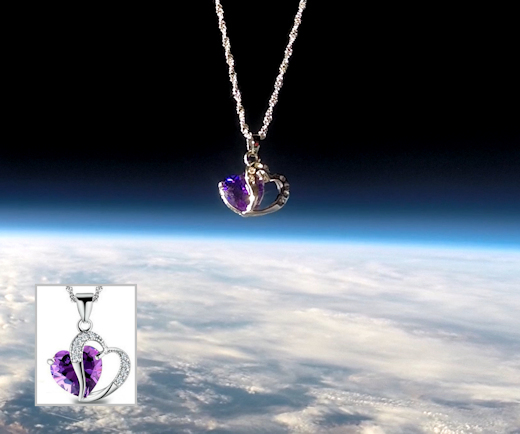
On Dec. 31, 2017, the students of Earth to Sky Calculus flew a payload-full of these heart-shaped pendants to the stratosphere, 35.1 km (115,158 feet) above Earth's surface. They make great birthday and Mother's Day gifts.
You can have one for $119.95. Each glittering pendant comes with a greeting card showing the jewelry in flight and telling the story of its journey to the edge of space. Sales of this pendant support the Earth to Sky Calculus cosmic ray ballooning program and hands-on STEM research.
Far Out Gifts: Earth to Sky Store
All proceeds support hands-on STEM education