GEOMAGNETIC STORM PREDICTED: NOAA forecasters say there is a 65% chance of G1-class geomagnetic storms on Feb. 26th when a high-speed stream of solar wind reaches Earth. The gaseous material is flowing from a canyon-like hole in the sun's atmosphere now bisecting the solar disk. Arctic sky watchers may expect bright auroras when the solar wind arrives. Free: Aurora Alerts


SPOTLESS SUN SPARKS PINK AURORAS: On Feb. 23rd the sun was completely blank (no sunspots) and NOAA classified solar activity as "very low." Nevertheless, this happened:

"Despite the blank sun, we witnessed a beautiful display of auroras," reports photographer Andrei Andritcu from Tromso, Norway. In addition to the usual green, the lights contained a vivid splash of pink.
In auroras, pink is a sign of nitrogen. Ordinary green auroras are caused by energetic particles from space hitting oxygen atoms 100 km to 300 km above Earth's surface. Pink appears when the energetic particles descend lower than usual, striking nitrogen molecules at the 100 km level and below.
Recent displays of pink and white auroras have coincided with spotless suns often enough to make observers wonder if there is a connection. E.g. perhaps solar wind emerging from the spotless sun is unusually penetrating. If so, we can expect to see more nitrogenous auroras in the years ahead. The sun is descending into a deep Solar Minimum, and the nadir (expected in 2019-2020) could be colored pink.
RARE HAWAIIAN LIGHT PILLAR: Frankie Lucena of Puerto Rico frequently scans the automated Gemini webcam on Hawaii's Mauna Kea volcano, looking for sprites and other forms of exotic lightning. On Feb. 13th he saw something--but it wasn't lightning. "It was a rare Hawaiian light pillar," he says. Here is one frame from the complete video:

"I was searching for thunderstorms and just happened to come across this rarely seen event in this part of the world," says Lucena. "Light pillars usually occur in cold climates like Canada so to see them this far south is unusual."
Light pillars appear when urban lights reflect from the flat faces of ice crystals fluttering down from high freezing clouds. The source of the crystals, in this case, was probably a bank of altostratus/cumulus clouds shown in the video. "I do not recall seeing examples of these pillars so far south or in a location like Hawaii," says atmospheric optics expert Les Cowley. "So these are very rare indeed."
Realtime Space Weather Photo Gallery
CROWD-FUNDING SPACE WEATHER RESEARCH: Did you know that cosmic rays in Earth's atmosphere are intensifying? It's true, and we are monitoring the phenomenon with regular space weather balloon flights to the stratosphere. This student science program is not supported by any government grant or corporate sponsorship. Instead, we raise our research funds by selling these:
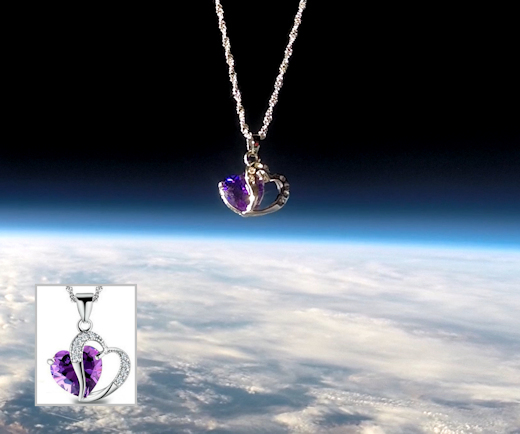
On Dec. 31, 2017, the students of Earth to Sky Calculus flew a payload-full of these heart-shaped pendants to the stratosphere, 35.1 km (115,158 feet) above Earth's surface. They make great birthday and Mother's Day gifts.
You can have one for $119.95. Each glittering pendant comes with a greeting card showing the jewelry in flight and telling the story of its journey to the edge of space. Sales of this pendant support the Earth to Sky Calculus cosmic ray ballooning program and hands-on STEM research.
Far Out Gifts: Earth to Sky Store
All proceeds support hands-on STEM education