GEOMAGNETIC STORM--UPDATE: NOAA forecasters say there is a 30% chance of G1-class geomagnetic storms on Feb. 27th as Earth moves through a high-speed stream of solar wind. One such storm already occurred earlier today, and another is possible as the solar wind continues to blow faster than 500 km/s (1.1 million mph). Arctic sky watchers should remain alert for auroras during the night of Feb. 27-28. Free: Aurora Alerts

SOLAR WIND LIGHTS UP ARCTIC SKIES: A stream of high-speed solar wind engulfed Earth during the early hours of Feb. 27th, triggering a G1-class geomagnetic storm. First contact with the gaseous material produced "a huge explosion of lights above and around us," reports Eric Fokke of Lofoten, Norway. He took this picture just after midnight local time:

"The gibbous moon lit up the snowy mountains beneath the auroras for a night of rare beauty," he says.
The solar wind is flowing from a canyon-shaped hole in the sun's atmosphere spewing a stream wide enough to affect Earth for another 24+ hours. The initial storm has subsided, but it could flare up again as our planet moves deeper into the windy stream. Monitor the aurora gallery for sightings. Free: Aurora Alerts

SUMMER SUN HALOS: Yesterday's high temperature in Florianópolis, Brazil, topped 90 degrees F, typical of the region's warm summer days. Nevertheless, when Cristiano Andujar looked up from the steps of the City Cathedral, he saw definite signs of freezing air. "There were two beautiful ice halos around the sun," he says. "People on the sidewalk were stopping and pointing."
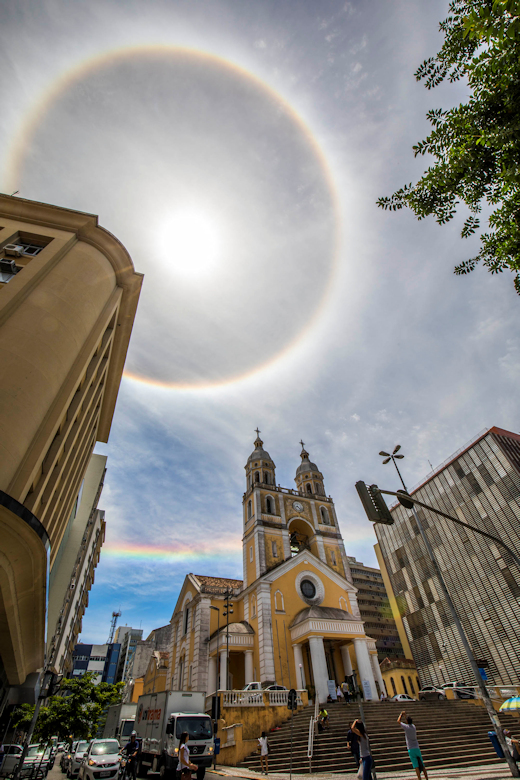
In this photo, which Andujar took, the big ring around the sun is a common 22-degree halo, caused by sunlight shining through hexagonal ice crystals in cirrus clouds. Floating almost 10 km high, these clouds were freezing despite scorching temperatures on the streets of Florianópolis.
Just below the 22-degree halo, Andujar's camera captured an intensely colorful band of light called a circumhorizon arc, also caused by ice crystals in the clouds. Summer is the season for circumhorizon arcs because they appear only when the sun is high in the sky--more than 58o above the horizon. The arc's enormous size and pure spectral colors make it one of the most beautiful of all ice halos.
Are you sweating under a summer sun? Look up anyway. You might see something very cool.
Realtime Space Weather Photo Gallery
CROWD-FUNDING SPACE WEATHER RESEARCH: Did you know that cosmic rays in Earth's atmosphere are intensifying? It's true, and we are monitoring the phenomenon with regular space weather balloon flights to the stratosphere. This student science program is not supported by any government grant or corporate sponsorship. Instead, we raise our research funds by selling these:
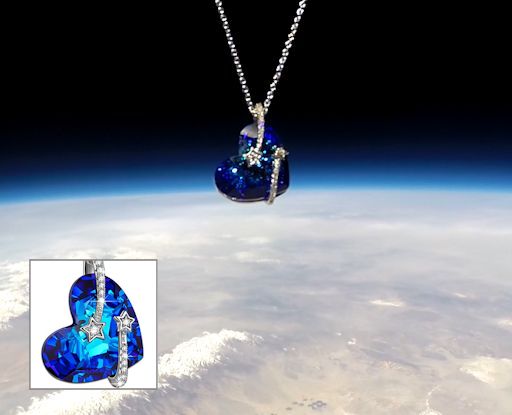
This pendant, and others like it, have touched the edge of space. We fly them to the stratosphere alongside our cosmic ray sensors for fundraising.
You can have one for $199.95. With a sterling silver backface that says "I Love You to the Moon and Back," these blue jewels make great Valentine's, Mother's Day, and birthday gifts. All sales support the Earth to Sky Calculus cosmic ray ballooning program and hands-on STEM research.
Far Out Gifts: Earth to Sky Store
All proceeds support hands-on STEM education