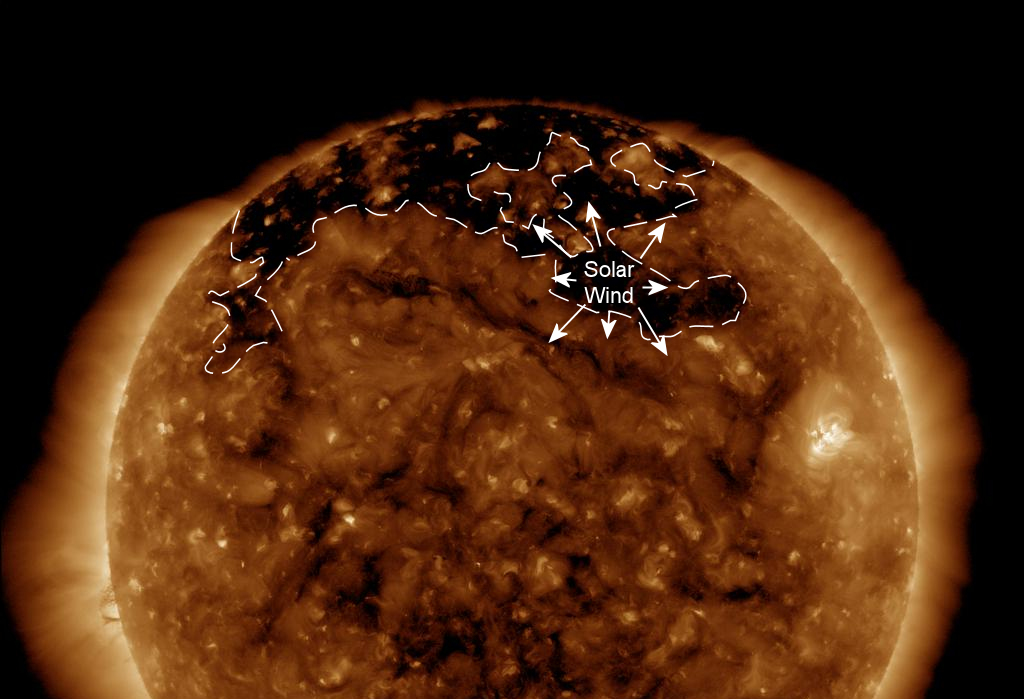
GEOMAGNETIC OUTLOOK: Earth's magnetic field is expected to be mostly undisturbed for the first three days of March. Geomagnetic activity might increase, however, on March 4th when solar wind flowing from a northern hole in the sun's atmosphere grazes our planet. Arctic sky watchers should be alert for auroras at that time. Free: Aurora Alerts
SUNSET PLANETS: This weekend, look west at sunset. If you have a clear view of the horizon, you can see Venus and Mercury beaming together through the rosy glow. Piotr Potępa sends this picture from Torun, Poland:
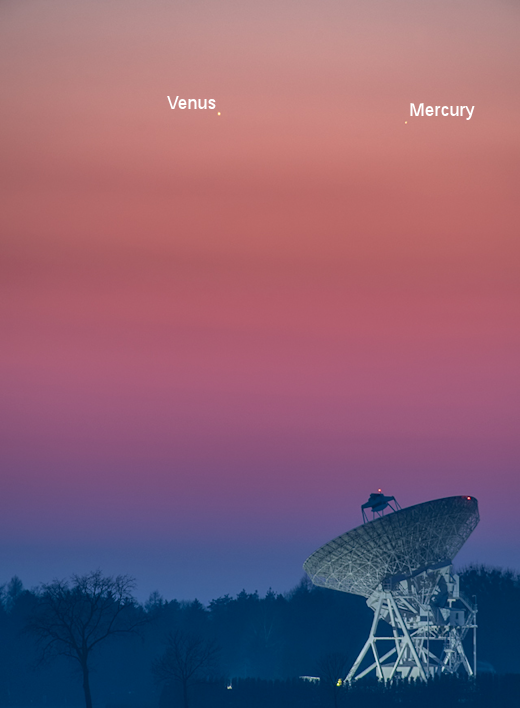
"The two planets were easy to find as they set behind the RT-4 radio telescope at the Center for Astronomy in Torun," says Potępa.
On Saturday, March 3rd, Venus and Mercury are just 1.1 degrees apart, and nearly as close on Sunday, March 4th. For some observers, only brilliant Venus may be visible to the naked eye. Mercury will show up in alongside, however, in digital cameras set for twilight exposures. Monitor the photo gallery for sightings.
Realtime Space Weather Photo Gallery
POLAR STRATOSPHERIC CLOUDS: Earth's stratosphere is extremely dry--drier than the driest desert on Earth. For that reason, clouds in the stratosphere are rare. Nevertheless, observers in Iceland are reporting an outbreak of colorful clouds in the stratosphere:
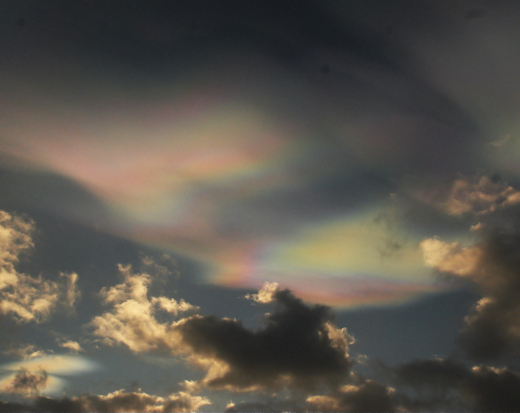
"These were seen in Northern Iceland in the Akureyri area," says photographer Adrian Pearman, whose photo captured both ordinary tropospheric clouds (grey thick puffs scudding across the lower atmosphere) as well as the pastel stratospheric clouds some 20 km overhead. "They were very bright and covered most of the visible sky."
Icy polar stratospheric clouds (PSCs) are a sign of very cold temperatures. For ice crystals to form in the arid stratosphere, temperatures must drop to around -85º C--so cold that sparse water molecules converge and stick together despite the great distance between them. High-altitude sunlight shining through tiny ice particles ~10µm across produce the characteristic iridescent colors.
Once thought to be mere curiosities, some polar stratospheric clouds are now known to be associated with the destruction of ozone. Indeed, an ozone hole formed over the UK in Feb. 2016 following an outbreak of ozone-destroying Type 1 PSCs.
Sky watchers around the Arctic Circle should be alert for these clouds. Outbreaks of PSCs often last for days, and their vivid iridescent colors are unforgettable.
Realtime Space Weather Photo Gallery
CROWD-FUNDING SPACE WEATHER RESEARCH: Did you know that cosmic rays in Earth's atmosphere are intensifying? It's true, and we are monitoring the phenomenon with regular space weather balloon flights to the stratosphere. This student science program is not supported by any government grant or corporate sponsorship. Instead, we raise our research funds by selling these:
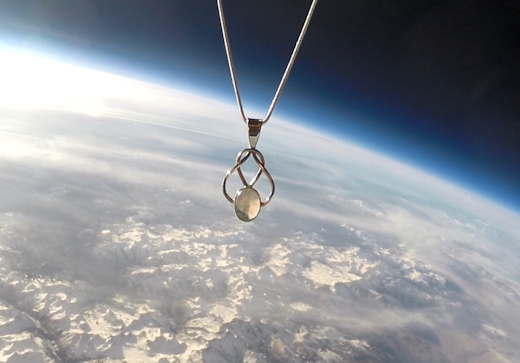
On Jan. 27, 2018, the students of Earth to Sky Calculus flew a payload-full of moonstone pendants 115,158 ft above Earth's surface. You can have one for $179.95.
Each necklace comes with a greeting card showing the jewelry in flight and telling the story of its journey to the edge of space and back. Sales support the Earth to Sky Calculus cosmic ray ballooning program and hands-on STEM research.
Far Out Gifts: Earth to Sky Store
All proceeds support hands-on STEM education