CHANCE OF STORMS TODAY: NOAA forecasters say there is a 45% chance of polar geomagnetic storms today, March 9th, when a stream of solar wind is expected to hit our planet's magnetic field. The gaseous material is flowing from a northern hole in the sun's atmosphere, and it could spark bright Arctic auroras when it arrives. Free: Aurora Alerts.

ARCTIC WINTER MIXES WITH SPRING: Seasons are changing on Earth as the March equinox approaches, now less than two weeks away. Last night in Enontekiö, Finland, Thomas Kast captured the transition in this rare photo of falling snowflakes and Northern Lights:
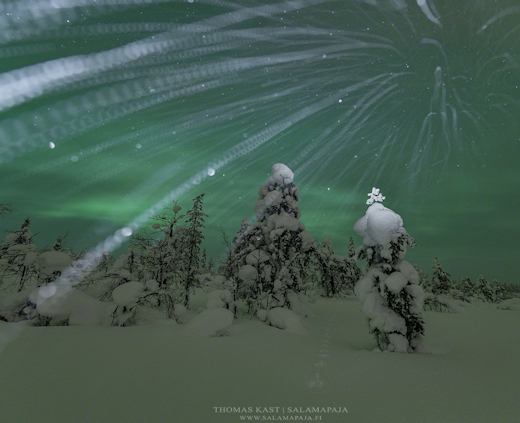
In his photo, spring is represented by green. Researchers have long known that auroras love equinoxes. During the weeks around the onset of spring, even gentle fluctuations in the solar wind can fill Arctic skies with verdant lights. The reason for this sensitivity has to do with the seasonal orientation of the sun's magnetic field--a phenomenon known as the "Russell-McPherron effect," named after the researchers who first studied and explained it .
Winter, of course, is represented by white. The snowy streaks in Kast's exposure signal that spring is nigh--but has not yet arrived.
"It was a funny feeling having snow flakes on your face, but stars and auroras in the sky," says Kast. "I had found some animal tracks and tried to light them with my flashlight, accidentally capturing the snowflakes. At first I felt I did something wrong, but then it was exciting to see both auroras and snowflake trails in the image at the same time." Free: Aurora Alerts.
FLIGHT OF THE EASTERNAUTS: Easter is coming early this year: April 1, 2018--hence the flight of the Easternauts. To support their cosmic ray ballooning program, the students of Earth to Sky Calculus have launched a payload full of bunnies to the edge of space:
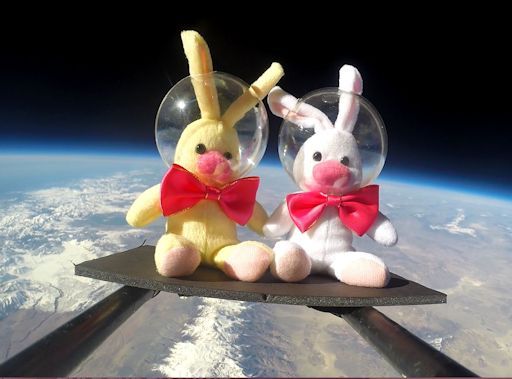
You can have one for $49.95. (Space helmet included!) They make great Easter gifts for young scientists, and all proceeds support STEM education. Each bunny comes with a greeting card showing the Easternaut in flight and telling the story of its journey to the stratosphere and back again.
Far Out Gifts: Earth to Sky Store
All proceeds support hands-on STEM education
THE SUN IS BLANK: Sunspots are becoming scarce. So far in 2018, the sun has been blank--that is, without sunspots--for 33 days. That's fully half of the time. Inspect the face of today's sun:

Could you find any dark cores? Answer: No. The last time the sun was blank more than 50% of the time was in 2009, near the end of the deepest Solar Minimum of the Space Age. Now the sun is entering a new Solar Minimum, and it is shaping up to be even deeper than before.
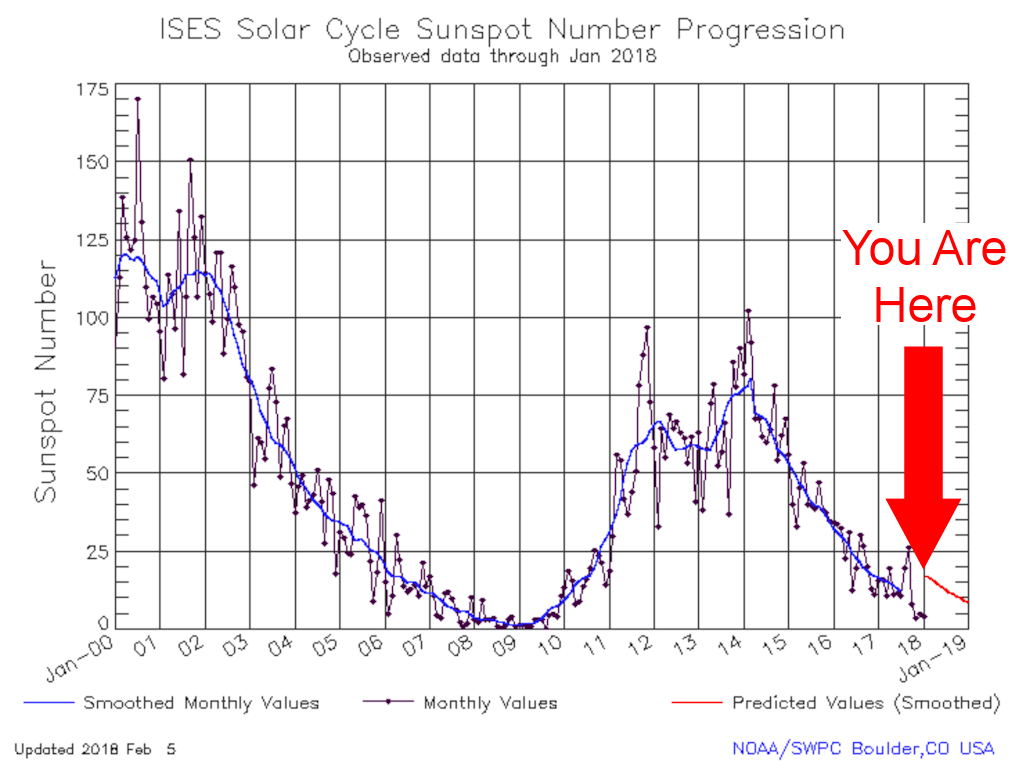
Periods of spotlessness are a normal part of the 11-year solar cycle. However, the current Solar Minimum may be remarkable as the ambient solar wind and its magnetic field are weakening to low levels never before seen in the Space Age. The flagging pressure of the solar wind, in turn, is allowing more cosmic rays to penetrate the solar system. These rays are being detected not only by NASA spacecraft in the Earth-Moon system, but also by space weather balloons in Earth's atmosphere. Read "The Worsening Cosmic Ray Situation" to learn more about this phenomenon.