PI DAY SOLAR WIND STREAM: A stream of solar wind flowing from a wide gash in the sun's atmosphere is approaching Earth. Estimated time of arrival: March 14th. Arctic sky watchers should be alert for auroras on Pi Day. Free: Aurora Alerts

A CRACK IN EARTH'S MAGNETIC FIELD: This morning, during the early hours of March 10th, a crack opened in Earth's magnetic field. Solar wind poured in and "the sky exploded with auroras," reports Kristin Berg who sends this picture from Tromsø, Norway:

"The air temperature was 10 degrees F below zero," she says, "but the cold was a small price to pay to see a magnificent display like this."
The "crack" was pried opened by the solar wind itself. Magnetic fields in the solar wind interacted with Earth's magnetic field, partially cancelling our planet's defenses against the oncoming gas. In the jargon of space weather forecasters, "B sub z tipped south."
NASA and European spacecraft have been detecting these cracks for years. Some are as large as California, and sometimes they grow wider than the whole planet. They tend to form most often during weeks around equinoxes--a seasonal phenomenon known as the "Russell-McPherron effect," named after the researchers who first studied and explained it.
FLIGHT OF THE EASTERNAUTS: Easter is coming early this year: April 1, 2018--hence the flight of the Easternauts. To support their cosmic ray ballooning program, the students of Earth to Sky Calculus have launched a payload full of bunnies to the edge of space:
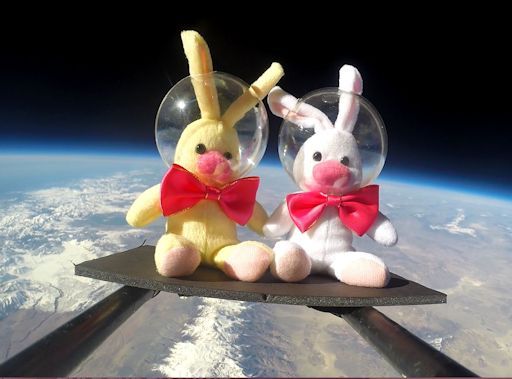
You can have one for $49.95. (Space helmet included!) They make great Easter gifts for young scientists, and all proceeds support STEM education. Each bunny comes with a greeting card showing the Easternaut in flight and telling the story of its journey to the stratosphere and back again.
Far Out Gifts: Earth to Sky Store
All proceeds support hands-on STEM education
THE SUN IS BLANK: Sunspots are becoming scarce. So far in 2018, the sun has been blank--that is, without sunspots--for 33 days. That's fully half of the time. Inspect the face of today's sun:

Could you find any dark cores? Answer: No. The last time the sun was blank more than 50% of the time was in 2009, near the end of the deepest Solar Minimum of the Space Age. Now the sun is entering a new Solar Minimum, and it is shaping up to be even deeper than before.
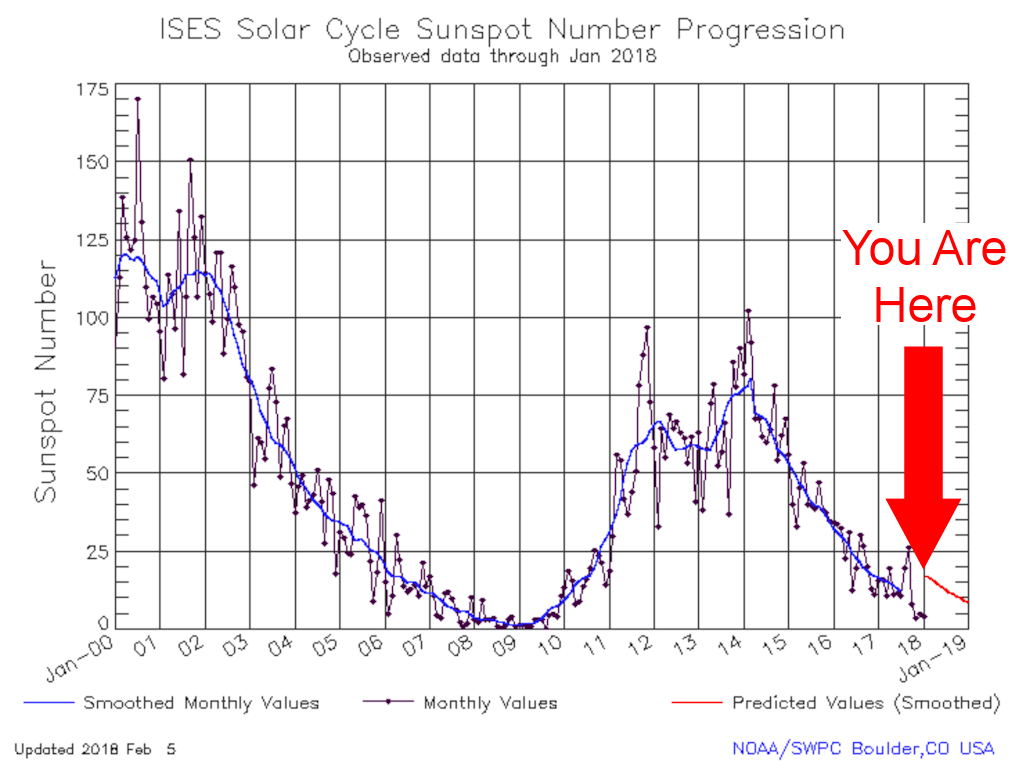
Periods of spotlessness are a normal part of the 11-year solar cycle. However, the current Solar Minimum may be remarkable as the ambient solar wind and its magnetic field are weakening to low levels never before seen in the Space Age. The flagging pressure of the solar wind, in turn, is allowing more cosmic rays to penetrate the solar system. These rays are being detected not only by NASA spacecraft in the Earth-Moon system, but also by space weather balloons in Earth's atmosphere. Read "The Worsening Cosmic Ray Situation" to learn more about this phenomenon.